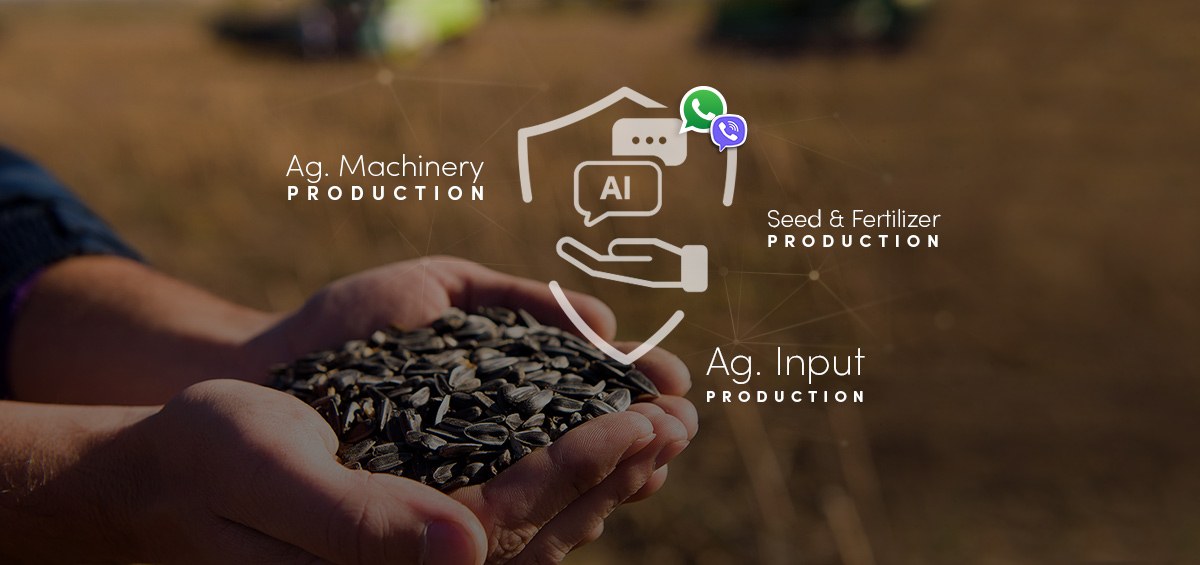
The concept of an AI advisor in agriculture is no longer theoretical. Companies across the ag-input, seed, and machinery sectors are already deploying AI-powered advisors to engage farmers at scale, deliver consistent agronomic guidance, and generate measurable commercial outcomes. But when someone says, “AI advisor,” what does that actually mean in practice? What does it do every day?
This article breaks down the six core jobs an AI advisor performs in a real agricultural deployment, based on results from enterprise-scale programs that reached thousands of farms and generated over 20 million EUR in sales pipeline.
Table of Contents
Why Agriculture Companies Deploy an AI Advisor in Agriculture
For most ag-input and machinery companies, the challenge is not a lack of agronomic knowledge. It is the inability to deliver that knowledge consistently, at scale, to every farm in the network. Sales teams are stretched thin. Field representatives can only visit a fraction of their accounts each season. Farmers who do not get timely advice often turn to competitors or make suboptimal purchasing decisions.
An AI advisor in agriculture solves this by acting as a digital extension of the sales and advisory team. It operates 24/7, speaks the local language, and delivers brand-consistent advice through channels farmers already use, like WhatsApp or Viber. The key difference from generic chatbots is that these advisors are trained on verified, company-specific agronomic knowledge and product portfolios.
6 Jobs an AI Advisor in Agriculture Performs Every Day
Here is what a well-deployed AI advisor actually does, based on real enterprise implementations.
1. Proactive Seasonal Outreach Based on Farm Profiles
The AI advisor does not wait for farmers to reach out. It proactively sends relevant seasonal insights based on each farm’s profile, including crop type, location, growth stage, and local weather conditions. For example, a corn grower in central Serbia might receive a timely reminder about optimal nitrogen application timing, while a citrus producer in southern Spain gets an alert about upcoming frost risk and protective measures.
This kind of personalized, proactive engagement is something that would require dozens of field representatives to do manually. The AI advisor handles it across hundreds or thousands of farms simultaneously.
2. Answering General Agronomy Questions
Farmers have questions throughout the season. What is the waiting period for a specific fungicide? When is the right time to apply a growth regulator to wheat? What are the symptoms of boron deficiency in sunflowers? An AI advisor trained on verified agronomic content can answer these questions instantly, in the farmer’s own language, any time of day.
This is not about replacing agronomists. It is about making expert-level agronomic knowledge accessible to every farmer in the network, especially those in remote areas or regions where the company has limited field staff.
3. Providing Product Information and Best Practices
Beyond general agronomy, the AI advisor serves as a knowledgeable guide to the company’s own product portfolio. It can explain the characteristics and advantages of specific seed hybrids, recommend application rates for crop protection products, and share best practices for getting the most out of specific inputs.
This matters because product knowledge often gets diluted as it moves from the product team to distributors to the field. The AI advisor ensures that farmers receive accurate, up-to-date product guidance directly from the source.
4. Competitive Argumentation and Alternatives
When a farmer mentions a competitor product or asks about alternatives, the AI advisor is equipped to respond with factual, evidence-based argumentation. It can compare active substances, explain differentiation points, and suggest the company’s own alternatives with supporting data.
This is one of the most commercially valuable jobs the AI advisor performs. In traditional setups, competitive positioning depends entirely on whether a sales representative happens to be present during the decision moment. With an AI advisor, the company’s perspective is always available, exactly when the farmer is evaluating options.
5. Delivering Value Through Built-In Agronomy Tools
Modern AI advisors go beyond conversation. They integrate practical tools that farmers can use in the field, such as pest and disease recognition from photos, real-time market price information, spray window recommendations based on weather data, and nutrient deficiency identification.
These tools make the AI advisor genuinely useful daily, not just during purchasing decisions. That sustained utility builds trust and keeps the company’s brand present throughout the entire growing season.
6. Booking Meetings with Sales Representatives
When a farmer signals commercial interest, whether by asking about pricing, availability, or requesting a field visit, the AI advisor captures that intent and books a meeting directly with the assigned sales representative. The lead arrives warm, qualified, and contextual. Sales teams receive not just a name and phone number, but a summary of the conversation, the farmer’s crops, and the specific products discussed.
This is where advisory turns into pipeline. The AI advisor does the relationship-building work at scale, and the sales team focuses its time on the conversations that are most likely to convert.
The Results: What an AI Advisor in Agriculture Delivers at Scale
These are not hypothetical benefits. In enterprise-scale deployments across multiple countries and crop segments, AI advisory programs have delivered measurable commercial outcomes:
- Over 3x more new farms reached compared to traditional sales outreach alone. The AI advisor engages farms that field teams simply do not have time to visit.
- Over 50% increased engagement with existing customers. Farmers who previously had minimal contact with the company started interacting regularly through the AI advisor, strengthening loyalty and share of wallet.
- Over 20 million EUR in generated sales pipeline. The combination of proactive outreach, product education, competitive positioning, and automated meeting booking created a measurable, trackable pipeline that sales teams could act on.
These results came from a fully managed AI advisory service that included setup, knowledge base creation, AI training, ongoing monitoring, and continuous optimization. The companies did not need to build internal AI capabilities. They focused on their core business while the AI advisor worked alongside their existing teams.
What an AI Advisor in Agriculture Means for Agriculture Companies in 2026
The question is no longer whether AI advisory will become standard in agriculture. It is a matter of timing. Companies that deploy an AI advisor in agriculture now are already building the data, relationships, and engagement infrastructure that will define competitive advantage in the coming years.
The six jobs described here are not futuristic. They are operational today, across real farms, delivering real pipeline. For companies in the seed, crop protection, machinery, or fertilizer space, the practical question is not “should we do this” but “how quickly can we start?”
If you are exploring how an AI advisor could work within your organization, a good first step is to assess your current farmer engagement model and identify where an AI-powered approach could fill the gaps. Learn more about how AI-driven advisory tools foster direct interactions with farmers, or explore three reasons why AI is the ideal tool for your agriculture sales team.
Are you ready to see what an AI advisor could do for your company?
Request a personalized assessment to evaluate how AI advisory fits your farmer engagement strategy, product portfolio, and commercial goals.