Most agri-input companies that launched an agricultural AI advisory program in the last two years will report the same two experiences: the technology worked, and the team was not sure what to do next. Farmer engagement was strong during the launch season. Questions came in, and the system answered most of them reasonably well. Yet when the season ended, the programme did not grow as expected.
That is not a technology failure. Instead, it is a programme design gap. The agricultural AI advisory programs that stall after season one and the programmes that generate multi-million euro commercial pipeline often run on the same underlying AI infrastructure. The difference lies in what sits behind the interface, how it is maintained, and how the programme connects to the commercial team’s workflow.
Table of Contents
What an agricultural AI advisory program actually is
An agricultural AI advisory program is not a chatbot, nor is it a product FAQ. Rather, it is a managed system that delivers verified, context-specific agronomic guidance to farmers at scale, through messaging channels they already use, on behalf of an agri-input company.
The system has three components, and only one of them is the AI interface. The knowledge base is a library of agronomic information, product guidance, regulatory requirements, and seasonal advice. Agronomists who understand the specific crops, geographies, and product portfolios the programme covers curate and validate every entry. The management process, meanwhile, is the ongoing work of updating the knowledge base, monitoring conversation quality, managing brand safety, and connecting advisory interactions to the commercial team’s workflow.
These three components are not equally difficult to build. Specifically, the AI interface is the easiest: a capable interface can be deployed in weeks. Building an accurate, trustworthy, continuously maintained agronomic knowledge base, however, takes months to do properly. The management process, furthermore, requires a structure that most input company marketing teams have not built before.
Consequently, the knowledge base is the differentiator in a well-designed agricultural AI advisory program, not the language model powering it.
Why most agricultural AI advisory programs stall after season one
The pattern that plays out in most first-season pilots is predictable in retrospect. Launch engagement is strong, driven partly by novelty and partly by genuine farmer curiosity. Additionally, early interactions are positive because the knowledge base covers the most common questions well.
By mid-season, however, farmers start asking questions that the knowledge base was not built to answer confidently. Specific local conditions, recent regulatory updates, and edge cases in product application all arise. As a result, the system responds with answers that are plausible but not verified. Some farmers notice the difference. Trust begins to erode before the company recognises it has a knowledge quality problem rather than a technology problem.
The wrong improvement gets prioritised.
At season’s end, engagement numbers look acceptable but not compelling. The internal team reviews the data and concludes that the pilot “worked but needs improvement.” Unfortunately, the improvement most commonly prioritised is the wrong one: a better interface, more channels, or faster response times. The knowledge base, which is the actual bottleneck, stays at pilot quality.
As a result, season two underperforms season one. The team then begins to debate whether an agricultural AI advisory programme is the right fit at all. In most cases, however, the technology was never the problem.
What scales an agricultural AI advisory program from pilot to pipeline
Programmes that scale share four characteristics that stalling pilots do not.
First, the knowledge base updates on the crop calendar rather than the calendar year. Agronomic advice is seasonal. Specifically, a knowledge base built in October for a winter wheat market needs substantial revision before the spring application window. Companies that treat the knowledge base as a static asset treat a seasonal product as if it never changes, and performance reflects that approach.
Second, conversation quality is monitored and acted upon. High-performing programmes maintain a defined process for reviewing conversation samples, flagging answers that are technically accurate but off-brand, and escalating questions the system cannot answer with confidence to a human agronomist. This is not a heavy process. It is, however, a disciplined one.
Third, the programme integrates directly into the sales team’s workflow. The commercial value of an agricultural AI advisory programme does not come from the conversations it generates. Instead, it comes from the qualified context that those conversations create for the field team. A farmer who has asked four questions about fungicide timing this season is a fundamentally different prospect from one who has had no advisory engagement. Programmes that route this context to sales reps consistently see faster pipeline conversion than those that treat advisory and sales as separate tracks.
Fourth, success is measured in commercial terms from the beginning. Key metrics include farms reached, engagement rate per farmer per season, qualified leads attributable to advisory interactions, and pipeline value. Programmes that measure only engagement metrics optimise for engagement. Programmes that measure commercial outcomes, by contrast, optimise for outcomes.
What agricultural research confirms about advisory trust
According to the Food and Agriculture Organization of the United Nations on digital agriculture, farmer trust in advisory channels builds incrementally over multiple interactions rather than in a single season. This finding aligns consistently with what AGRIVI observes across multi-season deployments of AGRIVI AI Engage.
What multi-season deployment data consistently shows
Across AGRIVI AI Engage deployments that have completed more than one full crop season, several patterns emerge consistently.
New farm reach in year two is typically 3 times higher than in the first season. Distributor networks expand the programme, and word-of-mouth engagement grows accordingly. Moreover, farmer engagement in year two is 50% higher per active user than in year one, driven primarily by knowledge base improvements and by farmers who have learned to trust the system.
The EUR 20 million benchmark
In the most mature deployment to date, spanning five countries and multiple crop types, the programme generated over EUR 20 million in engaged pipeline value attributable to advisory interactions. Notably, that programme maintains the most actively managed agronomic knowledge base of any deployment in the network. The connection is not coincidental.
For companies operating across EU markets, the European Commission’s agricultural digital strategy provides a helpful regulatory context for structuring data-sharing practices within advisory programmes. Understanding those requirements early reduces compliance overhead as programmes scale across jurisdictions.
The fully managed agricultural AI advisory program model
A fully managed agricultural AI advisory program means the knowledge base is built, maintained, and continuously validated by agronomists employed for that purpose. Conversations are monitored for accuracy, brand safety, and regulatory compliance. Performance data is reviewed and acted upon on a defined cycle.
Why the alternative model consistently underperforms
The technology-first model, where the input company builds and maintains the knowledge base internally, consistently produces lower-quality advisory at higher internal cost. Agronomic expertise across multiple crops, geographies, and product portfolios is rarely a capability sitting idle in a marketing or digital team.
The hidden cost of going it alone
Compliance and brand safety monitoring are frequently underestimated until a knowledge gap produces a problematic response at scale. Internal resourcing costs are also substantially higher than most marketing budgets anticipate at the pilot stage.
An agricultural AI advisory program is not a software subscription. It is a managed advisory service delivered through AI infrastructure. The management is the product.
Companies beginning to evaluate this transition can download the 6-Step Guide to Launch Your AI Agent from AGRIVI’s resource library. For a full overview of the platform capabilities, the AGRIVI AI Engage product page covers the technical and agronomic service components in detail.
Frequently Asked Questions
What is an agricultural AI advisory program?
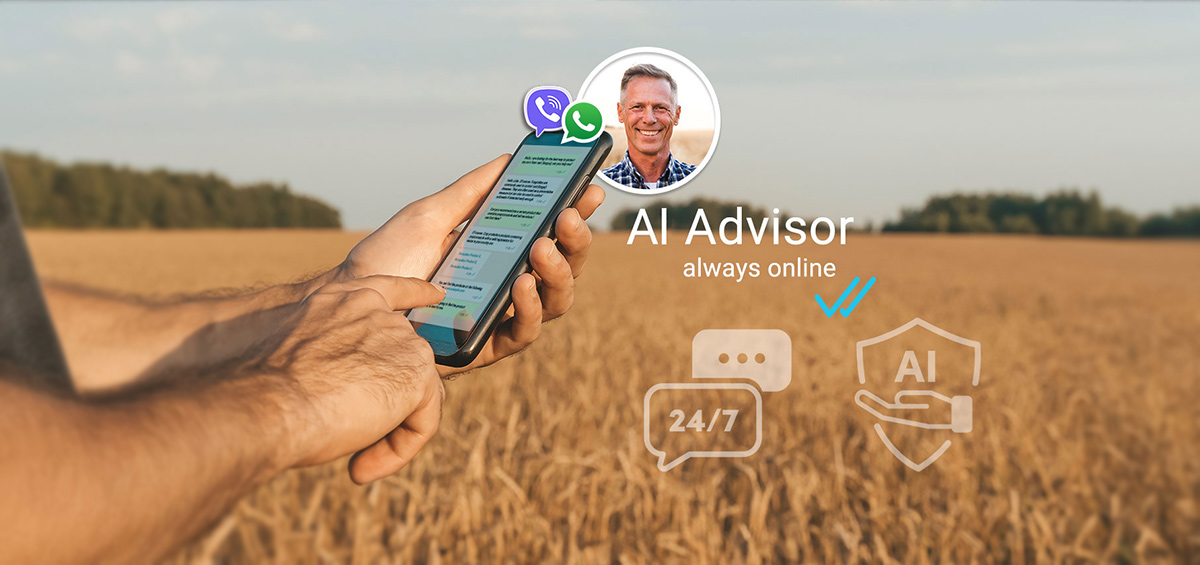
An agricultural AI advisory program is a managed system that delivers verified agronomic guidance to farmers at scale through messaging channels like WhatsApp or Viber, on behalf of agri-input companies. It requires an agronomist-curated knowledge base, an AI interface, and an ongoing management process to maintain quality and commercial relevance.
How do you measure the success of an AI advisory program in agriculture?
Key metrics include: number of new farms reached, engagement rate per farmer per season, qualified leads generated through advisory interactions, pipeline value attributed to the programme, and year-over-year engagement growth across successive crop seasons.
How long does it take to see commercial results from an agricultural AI advisory program?
Most programmes generate qualified engagement within the first crop season. Measurable commercial pipeline contribution typically becomes clear in the second season, once the knowledge base has been refined and the farmer base has grown through distributor network expansion and word of mouth.
What is the difference between an AI chatbot and an agricultural AI advisory program?
An AI chatbot answers questions from a general knowledge base. An agricultural AI advisory program, by contrast, delivers agronomist-verified guidance specific to the company’s products, local crop conditions, regional regulations, and seasonal timing. It is continuously updated and monitored for accuracy and brand safety.