
AI Governance in Agriculture: Who Owns What After Launch?
A live agricultural AI agent needs clear decisions, approved knowledge, human escalation and regular review. This guide outlines who owns each part of the operating model.
AGRIVI
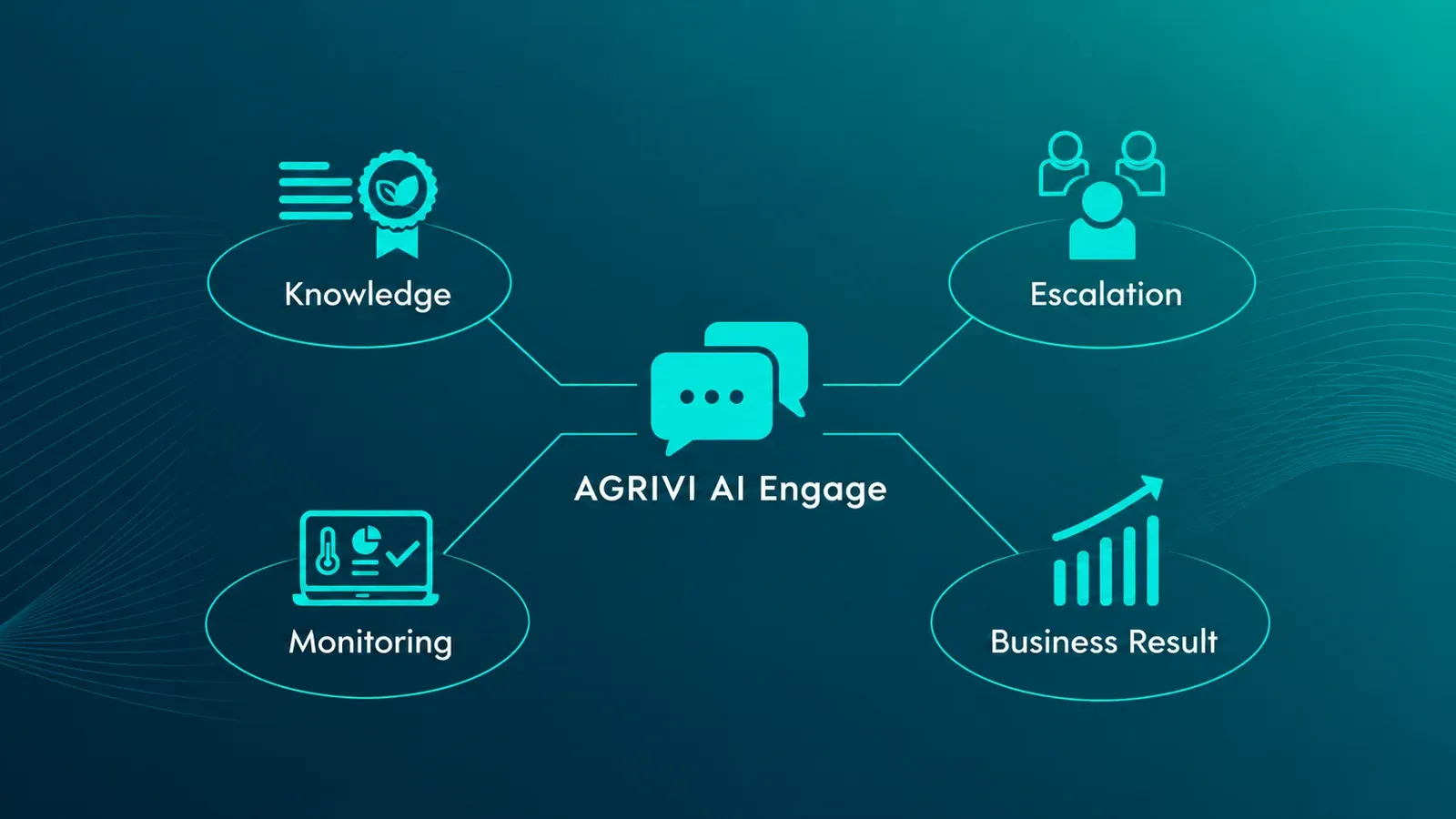
AI governance in agriculture is the set of assigned responsibilities, approved knowledge, escalation rules, monitoring routines and business decisions that keep an agricultural AI agent accountable after launch. Four operating owners are essential: knowledge, human escalation, monitoring and business results. Each must have authority to act, access to evidence and a defined review process.
An AI agent can answer farmer questions around the clock. Keeping its answers relevant, its routes operational and its follow-up effective requires more than a successful pilot. This guide explains who should own the day-to-day decisions, where AGRIVI fits in and how to review the model during a season.
At a Glance
- Four distinct accountabilities: approved knowledge, escalation, monitoring and business outcomes.
- The customer approves agronomic, product and commercial decisions; AGRIVI operates and supports the agreed AI Engage platform scope.
- Escalation needs a named human destination and an agreed response process before go-live.
- Quality review should use conversation evidence, unresolved cases and actual follow-up, not a single accuracy score.
- Start with one clear use case, test boundaries, document owners and review performance regularly.
What Does AI Governance in Agriculture Mean After Launch?
After launch, AI governance means continuously managing what the agent can say, when a person must intervene, how issues are detected and what the business does with the information collected. It is an operating discipline rather than a one-time approval exercise.
For an agri-input business, knowledge may change when product labels or local recommendations change. For a public advisory programme, a newly issued official notice may require a prompt update. In either case, the team needs a traceable route from identifying the change to approving it, deploying it and reviewing its effect.
The NIST AI Risk Management Framework uses the functions Govern, Map, Measure and Manage to organise risk management. The OECD AI Principles also emphasise accountability and ongoing risk management. Neither source substitutes for the operational owners that a specific agriculture programme must appoint.
Why Assign AI Governance Owners Before Deployment?
Owners should be appointed before deployment because farmer questions and operational exceptions begin immediately. A launch team may know how the Digital Agent should behave, but without assigned decision rights it is unclear who may approve a product correction, change an escalation boundary or close an unresolved case.
For agri-input companies managing farmer engagement, agronomy can own approved technical knowledge, sales can own commercial follow-up and a named operations lead can coordinate quality reviews. Privacy and security responsibilities should also be assigned through the organisation’s normal governance functions.
Ownership does not imply that every review is manual. Automated records, routing and reports can support it. What matters is that each exception reaches someone authorised to decide and that the decision is documented.
A related distinction is explained in AGRIVI’s article on brand architecture in agricultural AI advisory, which addresses knowledge boundaries and brand-level design choices before an agent is launched.
Four Operating Owners in Agricultural AI Governance
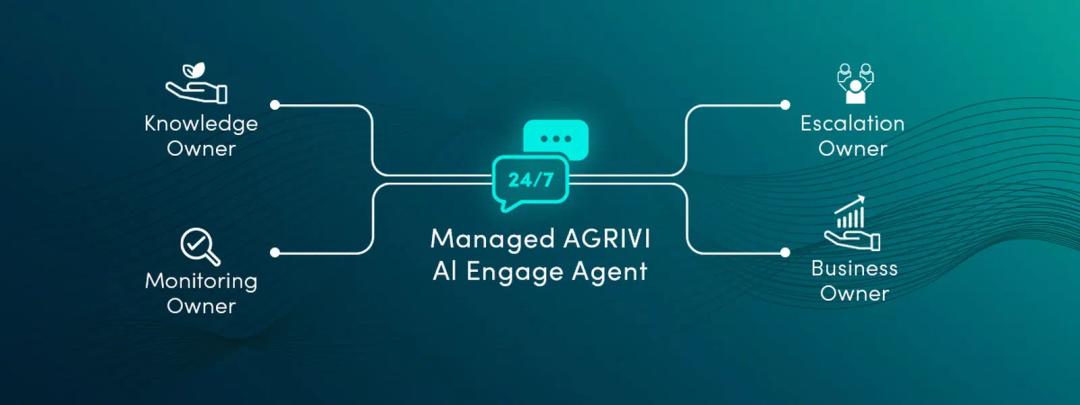
A practical agricultural AI governance model assigns four responsibilities: knowledge, escalation, monitoring and business results. One person may hold more than one role in a small deployment, but the decisions and evidence should remain distinguishable.
- Knowledge owner: approves the sources, product statements, local guidance and revised content available to the agent.
- Escalation owner: defines which cases must reach a qualified person and who is expected to respond.
- Monitoring owner: reviews conversation quality, unusual patterns, technical issues and changes requiring attention.
- Business owner: defines objectives, measures outcomes and ensures collected signals trigger appropriate actions.
AGRIVI AI Engage is the platform within AGRIVI’s AI Workforce. Its Digital Agents are configured for specific jobs, and the operating responsibility split should be defined for each deployment rather than inferred from the word “managed”.
Who Approves the AI Agent’s Knowledge?
Knowledge ownership belongs to the customer function qualified to approve agronomic, product, commercial or public-service information. AGRIVI can support preparation, configuration and controlled platform updates, but it should not independently determine which agronomic recommendations or product claims the customer approves.
A usable knowledge-change record should identify the source, version, language or market, proposed change, approver, effective date and test outcome. A pesticide-use instruction or fertiliser rate, for example, cannot be treated as universal guidance when authorisations or protocols vary by location.
The article on knowledge architecture for agricultural AI covers the content structure behind an agricultural Digital Agent. In a live programme, the owner should also review what farmers are actually asking, where answers are unclear and which seasonal changes require updated material.
For an AI Agri-Input Sales Representative, the approved portfolio, product-use guidance and recommendation boundaries are central to the role. Complex decisions remain with qualified sales and agronomy teams.
Who Owns Human Escalation?
The escalation owner decides when the Digital Agent should hand a question to a qualified person, where the case is sent and how the organisation follows up. A handoff is useful only if a real reviewer receives enough context and has responsibility for the next action.
Triggers may include missing agronomic context, a question outside approved knowledge, a sensitive or potentially harmful recommendation, a regulatory exception or a commercial decision that requires a person. The operating plan should state the destination, expected response and closure record for each trigger.
An AI Public Advisory Officer, for example, may route complex or official cases to the relevant public officer. Those boundaries and routes are defined when the programme is configured. The customer appoints the qualified personnel, while AGRIVI supports the agreed platform routing.
Escalation tests should cover real conversations in each intended language and representative crop scenarios. Test what happens when context is incomplete and when no reviewer is available, rather than testing only ideal questions.
Who Monitors Agricultural AI Quality?
Monitoring ownership covers the evidence used to decide whether a live agent is working as intended. That includes question patterns, unresolved or incorrectly routed cases, knowledge gaps, service issues, changes in engagement and the actions taken after a concern is discovered.
The reviewer should look beyond a single “accuracy” percentage. A correct answer that cannot reach the right farmer, or a correctly escalated case without human follow-up, can still fail the programme objective. Useful indicators therefore differ between a sales programme, a grower network and public advisory.
For an AI Supply Chain Manager, monitoring may include grower follow-up, information collection, supply exceptions and escalation to the correct sourcing or quality team. AGRIVI supports platform monitoring and the agreed improvement process; customer owners assess agricultural and business consequences.
A review log should capture the finding, severity, owner, decision, due date and closure evidence. The review frequency should match the programme’s scale, risk and seasonality.
Who Is Accountable for Business Results?
The business owner is accountable for the objective and the organisation’s response to what the Digital Agent learns. AGRIVI provides platform capability and agreed reporting support, but it does not replace the customer’s decisions about sales follow-up, agronomy, service quality or public programme delivery.
Before launch, set a baseline and define what counts as an outcome. For farmer engagement, that may mean distinct farms reached, qualified commercial enquiries, resolved advisory needs or completed follow-up. An activity count without a downstream action shows usage, not necessarily business value.
Selected AGRIVI AI Engage deployments have reported 3x farm reach within existing sales areas, with 70% of new sales originating from farmers first engaged by the AI agent and 20% upsell. These are reported outcomes from selected programmes, not a forecast or guarantee. Individual outcomes vary and depend on scope, adoption, knowledge quality and follow-up.
The agri-input distributor reach article provides further context on extending engagement across farmer networks. Governance should measure whether the resulting interactions reach the right field, sales or advisory owner.
Customer and AGRIVI: Who Does What?
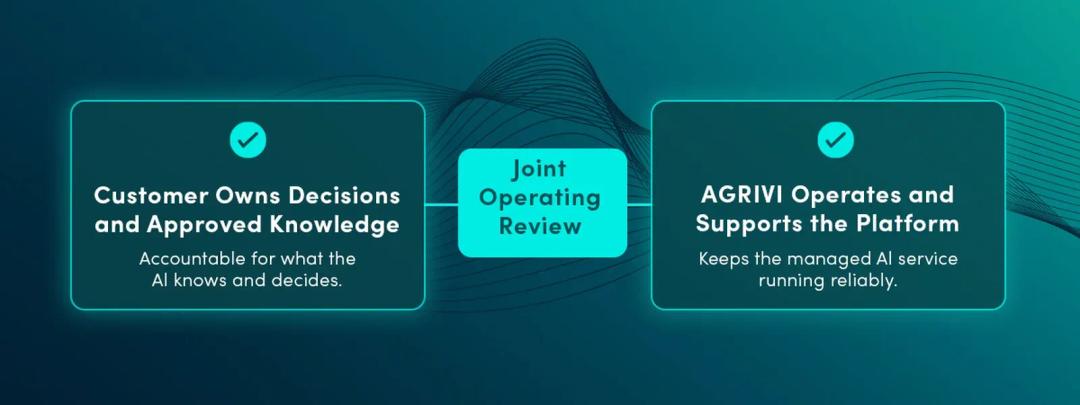
The deployment should separate customer decision rights from AGRIVI platform operations, while defining the work that requires both sides. This is a practical operating allocation, not a claim that all contracts or deployments have identical service terms.
- Knowledge: customer approves content and recommendations; AGRIVI supports knowledge structure, configuration and agreed updates. Evidence: sources, versions, approvals.
- Escalation: customer names qualified reviewers and decision rights; AGRIVI configures and supports agreed routing. Evidence: triggers, assigned cases, responses.
- Monitoring: customer assesses agronomic and commercial consequences; AGRIVI monitors platform operation and supports agreed improvement work. Evidence: samples, issue logs, changes.
- Business result: customer owns objectives, follow-up and decisions; AGRIVI provides managed platform capability and agreed reporting support. Evidence: baseline, actions, outcome review.
The split should also cover data access, privacy, security, change approval and incident response according to the programme’s agreements and applicable rules. Where an integration with another system is involved, the data owner and the team authorised to act on a signal must be explicit.
How to Set Up AI Governance Before Launch
Start with a defined agricultural use case and build ownership around actual farmer or grower workflows. A five-step sequence is usually more useful than a broad governance policy that leaves operating decisions unresolved.
- Step 1. Define the job. Confirm target users, channels, approved knowledge scope, expected business action and accountable business owner.
- Step 2. Assign authority. Name owners for knowledge, escalation, monitoring, business performance and privacy or security decisions.
- Step 3. Specify boundaries. Document when the agent may answer, when it must ask for more context and when it must route to a person.
- Step 4. Agree the operating review. Define logs, quality checks, issue severity, changes, approvals and review intervals with AGRIVI.
- Step 5. Test with real scenarios. Include crop-stage ambiguity, unavailable products, incorrect assumptions, regional differences and handoff to a human team.
AGRIVI’s guide to building an AI advisory programme covers the wider deployment sequence. Teams defining the practical governance model can also review AGRIVI AI Engage with a specialist as part of scoping, without assuming the same design is appropriate for every programme.
How Should Governance Be Reviewed Once the Agent Is Live?
Governance reviews should follow the pace at which the programme changes. A daily check may be appropriate for urgent issues or high-volume launches, while routine quality sampling and ownership decisions may be reviewed weekly or monthly. Seasonal changes and new product launches may require additional approvals.
A short, repeatable review should answer five questions: What changed? Which conversations or records show it? Who owns the decision? What action is needed? How will the team confirm that the action worked?
Keep a single decision and change record so technical fixes, approved knowledge updates and business follow-up remain connected. The goal is a governed service that can adapt during the season without requiring the entire deployment team to reconstruct the reason for each change.
AI Governance in Agriculture FAQs
Who Owns the Knowledge Used by AGRIVI AI Engage?
The customer approves and owns the substance of agronomic, product, commercial and public-service knowledge. AGRIVI supports its implementation and controlled maintenance within the agreed platform scope.
Who Is Responsible for Human Escalation?
The customer assigns qualified reviewers and decision rights. AGRIVI configures and supports the agreed routing process so out-of-scope cases can reach the appropriate person or team.
What Does AGRIVI Manage in an AI Engage Deployment?
AGRIVI operates and supports the AGRIVI AI Engage platform according to the agreed scope, which may include configuration, channel setup, monitoring, technical support and improvement work. Exact responsibilities should be documented for each deployment.
How Often Should an Agricultural AI Agent Be Reviewed?
Review frequency depends on interaction volume, risk, seasonality and rate of change. Urgent issues may need immediate attention; quality, escalation and business reviews are commonly scheduled at regular weekly or monthly intervals.
What Is the Difference Between Monitoring and Business Ownership?
Monitoring identifies changes, risks and performance patterns. Business ownership decides what those findings mean for the programme and ensures a person or team acts on them.
Does an AI Agri-Input Sales Representative Need AGRIVI 360 FMS?
No. The Digital Agent can operate through AI Workforce storage, integrate with supported existing systems or use AGRIVI 360 FMS context where relevant. The architecture depends on the deployment.
Can AI Governance Guarantee Accurate Advice or Business Results?
No. Governance reduces avoidable risks through approved knowledge, clear boundaries, human escalation and ongoing monitoring. Accuracy and business outcomes still depend on data quality, deployment design, adoption and human follow-up.
Published by AGRIVI. Editorial responsibility: AGRIVI Marketing & Communications.



Ready to digitalize your farm?
See how AGRIVI can help you apply these insights in your own operations.
Book a Meeting