
Digital Agriculture: What It Is, Key Technologies and How to Start
Digital agriculture uses sensors, imagery, data platforms and software to turn farm data into better decisions. This guide covers the technologies, benefits, barriers and how to start.
Tanja Folnovic

Digital agriculture, also called digital farming or smart farming, is the use of digital technologies such as sensors, satellite and drone imagery, data platforms, artificial intelligence and farm management software to collect data on the farm and along the food value chain, and turn it into better decisions and records you can trust.
Farming has always run on knowledge: when to sow, feed, spray, irrigate and harvest. Digital agriculture does not change that. It changes how much you can see, how fast you can act, and how well you can prove what you did. This guide explains what the term covers, the technologies behind it, what it can and cannot do, the barriers farms run into, and a practical way to start.
At a glance
- Also called: digital farming, smart farming, agriculture 4.0, digitalization of agriculture
- The idea: capture data from fields, machines, people and weather, connect it in one place, understand it, then act on it
- Key technologies: sensors and IoT, satellite and drone imagery, GPS and machine data, mobile data collection, analytics and AI, farm management software
- Main benefits: better decisions, lower input and labour costs, higher and steadier yield and quality, less waste, traceability and compliance records, resilience to climate and price swings
- Main barriers: cost and unclear return, patchy connectivity, skills and adoption, data scattered across tools
- Where to start: one clear problem, baseline records, a few tools, one system for the data, and a plan for who uses it
What is digital agriculture?
FAO's agricultural thesaurus describes digital agriculture as the use of new and advanced technologies, integrated into one system, to enable farmers and others along the agriculture value chain to improve food production (AGROVOC). The key word is "integrated". A weather app, a tractor guidance screen and a spreadsheet are digital tools. Digital agriculture is what you get when their data works together.
How it relates to similar terms
- Digital farming and smart farming are used as near-synonyms for digital agriculture (ITU).
- Precision agriculture is one part of it: managing each part of a field by what it needs. See our guide to precision agriculture.
- Agtech usually means the companies and products that supply the technology.
- Digitalization is the process of getting there, and it covers people and routines as well as software.
How digital agriculture works
Every digital agriculture setup follows the same loop:
- Capture. Record what happens in fields, on machines and with people: crops, activities, inputs, harvests, weather, images and sensor readings.
- Connect. Bring that data into one structured place, so a field, a cost and a work order refer to the same record.
- Understand. Analyse it: compare plan with actual, spot problems early, see cost and yield by field and crop.
- Act. Use what you learn to plan the next task, change a rate, schedule labour or show a buyer your records. Then record the result, and the loop starts again.
The loop only works if step 2 happens. Without it, you have data, but not digital agriculture.
The main technologies
- Sensors and IoT. Soil moisture probes, weather stations and machine sensors measure conditions where the crop is.
- Satellite and drone imagery. Vegetation indices such as NDVI show crop growth and stress, so you scout where it matters. Drone imagery adds detail for spot problems, plant counts and prescription maps.
- GPS and machine data. Guidance, section control and variable-rate application cut overlap and match inputs to zones. See our guide to variable rate technology.
- Mobile data collection. Field teams record work on a phone, ideally offline, so records are made when the work is done.
- Analytics and AI. Models that flag anomalies, forecast risk or turn imagery into maps, and assistants that answer farmers' questions.
- Farm management software. The system of record that ties the rest together: planning, operations, inventory, costs, compliance and traceability. See our guide to farming apps and when you need one system.
- Connectivity. Mobile networks, satellite internet and offline-first tools, so the system works where signal is weak.
Benefits of digital agriculture
- Better, earlier decisions. You see problems while there is still time to act.
- Lower input and labour costs. Inputs go where they pay back, and work is planned instead of improvised.
- Higher and steadier yield and quality. Timing and rates match what the crop needs.
- Less waste and a smaller footprint. Less fertiliser and fewer crop protection products are lost to runoff and over-application.
- Traceability and compliance. Records build up as work happens, ready for buyers, auditors and certification schemes.
- Resilience. Cost pressure and climate swings are easier to absorb when you know your numbers.
Cost pressure is a big reason adoption is growing. McKinsey's 2022 survey of US farmers found that about 55% of large farms used farm management systems and more than half used some form of precision agriculture hardware, with adoption higher on large and medium farms than on small ones (McKinsey, Voice of the US farmer in 2022). For how long it takes to recover the cost, see our analysis of the payback period of digital agriculture investments and of digital agriculture cost savings.
Digital agriculture in practice
- Targeted application. Satellite or drone imagery and yield maps become prescription maps that a sprayer or spreader follows.
- Satellite scouting. Imagery flags stressed areas, so agronomists walk the field where it matters.
- Work orders and costs per field. A manager sees what is planned, in progress and done, and follows actual cost against budget through the season.
- Farm-to-shelf traceability. Production records link harvest batches to fields, inputs and dates, so a buyer or auditor can trace a product back.
- Remote advice at scale. AI assistants answer farmers' questions through messaging apps such as WhatsApp, so input companies, cooperatives and public programmes can reach thousands of growers.
- Digital cooperatives. Member farms record work in the same system, so the cooperative sees its whole production base.
For a regional view, see what GITEX Africa 2026 revealed about digital agriculture's future on the continent, and how digital agriculture strengthens local production.
Barriers to digital agriculture
- Cost and unclear return. In McKinsey's survey, North American farmers named high cost (52%) and unclear ROI (40%) as the biggest obstacles to adopting farm management systems.
- Connectivity. Many farms have weak mobile signal and broadband. In the UK farmers' union NFU's 2026 survey, only 17% of members had reliable mobile signal across all outdoor areas of the farm, and 32% had fibre broadband (NFU). This is why offline-capable tools matter.
- Skills and adoption. Tools that people do not use change nothing. This is the barrier that most often decides whether a project works.
- Scattered data. Records spread across apps, spreadsheets and paper do not add up to one picture.
- Trust in data. Farmers want to know who can see their data and how it will be used.
Adoption is the success factor
Technology creates capability. Adoption creates value. A digital agriculture project succeeds when the team changes how it works: who records what, when, and who checks it. That needs a clear starting point, a set-up that fits your crops and routines, training for every role, and support after go-live.
That is why AGRIVI combines AGRIVI 360 Farm Enterprise with Digital Transformation & Business Consulting: a digital transformation assessment, platform implementation, process implementation, team training and adoption management, with a dedicated implementation and adoption team. AGRIVI brings 13 years of agriculture technology experience from deployments in more than 50 countries, adapted to local crops, teams and workflows. AGRIVI says most enterprise farms are fully operational within 4 to 8 weeks.
If you work with many growers, AGRIVI 360 Agriculture Supply Chain, AGRIVI 360 Traceability and AGRIVI AI Engage cover supply planning, farm-to-shelf records and farmer engagement through messaging apps.
How to start with digital agriculture
- Start with one problem, such as cost per field, scattered records, input waste or audit preparation, not with a technology.
- Collect baseline data. Field boundaries, yield records and soil tests cost little and show where the variation is.
- Add a few tools that solve that problem, and test them on one farm or one crop first.
- Keep the data in one system, so what you capture in the field ends up next to costs and results. See how to choose farm management software and what enterprise standards for evaluating it look like.
- Plan the rollout. Decide who owns it, who trains the teams and how you will check adoption. See our 10 steps for a successful farm management software implementation.
- Review each season and add technology only where it paid for itself.
For a step-by-step view, see 7 steps on how to digitize farm production.
Learn more about farm management software · Book a meeting · See customer stories
Digital agriculture FAQs
What is digital agriculture?
Digital agriculture is the use of digital technologies, such as sensors, satellite and drone imagery, data platforms, AI and farm management software, to collect data across the farm and food value chain and turn it into better decisions and reliable records. It is also called digital farming or smart farming.
What is the difference between digital agriculture and precision agriculture?
Precision agriculture is one part of digital agriculture. It manages each part of a field by what it needs, using GPS, sensors and variable-rate equipment. Digital agriculture is wider: it also covers records, planning, costs, traceability and supply-chain data across the whole operation.
What is the difference between digital agriculture, digital farming and smart farming?
In practice, nothing. The three terms are used as near-synonyms. Digital agriculture is the most common formal term, and smart farming often stresses sensors and automation.
What technologies are used in digital agriculture?
Sensors and IoT, satellite and drone imagery, GPS and machine data, mobile data collection, analytics and AI, farm management software, and the connectivity that links them.
What are examples of digital agriculture?
Targeted fertiliser or spray application from prescription maps, satellite scouting, work orders and cost tracking per field, farm-to-shelf traceability records, and AI assistants that answer farmers' questions through messaging apps.
What are the benefits and challenges of digital agriculture?
Benefits include better decisions, lower costs, steadier yield and quality, less waste and ready compliance records. Challenges include cost and unclear return, weak connectivity, skills and adoption, and data scattered across tools.
How big is the digital agriculture market?
Estimates vary widely with the source and with what is counted, so we do not quote a single figure. A more useful signal is adoption: McKinsey's 2022 survey of US farms found about 55% of large farms using farm management systems.
How do I get started with digital agriculture?
Pick one problem, collect baseline data, add a few tools, keep the data in one system, plan who owns the rollout and who trains the teams, and review after each season.
Related Articles

What GITEX Africa 2026 Revealed About Digital Agriculture’s Future on the Continent
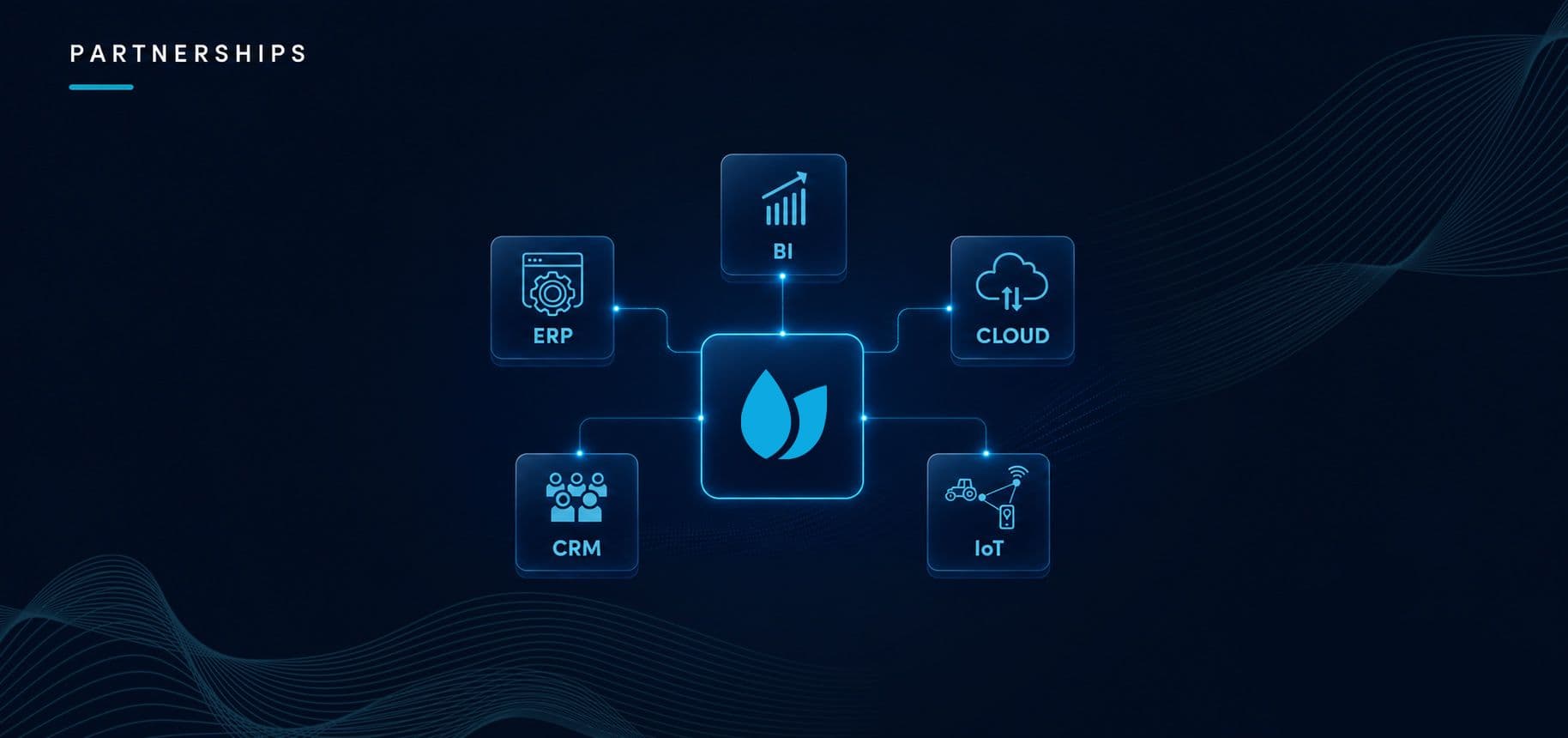
Agriculture Systems Integration: Connecting Farm Operations With ERP, CRM, BI, Cloud, and IoT
Agriculture Partner Ecosystems: How Product, Customer Access, and Delivery Create Enterprise Capability
Ready to digitalize your farm?
See how AGRIVI can help you apply these insights in your own operations.
Book a Meeting