Key Takeaways – AI Competitive Advantage
At Adria Business Forum 2026 in Zagreb, AGRIVI CEO Matija Zulj represented the agri-food technology sector in a panel on artificial intelligence and competitive advantage alongside leaders from pharma, automotive, AI platforms, and industrial robotics. Later that day, 2024 Nobel laureate James A. Robinson spoke on why nations fail and prosper. Read together, the two conversations pointed to the same practical conclusion: AI’s competitive advantage does not come from adopting tools faster than everyone else. It comes from the systems around the technology, including data discipline, clear ownership, trusted partner networks, and processes that turn insight into action.
At Adria Business Forum 2026 in Zagreb, AGRIVI CEO Matija Zulj joined business leaders from JGL, Zubak Grupa, Mindsmiths, and Robotiq for a panel on AI competitive advantage. Later in the same room, 2024 Nobel laureate James A. Robinson spoke about why nations fail and prosper. The connection between the two sessions was not ceremonial. Both pointed to the same deeper question: why do some systems turn potential into progress, while others do not?
The Forum’s Premise: Institutions, Prosperity, and Competitive Advantage
The forum placed one question at the center of the day: what makes progress durable? Robinson’s work answers that question at the level of nations. The AI panel asked it at the level of companies. In both cases, the answer is less about access to resources or technology and more about the systems that make those resources productive.
Held on June 16 at the Mozaik Center in Zagreb, the 2026 edition of Adria Business Forum was organized by Muller Adria and the Croatian Society of Economists. Its keynote speaker was James A. Robinson, co-author of Why Nations Fail and recipient of the 2024 Sveriges Riksbank Prize in Economic Sciences in Memory of Alfred Nobel, awarded together with Daron Acemoglu and Simon Johnson for research on how institutions shape long-term economic outcomes.
That institutional thesis created a useful lens for the morning discussion on artificial intelligence. The panel was not a technical debate about tools. It was a business discussion about what has to exist around AI before it can create a durable advantage: usable data, operational ownership, validation, and decision processes.
The AI Competitive Advantage Panel: Conditions Over Speed
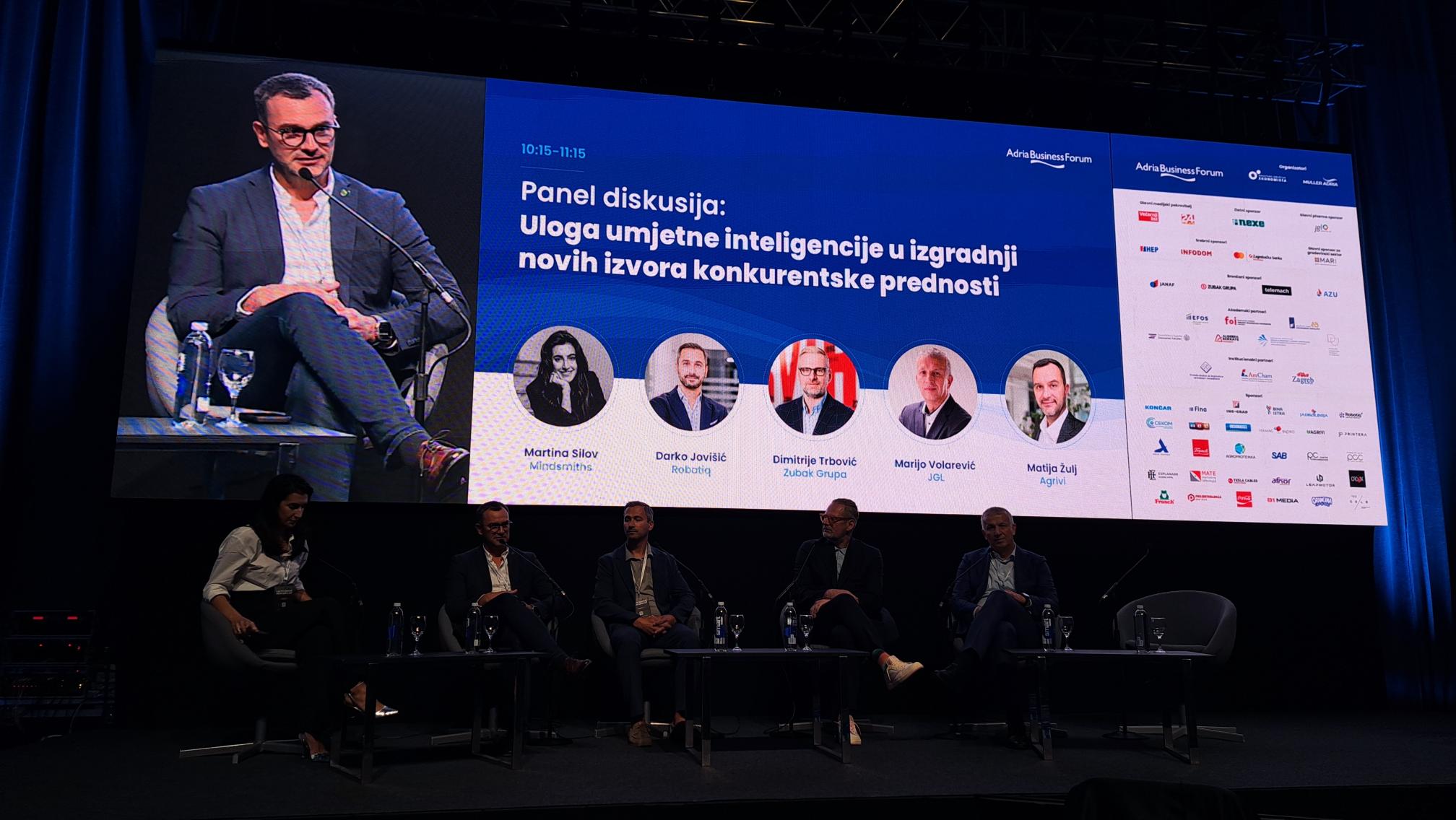
The morning panel on AI competitive advantage opened the forum’s content programme and brought together leaders from pharma, automotive, AI platforms, industrial robotics, and agri-food technology. Across very different industries, the conversation converged on the same point: AI’s competitive advantage depends on the conditions around the technology, not on how quickly the technology is adopted.
The morning panel, “The Role of Artificial Intelligence in Building New Sources of Competitive Advantage,” opened the forum’s content programme from 10:15 to 11:15. It brought together companies working across pharma, automotive, AI platforms, industrial robotics, and agri-food technology around a practical question: what determines whether AI investments become business value?
For AGRIVI, the agri-food angle is especially important because AI has to work across fragmented data, field conditions, advisor networks, and decisions made far from a clean office environment. That makes agriculture one of the hardest and most relevant tests for enterprise AI.
AGRIVI’s presence in that conversation matters because agri-food is often treated as a slower, more traditional sector, even though it is one of the environments where AI has the hardest work to do. Farm-level decisions depend on fragmented data, local agronomic context, partner networks, weather, soil, crop cycles, input availability, and human trust. In that setting, AI is not valuable because it sounds advanced. It is valuable only when it becomes useful inside real decision workflows.
Matija put a simple hypothesis on the table: AI will not reward organizations that adopt technology fastest. It will reward those who build the conditions for technology to create value. For agri-food companies, those conditions include knowledge architecture, trusted partner networks, data discipline, and processes that turn insight into action.
Robinson’s Institutional Thesis Applied to AI Adoption
Robinson’s research gives this business discussion a sharper frame. His core argument is that long-term prosperity depends on institutions: the rules, incentives, and operating systems that determine whether people can turn ideas and effort into productive outcomes. Applied to companies, the same logic is direct. AI capability without operating discipline creates output. It does not automatically create an advantage.
In his afternoon keynote, Robinson discussed why some nations build inclusive institutions that distribute opportunity and reward productive activity, while others build extractive institutions that concentrate benefits and resist reform. The historical cases are national, but the management lessons travel well.
Enterprise AI has its own version of this question. Does the organization have the systems to absorb AI and turn it into better decisions? Are the data flows clear? Are outputs validated? Do teams know who owns the final result? Can knowledge move from expert to process to tool and back again? Without that layer, AI produces material that people may read, test, or admire, but not trust enough to act on.
This is where Matija’s morning framing becomes useful. The AI panel and Robinson’s keynote were not the same conversation, but they were asking related versions of the same question: how do organizations build the capacity to absorb a transformative technology, rather than simply deploy it?
What Agri-Food Companies Are Learning About AI Competitive Advantage
Across the agri-food value chain, AI returns rarely come from the tool alone. They come from operators who first built usable farm-level data infrastructure, defined how human experts review AI-supported recommendations, and connected AI to existing commercial, agronomic, and field processes.
This is the pattern AGRIVI observes across input manufacturers, food companies, and public-sector clients in more than 50 countries. The technology layer is becoming more available. Large language models, recommendation engines, computer vision, satellite and drone imagery, and AI advisory platforms are no longer the scarce part of the equation.
What remains scarce is execution discipline. Agri-food companies need structured knowledge, clean field records, trusted advisory networks, and workflows that connect insight to decisions in the field. Without that operating base, AI remains a parallel tool. With it, AI can become part of the way farmers, advisors, sales teams, and management actually work.
AGRIVI AI Engage, AGRIVI’s white-labeled AI advisory platform for agri-input and machinery manufacturers, is built around that premise. The technology stack matters, but it is not the whole offer. Setup, training, optimization, go-to-market support, and continuous improvement determine whether an AI advisory platform produces farmer engagement at scale or sits unused inside a client’s IT environment.
That same point connects AGRIVI’s recent positioning beyond this forum, including the European Innovation Council Summit in Brussels, the EU Implementation Dialogue with European Commissioner Valdis Dombrovskis, and industry conversations on farm-level data infrastructure as a serious investment thesis.
The Operating Layer Where Competitive Advantage Lives
AGRIVI applies the same logic internally. Giving people access to AI tools is useful, but access is not transformation. The operating layer is built through standards, ownership, training, shared practices, and clear expectations for how AI-supported work is reviewed.
The same thinking applies to AGRIVI’s internal AI transformation. The first phase is access: giving team members the right tools for their roles and encouraging experimentation. The second is discipline: upskilling teams, sharing best practices, defining AI-supported workflows, and setting clear ownership for each use case.
One principle from that internal approach is especially practical: AI can support the work, but people still own the output. That principle changes how teams talk about AI. It is not AI who prepared this. I prepared this using AI. The difference sounds small, but it keeps accountability where it belongs.
For fully automated or AI-supported processes, the same principle applies at the workflow level. Quality control and verification cannot be added as decoration after the tool is launched. They have to be built into the process from the beginning. That is the difference between using AI and becoming more productive because of AI.
For enterprise buyers and investors evaluating AI in agri-food, this reframes the central question. The useful diagnostic is not only how advanced the technology stack appears. A useful diagnostic is whether the company has the systems, data discipline, partner network, and ownership model needed to convert technology into repeatable value. That is where competitive advantage compounds, or fails to.
Matija Zulj at the table with James A. Robinson
How agri-input companies design AI advisory programmes that produce measurable farmer engagement – Explore AGRIVI AI Engage.
Frequently Asked Questions
What was the topic of the Adria Business Forum 2026 in Zagreb?
Adria Business Forum 2026 was held on June 16, 2026, at the Mozaik Center in Zagreb under the theme “Why Nations Fail.” The forum brought together Croatian business leaders and 2024 Nobel laureate James A. Robinson to discuss institutions, competitiveness, AI, and the conditions that determine long-term progress.
Who delivered the keynote at Adria Business Forum 2026?
The keynote was delivered by James A. Robinson, recipient of the 2024 Sveriges Riksbank Prize in Economic Sciences in Memory of Alfred Nobel and co-author of Why Nations Fail. His lecture and moderated Q&A with Dubravko Merlic explored why some nations succeed economically while others stagnate, with a focus on the role of institutions.
What was the AI panel where AGRIVI participated?
The panel focused on the role of artificial intelligence in building new sources of competitive advantage. It included representatives from Mindsmiths, Robotiq, Zubak Grupa, JGL, and AGRIVI. The discussion focused on what determines whether AI investments produce business value rather than isolated experimentation.
How are Robinson’s ideas connected to AI’s competitive advantage?
Robinson’s work argues that prosperity depends on institutions, not only on resources or ideas. The same logic applies to enterprise AI. AI creates value when companies have the right systems around it: clean data, clear ownership, validated workflows, expert review, and processes that turn insight into action.
What is AGRIVI’s position on AI adoption in agri-food companies?
AGRIVI’s position is that AI adoption in agri-food depends on execution discipline, not tool adoption alone. Across its work with agri-food organizations in more than 50 countries, AGRIVI sees the strongest AI potential where farm-level data infrastructure, human expertise, partner networks, and commercial workflows are already connected.