
Center Pivot Irrigation: How It Works, Parts, Pros and Cons
A center pivot rotates a sprinkler line around a central point to irrigate a circle of crops. This guide covers how it works, its parts, types, efficiency, pros and cons, and when it pays off.
Tanja Folnovic
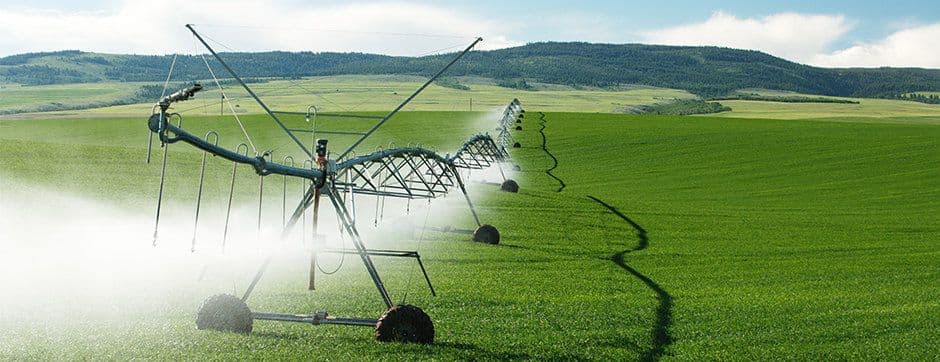
A center pivot irrigation system (also spelled centre pivot, or called central pivot irrigation) is a long sprinkler pipe on wheeled towers that rotates around a central point and irrigates a circle of crops. Well-managed pivots apply about 75–90% of the water they pump to the crop, and they need very little labour, which makes them the standard choice for large, open fields of field crops.
Pivots are among the most widely used irrigation systems in the world, and the circular fields they leave are familiar from the air. They suit large, regular fields and field crops such as maize, soybeans, small grains, potatoes and forage. They cost a lot to install and leave the corners of square fields dry unless you add extra equipment. This guide covers how a pivot works, its parts and variations, how efficient it is, the pros and cons, and when it is the right choice.
At a glance
- How it works: a pressurised lateral pipe on motorised towers rotates around a pivot point, spraying water through nozzles along its length
- Typical application efficiency: about 75–90% when well designed and managed, higher with low-pressure drop nozzles
- Area: a standard quarter-section pivot irrigates about 50 ha (125–130 acres)
- Best for: large, regular fields of field crops, potatoes, forage and vegetables
- Main downsides: high installation cost, dry corners without a corner arm, energy use, wet foliage
- Main upsides: low labour once installed, long service life, even application, easy fertigation and chemigation
Efficiency figures are potential values for well-designed, well-managed systems, not guaranteed field results. Sources: USU Extension, Sacramento Valley Irrigation Efficiency Table.
What is a center pivot irrigation system?
A center pivot is a mechanised, pressurised sprinkler system. A pipe called the lateral is supported on a line of mobile towers. Each tower has its own motor and wheels, so the whole line turns slowly around the pivot point at the centre of the field. Nozzles along the pipe spray water, so the machine irrigates a circle.
A pivot is technically a type of sprinkler irrigation, but it is common and distinctive enough to be treated as a method of its own. See our sprinkler irrigation guide for the wider family.
How does a center pivot work?
- Water arrives at the pivot point. It comes from a well, canal or reservoir, through a pump and buried pipe.
- The lateral carries it outward. Water flows along the pipe to the nozzles.
- Towers move the line. Electric (or hydraulic) motors on each tower drive the wheels. The outermost tower sets the pace and the others follow to keep the line straight.
- Nozzles spray the crop. They sit on the pipe or hang from drop tubes, sprinkling water at a rate set by flow and tower speed.
- The control panel runs it. It starts, stops and reverses the machine, and sets the speed, which determines how much water the crop gets per pass.
The slower the pivot turns, the more water each part of the field receives. Because the outer end covers much more ground than the inner end, nozzle sizes increase toward the outer end to keep application even.
Parts of a center pivot system
- Pivot point and control panel. The fixed centre that the machine turns around, and the panel that starts, stops and steers it.
- Span. A section of pipe between two towers. Water runs along each span.
- Towers (drive units). A-frame supports with a motor and wheels that move the line.
- Lateral pipe. Usually galvanised or stainless steel, carrying water to the nozzles.
- Sprinklers and nozzles. Mounted on top of the pipe or on drop tubes. Sizes and spacing are designed for the span so application stays even.
- Pressure regulators. Keep each nozzle at its design pressure.
- Power. Electricity from the grid or a generator for the tower motors, plus the pump.
- End gun (optional). A large sprinkler at the end of the pivot to reach a little further.
Types and add-ons
Linear move (lateral move). The same machine, but it travels in a straight line instead of turning, so it irrigates a rectangular field with no dry corners. Water comes from a ditch or hose along the field, and it generally needs more labour than a standard pivot.
Corner system (swing arm). An extra tower and pipe on the end of the pivot that swings out into the corners of a square field, following a guidance system, to irrigate acreage the circle would miss.
End gun. A cheaper way to reach the corners than a corner arm, but it covers the area less evenly, so some parts can be over- or under-watered.
Towable pivot. A pivot mounted on a towable end tower that you can hitch to a tractor and move between fields. Good for small areas or supplemental irrigation, but it costs labour to move, so it is a poor fit in dry climates that need frequent irrigation.
LEPA and drop nozzles. Low Energy Precision Application puts nozzles close to the ground on drop tubes and applies water at low pressure. It cuts evaporation and wind drift and saves energy, which suits windy areas. The trade-off is more runoff, and application below the canopy can damage some crops.
Variable-rate irrigation (VRI). Speed control changes how fast the pivot moves over different sections, and zone control changes the application along the span. Both work with soil moisture sensors, weather data, satellite or drone imagery and GPS. See the technology section below.
Which fields and crops suit a pivot?
Fields. Pivots do best on large, regular fields. They adapt to rolling land and can work on slopes (the old rule of thumb is up to about 15%, and 30% with the right equipment), so you rarely need to level the field or build levees as flood irrigation does. The corners outside the circle stay dry unless you add a corner arm or end gun.
Crops. Almost any crop that does not grow taller than the pivot's clearance: maize, soybeans, small grains, alfalfa and other forage, potatoes and many vegetables. Orchards and vines can be adapted. Pivots are mostly used on larger farms because of their cost.
Advantages of center pivot irrigation
- Low labour. Once installed, a pivot runs itself and can be automated and monitored remotely.
- Long life. A well-maintained pivot lasts around 20 years with routine maintenance.
- Good efficiency. Higher than many other sprinkler setups and than most flood systems, especially with drop nozzles.
- Even application when nozzles are properly sized and maintained.
- Fertigation and chemigation. Fertiliser and crop protection products can be applied through the system, which gives a uniform application at low cost.
- Works on uneven ground with no levelling.
- Frost and heat protection is possible in some setups.
Disadvantages of center pivot irrigation
- High upfront cost. Pivot machines, power, the pump and the water source add up. Cost grows with length and with extras such as corner arms. Get quotes for your field instead of relying on a general figure.
- Dry corners. Without a corner arm or end gun, a circle in a square field leaves about a fifth of the area unirrigated. A linear move avoids this.
- Energy use. Pressurised systems need pumping energy, though low-pressure nozzles cut it.
- Wind drift and evaporation. Top-mounted spray heads lose water in high winds, with losses reported up to about 15%. Drop nozzles reduce this.
- Wet foliage. Frequent irrigation raises humidity and can favour fungal disease, particularly near the pivot centre where the machine passes most often.
- Groundwater depletion. Pivots that draw on aquifers such as the Ogallala in the United States have been linked to falling water tables.
How to get more from a center pivot
- Check uniformity. A catch-can test shows worn, blocked or wrong-sized nozzles.
- Use drop nozzles or low-pressure packages to cut wind drift, evaporation and energy.
- Match application rate to the soil so water soaks in instead of running off, especially at the outer end where application is heaviest.
- Maintain the machine. Service gearboxes, tyres, alignment and sprinklers before the season.
- Schedule by data. Use soil moisture probes, weather data and evapotranspiration, not the calendar.
Variable-rate irrigation for center pivots
Variable-rate irrigation (VRI) adjusts how much water each part of a field gets, because soil and crop needs vary within a field.
- Variable speed control: the pivot slows down over drier areas and speeds up over wetter ones.
- Variable zone control: individual sprinklers or groups switch on and off, or change flow, along the span.
VRI uses soil moisture sensors, weather stations, satellite or drone imagery and GPS to decide where and how much to apply. It saves water and energy and reduces over-watering in low spots and under-watering on light soils.
Pivot vs other irrigation methods
- Sprinkler (fixed or moved): 70–85% efficient, flexible on small and irregular fields, more labour. See the sprinkler guide.
- Drip: 85–95% efficient, best for high-value crops and scarce water, highest installation cost per hectare of crop. See the drip guide.
- Flood and furrow: cheapest to install, 40–90% efficient depending heavily on design. See the flood irrigation guide.
- Sub-irrigation: water from below the root zone. See sub-irrigation systems.
For a full comparison, see our guide to irrigation methods.
When a center pivot is the right choice
A pivot usually pays off when:
- you farm large, regular fields of field crops, potatoes or forage;
- labour is scarce or expensive;
- water is available but you want it applied efficiently;
- the land is rolling and you would otherwise have to level it;
- you want to apply fertiliser or crop protection products through the system.
It is usually the wrong choice for small or irregularly shaped fields, for high-value crops where drip is more precise, or where water is so scarce that only the most efficient method makes sense.
A short history
The first center pivot was built by Nebraska farmer Frank Zybach, who applied for a patent in 1949, after watching farmers laboriously move irrigation pipes by hand. It spread fast across the Great Plains, helped by motorised and electric well pumps that made large volumes of groundwater available and by the memory of the 1930s Dust Bowl drought. Today about 29% of irrigated land in the United States is irrigated by center pivot, according to the USDA, and pivots are used on every continent, including through shared systems on smallholder farms in parts of Africa.
How to manage center pivot irrigation in farm management software
Records show whether a pivot is paying off. AGRIVI 360 FMS gives farm managers one place to:
- Record every irrigation by field, crop and date, including water source, amount, duration and energy and labour costs
- Record fertigation and chemigation, with the products applied
- Plan and assign work such as pre-season servicing, nozzle checks and repairs
- Compare irrigation with outcomes by looking at water use and costs against yield and quality, to judge the return on a pivot or whether another method would do better
- Track input stock so fertigation products are accounted for
Learn more about AGRIVI 360 FMS · Book a meeting
Center pivot irrigation FAQs
What is a center pivot irrigation system?
A center pivot (also spelled centre pivot) is a mechanised sprinkler system. A pressurised pipe on motorised towers rotates around a central point and irrigates a circular area of crops.
How does a center pivot irrigation system work?
Water is pumped to the pivot point and flows along the lateral pipe to nozzles. Motors on the towers move the pipe slowly around the field while the nozzles spray. The control panel sets the speed, which determines how much water each part of the field receives.
How much area does a center pivot irrigate?
A standard quarter-section pivot irrigates about 50 ha (125–130 acres) inside a 65 ha (160-acre) square. Pivot length and field size vary, so the area depends on the machine.
How efficient is center pivot irrigation?
About 75–90% when well designed and managed, and higher with low-pressure drop nozzles. That is better than many other sprinkler setups and than most flood systems, but not as efficient as drip.
What crops can a center pivot irrigate?
Almost any crop that does not grow taller than the pivot: maize, soybeans, small grains, alfalfa and other forage, potatoes and vegetables. Orchards and vines can be adapted.
Are center pivot systems sustainable?
They are efficient with water and energy compared with many alternatives, but pivots drawing on groundwater have contributed to aquifer depletion in some regions. Drop nozzles, scheduling by soil moisture and variable-rate irrigation all reduce their water use.
How much does a center pivot cost?
There is no single price. It depends on the length of the machine, the number of towers, the corner arm and other options, the pump and power supply, and the water source. Ask suppliers for quotes for your field, and compare the cost per hectare against your crop returns.
What is the difference between a center pivot and a linear move system?
A center pivot turns around a fixed point and irrigates a circle. A linear move travels in a straight line and irrigates a rectangle, with no dry corners, but it needs a water supply along the field and usually more labour.

Ready to digitalize your farm?
See how AGRIVI can help you apply these insights in your own operations.
Book a Meeting