Key Takeaways – Farm Management Software Evaluation
• Enterprise evaluation should begin with operating requirements, not a feature checklist copied from vendor websites.
• The system must represent agriculture at the level where work, agronomy, resources, and costs are actually managed.
• Reliable evaluation tests whether different roles work from one current record and whether information remains usable across integrations and reporting.
• Implementation ownership, role-based adoption, support, and long-term improvement belong in the buying criteria before a contract is signed.
• A strong evaluation creates a scorecard that connects every requirement to a business decision, workflow owner, evidence request, and acceptance criterion.
Farm management software evaluation is the structured process used to assess whether a platform can support the operating, agronomic, economic, data, and governance requirements of an agriculture enterprise. It goes beyond comparing features. A complete evaluation tests the system’s agriculture depth, record reliability, decision support, integration model, adoption requirements, implementation accountability, and long-term support.
Enterprise agriculture buyers often receive demonstrations that look polished because the vendor controls the data, sequence, and scenario. The difficult question is whether the platform can become a dependable part of the customer’s operation across farms, blocks, crops, teams, seasons, and management levels.
After 13 years in agriculture technology, AGRIVI’s view is direct: reliability cannot be assessed from a feature list alone. Buyers need standards that connect software capability with the way agriculture work is planned, recorded, reviewed, and improved. The seven standards below provide that structure.
What Farm Management Software Evaluation Should Test
Farm management software evaluation should test whether the platform can hold agriculture-specific records, support current decisions, preserve one reliable baseline across roles, and fit the customer’s wider technology environment. It should also test who owns implementation, adoption, support, data quality, and improvement after the buying decision is complete.
The evaluation team should include operating, agronomy, finance, and technology perspectives. Each function sees a different risk. Operations needs workable planning and execution. Agronomy needs crop and field context. Finance needs cost and performance visibility. IT needs clear data ownership, access, security, and integration responsibilities.
A useful evaluation question has four parts: the business decision, the workflow that produces the information, the person who owns it, and the evidence the vendor must provide. This makes the process more demanding than a standard request-for-proposal checklist, but it also makes the final decision more defensible. The FAO Digital Agriculture and AI Innovation programme and the OECD’s review of agricultural digitalisation provide wider context for evaluating technology together with data, governance, and operating capacity.
Standard 1: Farm Management Software Evaluation Agriculture-Specific Operating Depth
The first standard is whether the system represents agriculture at the level where work and decisions occur. Enterprise farms need more than generic tasks and inventory. The platform should reflect fields, blocks, crops, varieties, growth stages, agronomic plans, work orders, resources, activities, and season-specific operating context.
Agriculture depth matters because the same activity can carry different meaning depending on crop, block, timing, conditions, and production objective. A generic work-management tool may record that a task happened. An agriculture system should connect that task with the agronomic reason, resources used, people and equipment involved, and the effect on the operating and cost record.
During evaluation, use the customer’s own high-value workflows. Ask the vendor to show how the platform handles a real spray programme, labor sequence, irrigation decision, harvest plan, or block-level cost review. A standard demonstration with generic sample data does not test agriculture depth.
Standard 2: One Reliable Record Across Roles
The second standard is whether agronomy, operations, and finance can work from one current record while seeing the information through role-specific views. A dependable platform should reduce duplicate entry, conflicting spreadsheets, and manual reconciliation rather than add another reporting layer above disconnected source systems.
The evaluation team should trace one real activity through the system. When agronomy records a field action, can operations see the work status and resource effect? Can finance see the related cost allocation? Can managers review the same underlying record without waiting for a separate export or month-end consolidation?
This is also a data-governance question. The OECD’s work on agricultural digitalisation notes that data access, control, quality, and governance shape trust in digital systems. Buyers should therefore ask who creates, changes, approves, exports, integrates, and audits the records.
Standard 3: Timely Economic Visibility
The third standard is whether the platform connects operational activity with economic visibility while the season is still active. Enterprise buyers should test whether managers can review costs, resource use, budget variance, and performance at the level where they make decisions, including farm, crop, field, or block.
The keyword is timely. A system that produces a complete cost explanation after month-end may support reporting, but it does not necessarily support in-season management. Buyers should test when cost information becomes visible, what source records create it, and how managers investigate variance before the next decision window closes.
AGRIVI 360 FMS supports budget-versus-actual and block-level analysis from the same operating records used to plan and execute work. Across selected AGRIVI deployments, enterprise specialty-crop operations report around 23% input savings and around 10% revenue increase. Those outcomes depend on scope, adoption, and operating conditions, so they should be used as proof of potential rather than a guaranteed result.
Standard 4: Integration, Data Access, and Governance
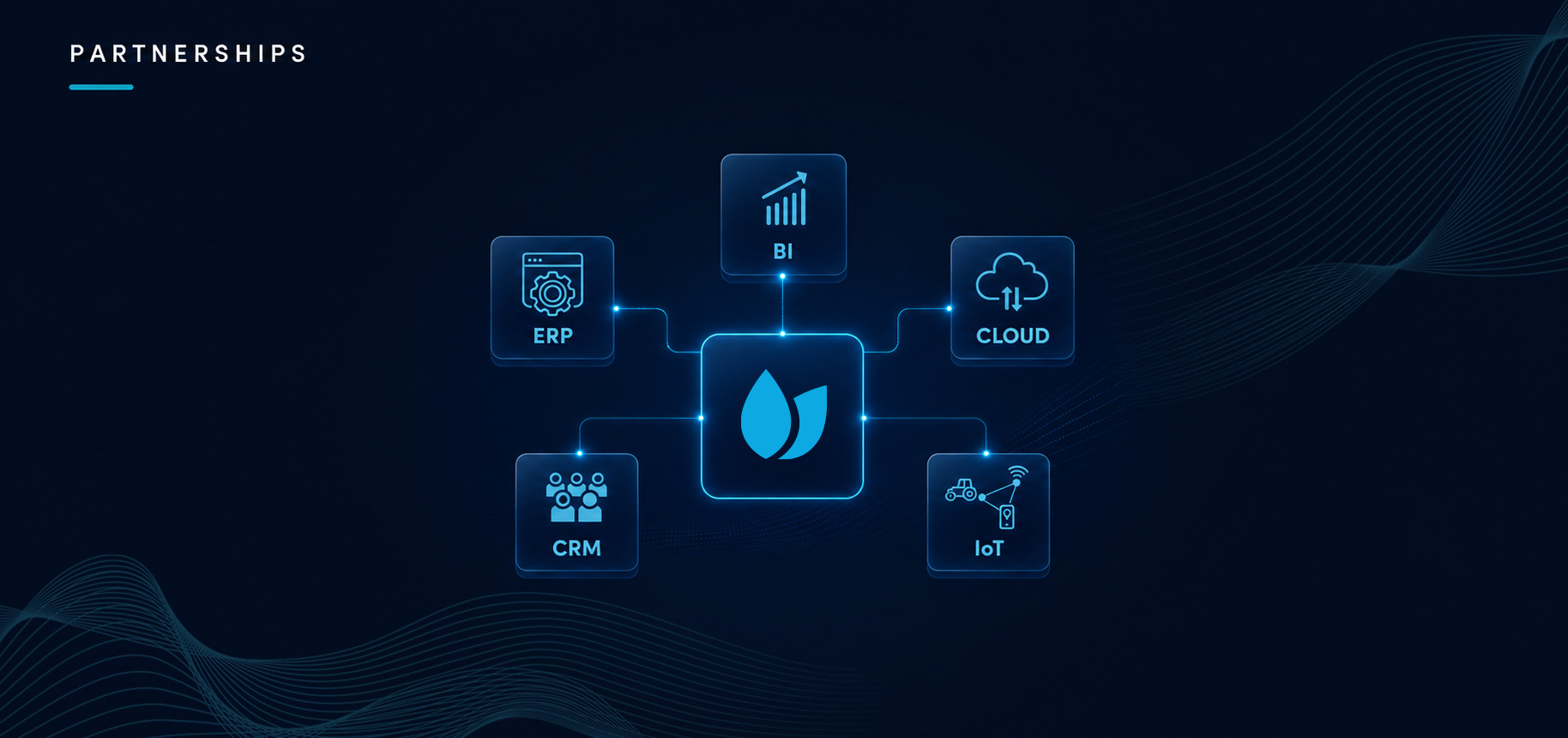
The fourth standard is whether the platform has a clear role inside the enterprise architecture. Evaluation should cover data access, import and export, integration ownership, master-data responsibilities, external data sources, identity and permissions, and the boundary between the agriculture system and ERP, CRM, BI, cloud, or IoT platforms.
The goal is not to connect every system before the first project. It is to understand which records belong in the agriculture operating layer, which systems remain authoritative for other domains, and how information will move between them. A diagram without ownership and update rules is not an integration model.
Ask the vendor to explain the architecture using one concrete workflow. For example, trace a planned activity from agriculture operations into resource use, cost allocation, procurement, and management reporting. Confirm what data is transferred, when it is transferred, which system owns it, and how errors are handled.
Standards 5 to 7: Adoption, Accountability, and Support
The final three standards assess whether the system can become an operating capability rather than remain a technical installation. Buyers should evaluate role-based adoption, implementation accountability, and long-term support before configuration begins. These standards determine whether the organization can use the platform consistently after the project team leaves.
Evaluate adoption by role and workflow. Field teams, agronomists, operations managers, financial controllers, and executives need different views, responsibilities, and usage rhythms. The vendor should explain how the implementation will define ownership, prepare data, configure workflows, train users, and verify that critical processes are being completed correctly.
Accountability should be explicit. The customer owns business decisions, internal roles, source-data quality, and operating change. AGRIVI owns product scope, implementation guidance, platform support, and agreed delivery responsibilities. A partner may own integration, local delivery, training, or first-line support. The evaluation should document those boundaries.
Long-term support includes more than technical incident handling. Enterprise buyers should ask how the vendor will manage product updates, process changes, new farms, new crops, reporting needs, and additional users. A reliable system should have a practical route for improvement and expansion without forcing the customer to redesign the operating model each season.
Standard 5: Role-Based Adoption
Test the normal work of each role, not only administrator functions. Confirm who enters records, who reviews them, who approves exceptions, and which decisions depend on completion. Use observable workflow completion as the adoption criterion instead of a training-attendance number.
Standard 6: Implementation Accountability
Define the expected business improvement, scope, responsibilities, data readiness, acceptance criteria, and decision rights before configuration. A project plan should show who owns each dependency and what happens when a required input is incomplete or delayed.
Standard 7: Long-Term Support and Improvement
Assess how the vendor will handle support, product expertise, operating changes, and account expansion after launch. The strongest model keeps product ownership clear while giving the customer a known route for questions, escalation, process review, and additional use cases.
Farm Management Software Evaluation: Seven Standards in One Scorecard
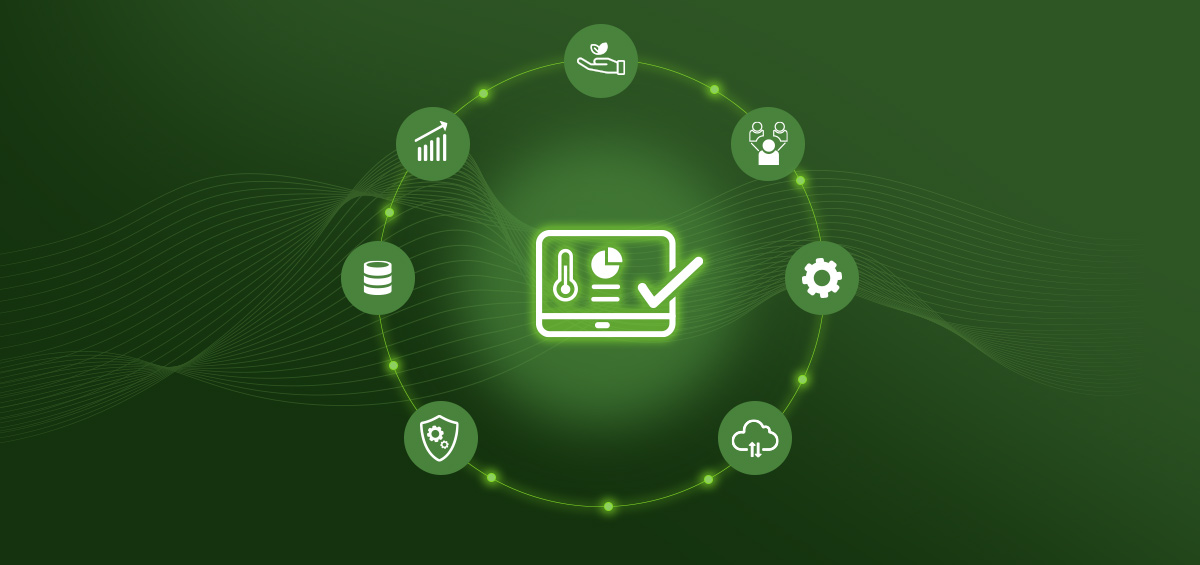
Farm management software evaluation becomes easier to govern when each standard has a clear question, required evidence, business owner, and acceptance criterion. The scorecard should not reward the largest number of features. It should show whether the proposed system can support the customer’s critical operating model with known responsibilities and manageable risk.
Starting a Farm Management Software Evaluation With Business Criteria
Starting a farm management software evaluation with business criteria keeps the process focused on decisions and operating improvement. The team should define priority workflows, owners, current limitations, required evidence, and acceptance criteria before requesting demonstrations. This gives every vendor the same problems to solve and makes comparison more credible.
- Select 3 to 5 high-value workflows where current information, coordination, or visibility is insufficient.
- Name the operating, agronomy, finance, and technology owners for each workflow.
- Describe the current record, decision timing, handoffs, and economic consequence.
- Ask each vendor to demonstrate the workflow with customer-relevant data and explain ownership across implementation and support.
- Score the evidence against the seven standards and document unresolved risks before commercial negotiation.
Apply the Seven Standards to Your Enterprise Farm – Book a 30-minute discussion with an AGRIVI enterprise specialist to review your priority workflows, evaluation criteria, and evidence requirements.
Frequently Asked Questions About Farm Management Software Evaluation
What Should Enterprise Buyers Evaluate First in Farm Management Software?
Buyers should begin with the business decisions and workflows that the platform must support. Define the agriculture context, operating owner, required record, decision timing, and economic consequence. Feature comparison comes later, after the evaluation team has established what reliability means for the customer’s own operation.
Why Is a Feature Checklist Not Enough?
A feature checklist confirms that a function exists, but it does not prove that the function fits the customer’s crop structure, workflow, data ownership, decision rhythm, or enterprise architecture. The evaluation should require evidence that the system can support complete operating scenarios with clear roles and responsibilities.
Which Functions Should Join the Evaluation Team?
The core team should represent agronomy, operations, economics or finance, and technology. Depending on scope, procurement, sourcing, quality, executive management, and field users may also participate. Each function should own specific evaluation questions rather than attend every discussion without a defined role.
How Should Integration Be Evaluated?
Evaluate integration through concrete data flows. Identify the source record, destination system, update frequency, ownership, error handling, access rights, and business decision supported. Avoid treating a list of available interfaces as proof that the customer’s required workflow is already designed or technically confirmed.
How Does AGRIVI 360 FMS Fit These Standards?
AGRIVI 360 FMS is designed as the agriculture-specific system of record and system of action. It connects agronomic plans, operational work, resources, costs, and management views. Final fit still depends on customer scope, data readiness, required integrations, implementation responsibilities, and the workflows selected for the project.