Key Takeaways – Specialty Crop Farm Management
Specialty crop farm management requires block-level data visibility to handle the complexity of multi-variety operations across hundreds of blocks.
The shift from farm-level to block-level data visibility is the single most impactful operational change a large specialty crop operation can make.
Block-level data changes four areas: planning by variety, real-time cost tracking, integrated pest monitoring, and harvest intelligence.
Farms adopting structured digital management at the block level report up to 23% reduction in input costs in the first full season.
The transition follows four practical steps: structure your farm, track at the block level, add cost allocation, then analyze and plan forward.
Specialty crop farm management operates under a different set of rules than commodity agriculture. When a farm grows 15 varieties across 200 blocks, with staggered planting windows, hand-harvest schedules, and crop-specific spray programs running simultaneously, the tools and processes that work for a grain operation simply do not transfer. According to the USDA Economic Research Service, specialty crops account for roughly 38% of total U.S. crop value despite being grown on less than 10% of harvested acreage. That value density reflects the operational intensity required to produce them.
Most large specialty crop operations manage this complexity through a combination of experience, spreadsheets, and institutional memory. It works, until it does not. A missed spray window because labor was allocated elsewhere. A cost overrun was discovered at season’s end rather than mid-season, when it could still be corrected. A variety quietly underperforms for two seasons before anyone notices.
The farms that have moved past this describe a consistent experience: when the team operates from block-level data in real time, the quality of decisions changes. Input costs go down. Seasonal surprises become rare. The gap between what the farm planned and what it achieved narrows.
This article walks through what specialty crop farm management looks like when teams have access to structured, real-time data at the block level, and what changes as a result.
Why Specialty Crop Farm Management Is Fundamentally Different
Row crop operations deal with scale and efficiency. Specialty crop farm management deals with complexity and precision. The distinction matters because the tools designed for one rarely serve the other well.
Consider the operational reality of a large specialty crop farm across three dimensions:
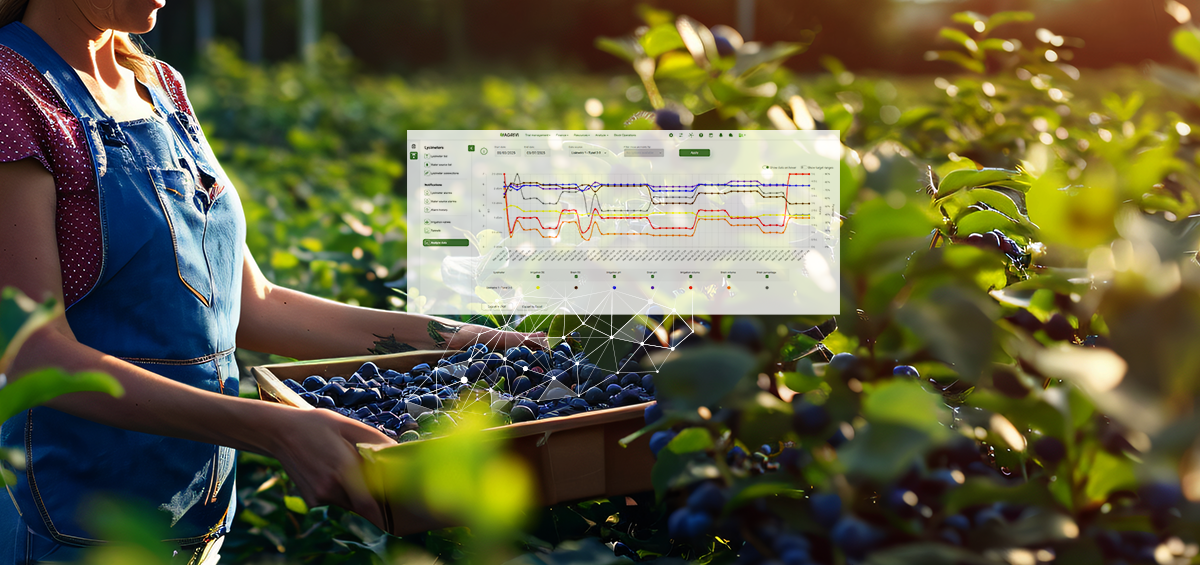
Multi-variety management. A single farm may grow berries, tree fruit, tropical crops, or spices simultaneously. Each variety has its own spray program, nutrition schedule, and harvest window. According to the USDA ERS, this value density reflects the operational intensity required to produce specialty crops at scale. Generic farm management tools designed for single-crop commodity operations cannot accommodate this variety-level complexity without significant workarounds.
Labor-intensive operations. Hand-harvest crops require precise scheduling tied to maturity, weather forecasts, and market demand. A two-day delay in berry harvest can mean the difference between premium grade and processing grade. Labor coordination across multi-variety blocks demands real-time visibility that spreadsheets and weekly check-ins cannot provide.
Granular cost attribution. When you grow multiple crops across hundreds of blocks, understanding which blocks are profitable requires tracking inputs, labor, and overhead at a level that farm-wide accounting cannot provide. Total farm profitability conceals block-level performance patterns that drive long-term strategic decisions.
For these reasons, generic farm management tools designed for commodity operations often fall short in specialty crop environments. The planning structures, cost tracking mechanisms, and reporting needs are fundamentally different.
What Block-Level Data Changes in Specialty Crop Farm Management
The shift from farm-level to block-level data visibility is the single most impactful operational change a large specialty crop operation can make. Here is what it changes in practice across four areas.
Shift 1: Planning by Block and Variety
In effective specialty crop farm management, planning happens at the block and variety level, not the farm level. Instead of a single-season budget, the farm builds a plan for each crop-block combination. Budget projections draw from historical data specific to that block: its yield history, its input requirements in prior seasons, and its labor intensity at harvest. Consequently, the result is a season plan that reflects the farm’s actual complexity, not a simplified average.
When the agronomist plans the spray program for a specific early-maturing cherry variety on a south-facing slope, they reference that block’s specific historical data, not a farm-wide average. The plan is more accurate, and deviations are more visible when they occur.
Shift 2: Real-Time Cost Tracking Per Block
As inputs are applied and labor is logged, costs accumulate at the block level in real time. The operations manager does not wait for month-end accounting to know where the farm stands financially. They see the trajectory forming as the season progresses and can intervene while the season is still running.
One fruit producer with over 500 hectares in our network reduced input costs by 23% in their first full season with block-level cost tracking. The operations did not change. The visibility did. They caught cost variances early enough to adjust, and those adjustments compounded across hundreds of blocks throughout the season.
Shift 3: Integrated Pest and Disease Monitoring
When IoT sensors, scouting data, and weather information feed into the same system as field history and growth stage records, crop protection decisions are based on integrated signals rather than isolated observations. A system that combines these data streams can identify elevated risk conditions before damage appears in the crop.
In practice, this means a pest alert is not simply ‘codling moth detected in Trap 7.’ It becomes: ‘codling moth detected in Block A-3, growth stage: fruit development, weather forecast: warm and humid next 48 hours, historical comparison: 2x above seasonal average.’ The response is calibrated to the actual risk level, not the observation alone.
Shift 4: Harvest and Post-Harvest Intelligence
Yield data by variety, by block, and by quality grade is tracked in the same platform used for planning and operations. Therefore, this season’s harvest data feeds directly into next season’s planning. Budget projections for the coming year draw from the farm’s own performance history rather than industry averages.
A tropical fruit operation with 12 varieties in our network discovered through block-level yield tracking that two of their varieties had been quietly underperforming for three consecutive seasons, cross-subsidized by the other ten. Without block-level tracking, this pattern was invisible in the aggregated farm data. With it, the team could make an informed variety selection decision for the following planting cycle.
Results From Farms Using Block-Level Specialty Crop Farm Management
The outcomes from farms that have adopted structured digital management at the block level are consistent across different crops and geographies. Three results stand out across our network.
Input Cost Reduction in Specialty Crop Farm Management
Up to 23% reduction in input costs in the first full season. This comes not from spending less, but from spending more precisely. Block-level cost visibility enables targeted treatment decisions based on actual pest pressure and historical patterns rather than uniform schedules.
Farm Management Planning Efficiency
Season planning reduced from weeks to days. An agave producer in our network cut their season planning process from three weeks to four days by using structured digital planning with historical block-level baselines. The team spends less time building the plan and more time executing it.
Hidden Specialty Crop Performance Visibility
Identification of underperforming blocks and varieties that farm-wide metrics mask. This intelligence informs long-term decisions about variety selection, block allocation, and investment priorities. According to the FAO, digital agriculture tools can improve decision-making precision by 15 to 30% in complex, multi-crop environments where data integration replaces fragmented manual tracking.
Getting Started With Block-Level Specialty Crop Farm Management
The transition to block-level digital farm management follows a practical sequence. Each layer builds on the one before it. Most operations complete the full sequence within one growing season.
Step 1: Structure Your Farm
Define your fields, blocks, and varieties in the system. This is the foundation that everything else depends on. Without a structured farm map, cost tracking and analytics have no framework. The AGRIVI 360 Farm Enterprise platform supports crop-specific workflows from this first step, accommodating the variety-level complexity that generic tools cannot handle.
Step 2: Track Activities at the Block Level
Log field operations, including spraying, fertilizing, harvesting, and labor, against specific blocks rather than the farm as a whole. This is where the data starts generating value. Each logged activity becomes a data point that informs cost tracking, historical comparison, and future planning.
Step 3: Add Cost Allocation
Link input costs and labor costs to the blocks and activities that consumed them. Real-time budget versus actual visibility becomes possible at this stage. Additionally, deviations from the seasonal plan become visible in time to correct them rather than after the season closes.
Step 4: Analyze and Plan Forward
Use the accumulated block-level data to inform next season’s planning, variety decisions, and resource allocation. This is where the long-term ROI compounds. A good starting point is to assess your current digital readiness. The Farm Digitalization Score takes five minutes and gives a clear picture of where your operation stands and where the highest-impact opportunities are.
For a full overview of the evaluation and procurement process, the How to Buy FMS guide walks through the six-step decision framework that large specialty crop operations typically follow.
AGRIVI 360 Farm Enterprise is built specifically for large specialty crop operations. Book a meeting to see how block-level data management works for your crops, your blocks, and your team. See How Specialty Crop Farms Use AGRIVI 360 FMS.
Frequently Asked Questions About Specialty Crop Farm Management
What Crops Does AGRIVI 360 Farm Enterprise Support?
AGRIVI 360 Farm Enterprise is built specifically for specialty crops, including berries, tree fruit, root vegetables, tropical fruit, spices, coffee, agave, grapes, and nuts. The platform supports crop-specific workflows for each category. For a full overview of how the platform is structured for specialty crop operations, the AGRIVI 360 Farm Enterprise page covers the supported crop types and capabilities.
How Long Does It Take to Implement Farm Management Software on a Large Farm?
Most large specialty crop operations are operational within one season. The first step is structuring your farm in the system: defining fields, blocks, and varieties. From there, teams begin logging activities and generating block-level data within days. The transition from a standing start to full block-level cost visibility typically happens within the first three months of use.
Can I Track Costs Per Block and Per Activity in Real Time?
Yes. AGRIVI 360 Farm Enterprise tracks costs at the block, crop, and activity level in real time. As inputs are applied and labor is logged, costs accumulate against the relevant block and activity. Budget versus actual is visible throughout the season, not only at month-end.
Does the Platform Integrate With IoT Sensors and Weather Stations?
Yes. AGRIVI 360 Farm Enterprise integrates with Crossmart and TrapView for IoT pest monitoring, as well as weather stations and soil sensors. These data streams feed into the same platform alongside field history and growth stage information. As a result, crop protection decisions draw from integrated signals rather than isolated observations.
How Is Specialty Crop Farm Management Different From Standard Farm Management Software?
Standard farm management software is typically built for single-crop or commodity operations where uniformity across the farm is the norm. Specialty crop farm management requires tools that handle variety-level differentiation, block-level cost attribution, staggered harvest windows, and multi-crop planning simultaneously. Moreover, tools built for commodity operations do not accommodate the reporting and traceability requirements that specialty crop buyers and retailers increasingly expect.