Key Takeaways – Agriculture Systems Integration
- Enterprise agriculture needs agriculture-specific data infrastructure because generic enterprise systems rarely represent fields, crops, agronomic plans, work, and production economics together.
- Integration quality depends on ownership, update rules, business context, monitoring, and exception handling, not only on available interfaces.
- AGRIVI 360 FMS provides the agriculture-specific system of record and system of action. AGRIVI AI Engage adds managed AI capacity for farmer-facing workflows.
- Solution partners can contribute discovery, architecture, data preparation, implementation, integration, training, support, and account development.
Agriculture systems integration is the design and operation of data flows between agriculture-specific records and enterprise platforms such as ERP, CRM, business intelligence (BI), cloud services, and Internet of Things (IoT) platforms. A complete model defines system ownership, data meaning, update timing, monitoring, exception handling, and the decisions that use the connected records.
Many food and agriculture companies already have mature systems for finance, procurement, customers, analytics, infrastructure, and devices. However, field operations may still live in spreadsheets, isolated agronomy applications, paper records, or messages. Therefore, the missing element is often agriculture-specific data infrastructure that can preserve operational context.
This creates a clear role for AGRIVI and solution partners. AGRIVI brings agriculture products and domain knowledge. Meanwhile, partners bring enterprise architecture, integration experience, customer context, and delivery capacity. Together, they can connect farm information with the systems that run the wider business.
What Agriculture Systems Integration Actually Connects
Agriculture systems integration connects records and workflows from distinct operating domains. These may include fields, crops, agronomic plans, work orders, resources, costs, grower relationships, or farmer conversations. The connected enterprise domains may include finance, procurement, inventory, CRM, analytics, cloud services, and device platforms.
The first design question is not which API to use. Instead, the team should ask what information the customer needs, where it originates, which system remains authoritative, and how the destination will use it. Technical connectivity becomes valuable only after those operating questions have clear answers.
A partner should begin with a workflow map. First, trace one decision or transaction from its agricultural source through the enterprise process. Then identify every owner, record, timing dependency, transformation, exception, and manual handoff. This work shows whether the integration needs a transfer, a shared identifier, a business rule, or a broader process change.
Why Farm Operations Need Agriculture-Specific Context
Farm operations need agriculture-specific context because fields, crops, growth stages, agronomic plans, weather, pest pressure, work timing, resources, and production economics interact. Generic enterprise records do not normally represent these relationships. As a result, a technically correct transfer may still produce a weak operational decision.
For example, an ERP transaction may show a resource quantity and cost. The agriculture record explains where the resource was used, for which crop and field, under which plan, by which team, and against which budget. Similarly, a device platform may show a sensor reading, while the agriculture record provides the crop, location, threshold, and related action.
Therefore, the architecture should preserve the agriculture layer instead of flattening it into generic categories. The enterprise system still receives the records it needs. However, the agricultural source remains connected to the context that gives each record meaning.
Agriculture Systems Integration Across ERP, CRM, BI, Cloud, and IoT
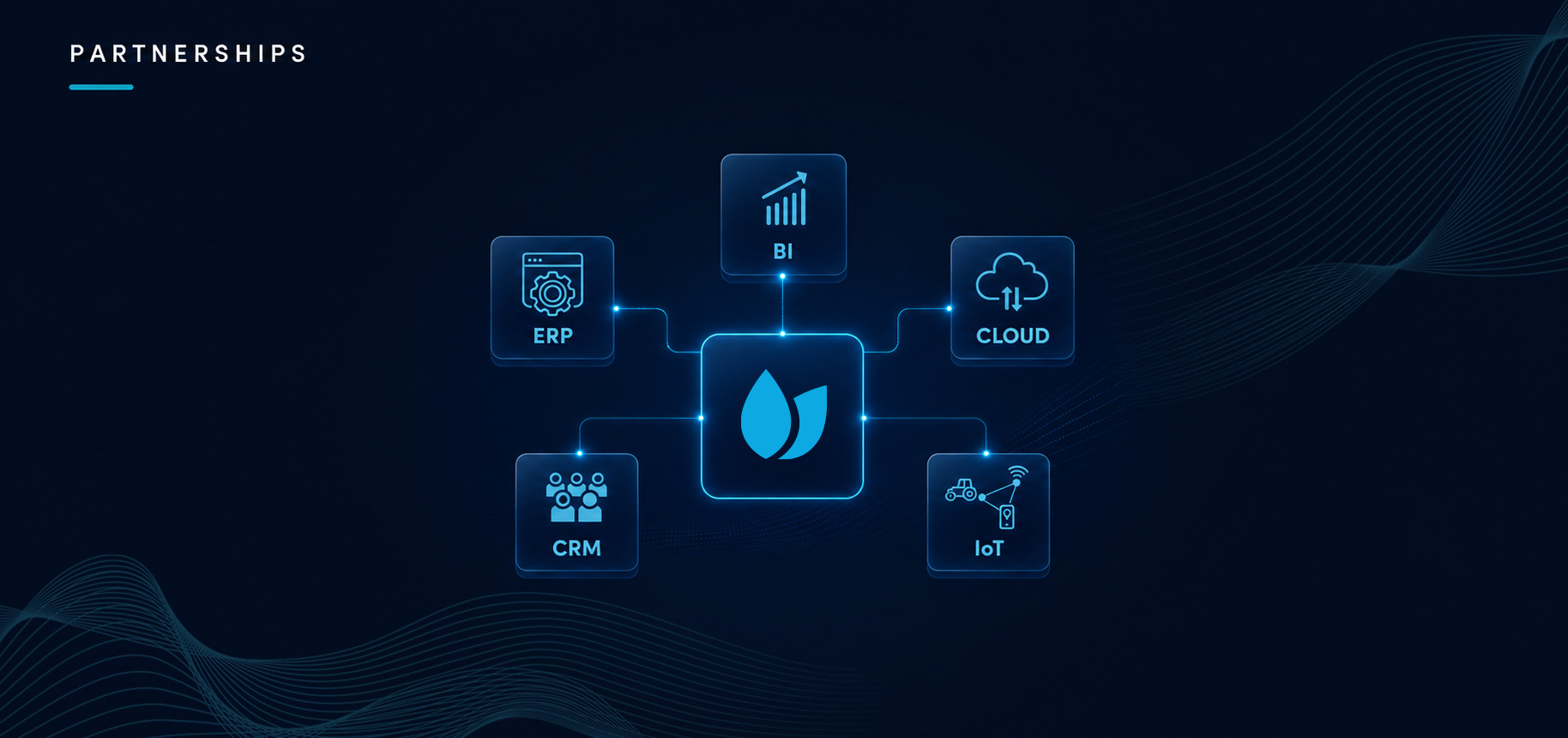
Agriculture systems integration should assign a distinct role to each platform. ERP may own financial, procurement, inventory, and corporate master data. CRM may own accounts, contacts, and commercial processes. BI may combine approved records for analysis. Cloud services provide infrastructure, while IoT platforms collect device signals.
AGRIVI 360 FMS provides the agriculture-specific record for fields, crops, plans, work, resources, activities, and costs. AGRIVI AI Engage supports farmer-facing conversations, approved knowledge, routing, and collected intelligence. Consequently, the architecture can connect agriculture workflows with enterprise platforms without creating duplicate ownership or hidden reconciliation.
Standards such as AgGateway ADAPT illustrate the value of common data models and interoperability in agricultural software. However, a standard does not decide customer scope, ownership, quality rules, update timing, or support. In addition, the OECD report on agricultural data governance highlights trust and rights over data access. The FAO Digital Agriculture and AI Innovation programme places interoperability within the wider conditions needed for digital adoption.
The Role of AGRIVI 360 FMS as System of Record and System of Action
AGRIVI 360 FMS serves as the agriculture-specific system of record and system of action. It holds the operating context needed to plan, carry out, monitor, and review farm work. Therefore, enterprise systems receive a structured agricultural source, while farm teams work from records tied directly to operations.
As a system of record, AGRIVI 360 FMS structures farms, fields, crops, agronomic plans, resources, activities, and production economics. As a system of action, it supports work planning, execution, monitoring, risk response, and management decisions. The same records can support role-specific views without separate versions of the farm.
Nevertheless, the integration boundary must remain explicit. AGRIVI should not be described as the owner of every enterprise record. Equally, an ERP should not be assumed to hold the complete agriculture context. Clear boundaries support stronger governance and clearer service responsibilities.
What AGRIVI AI Engage Adds to the Architecture
AGRIVI AI Engage adds managed AI capacity for farmer engagement, 24/7 advisory, data collection, and interaction intelligence. It provides a farmer-facing conversational layer that uses approved knowledge, works through selected channels, routes questions, and captures structured signals from farmer interactions.
However, the value depends on more than an AI response. The customer needs approved knowledge, business rules, channel identity, escalation ownership, monitoring, and links to relevant commercial or operational systems. For example, CRM integration can route qualified interest, while BI can analyse conversation topics and recurring field signals.
Partners can contribute workflow definition, knowledge preparation, integration, governance, adoption, and monitoring. AGRIVI operates and supports the managed service. The customer remains responsible for approved content, internal decisions, and the business use of collected information.
Agriculture Systems Integration: Interface Design vs Operating Model
Agriculture systems integration works when interface design has an operating model around it. An interface moves data. By contrast, the operating model defines why the data moves, who owns it, how quality is checked, what happens when the flow fails, and which decision depends on the result.
Where Partner Services Fit
Partner services fit where a customer needs enterprise architecture, data preparation, integration, implementation, training, support, or change management around AGRIVI products. Each service should connect to a specific customer workflow. In addition, AGRIVI, the partner, and the customer need a clear division of responsibility.
Discovery services identify the current process, systems, owners, decisions, and gaps. Architecture services define system roles, identifiers, data flows, access, and governance. Implementation may include data preparation, workflow setup, integration, onboarding, and training. After launch, recurring support can cover first-line coordination, monitoring, reporting, and account development.
A partner should not claim that every integration is ready before technical confirmation. Scope, data quality, APIs, customer systems, security, and delivery responsibility need review. Clear qualification protects commercial credibility and creates a realistic project plan.
Starting With Agriculture Systems Integration: Recommended Sequence
Starting with agriculture systems integration requires one high-value workflow and a shared view of system ownership. A complete map of every application is rarely the best first move. Instead, one focused workflow provides enough detail to test architecture, data, responsibilities, limitations, and business value.
Step 1: Select one workflow that crosses agriculture operations and an enterprise system. Examples include cost allocation, procurement, customer engagement, reporting, or device-triggered action.
Step 2: Map the source record, agriculture context, destination record, timing, and supported decision.
Step 3: Assign ownership for data creation, quality, mapping, integration, monitoring, exception handling, and support.
Step 4: Confirm the technical method and limitations after the operating design is agreed.
Step 5: Test the complete workflow with realistic records and acceptance criteria before adding more connections.
Frequently Asked Questions About Agriculture Systems Integration
These questions cover the decisions that enterprise agriculture teams and solution partners should settle before implementation. The answers define the role of agriculture data infrastructure, clarify AGRIVI product boundaries, and set a practical starting point for integration architecture and partner services.
Why Do Enterprise Agriculture Companies Need Agriculture Data Infrastructure?
Generic enterprise systems manage finance, procurement, customers, analytics, infrastructure, and devices. However, they do not usually represent fields, crops, agronomic plans, work, resources, and production economics together. Agriculture data infrastructure preserves those relationships and connects them with the wider enterprise process.
Does AGRIVI Replace ERP, CRM, BI, Cloud, or IoT Platforms?
AGRIVI does not replace those platforms. AGRIVI 360 FMS provides the agriculture-specific system of record and system of action. AGRIVI AI Engage supports managed farmer-facing AI workflows. ERP, CRM, BI, cloud, and IoT keep their defined roles, while integration governs the information exchanged between them.
What Should Be Defined Before an Integration Is Built?
Define the business workflow, source and destination records, system ownership, identifiers, quality rules, update timing, access, monitoring, exception handling, and support responsibilities. The team should select the technical interface after these decisions because an available API cannot replace an operating design.
What Services Can an AGRIVI Solution Partner Provide?
Depending on capability and agreement, a partner may support discovery, architecture, data preparation, implementation, integration, training, first-line support, monitoring, reporting, and account development. However, the partner should not promise unconfirmed integration readiness, delivery dates, or customer results.
How Should a Customer Start an Enterprise Agriculture Architecture Project?
Begin with one high-value workflow that crosses agriculture and enterprise systems. Map the decision, records, owners, timing, current manual work, and economic consequence. Then use that workflow to define system roles, responsibilities, technical requirements, and acceptance criteria before expanding the architecture.
Connect Agriculture Operations With Enterprise Architecture
AGRIVI products can complement ERP, CRM, BI, cloud, IoT, data, and consulting environments when the customer workflow and system boundaries are clear.
Explore the AGRIVI Solution Partner Program