
What Makes an AI Workforce Role Operational in Agriculture?
A Digital Agent becomes operational when its role, approved knowledge, workflows and human review routes are clear. Use these six checks to assess readiness.
AGRIVI
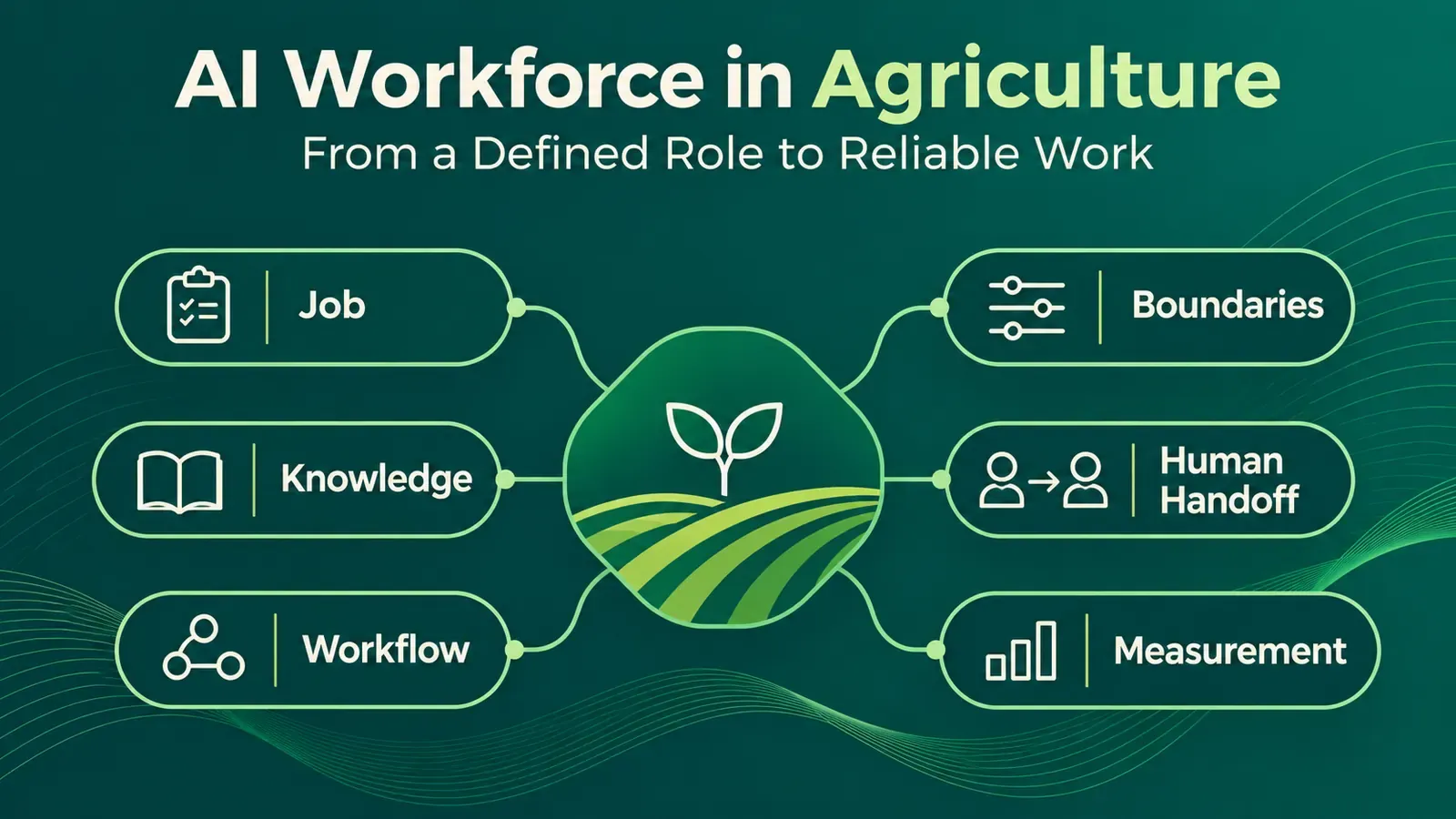
An AI Workforce role becomes operational when a Digital Agent has a defined job, approved knowledge, a repeatable workflow, decision boundaries, a route to qualified people and measures that show useful work. In agriculture, those elements must reflect crop, location, season and organisational responsibilities. They turn a conversational capability into a managed business role.
A conversation that sounds fluent is only one part of the experience. An agri-input manufacturer, food company or public advisory programme also needs to know what happens after an answer, who approves changes and which person receives an exception. Those questions define the operating model.
At a Glance
- AI Workforce is the AGRIVI category; AGRIVI AI Engage is the platform used to deploy agriculture-specific Digital Agents.
- The six elements are job definition, approved knowledge, workflow, boundaries, human handoff and measurement.
- The customer approves the substance of agronomic, commercial or public-service knowledge and assigns decision owners.
- AGRIVI configures and supports the platform within the agreed deployment scope.
- A routine answer can complete an approved workflow; exceptions move to qualified people with relevant context.
- A role is ready to scale when its decisions, evidence and human responsibilities are testable.
What Is an Operational AI Workforce Role in Agriculture?
An operational AI Workforce role is a defined set of agriculture-specific tasks performed by a Digital Agent under approved knowledge, business rules and human oversight. It has an identifiable purpose, a clear process and a measurable outcome. The role should be reviewable by a commercial, agronomy, supply-chain or public-sector owner without requiring that person to read technical model specifications.
Within AGRIVI, AI Workforce is the category and AGRIVI AI Engage is the platform. A deployment may work through channels such as WhatsApp, Viber or web conversations according to the agreed scope. The channel is where a person interacts with the service; the role determines which work is supported.
The FAO Digital Agriculture and AI Innovation Roadmap emphasises trusted, inclusive technology and real-world impact. For an agricultural organisation, that makes role definition, local context and responsible ownership relevant from the beginning.
The Six Elements That Make a Digital Agent Operational
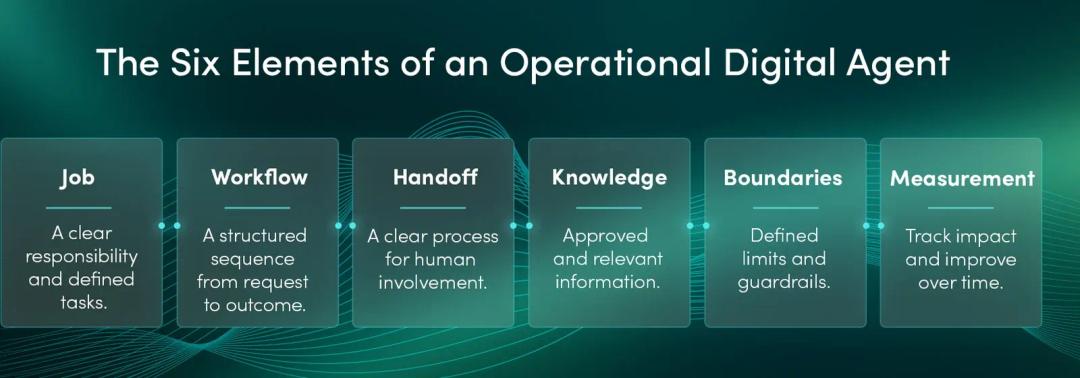
Six elements allow business teams to test whether a Digital Agent is ready to support real work. Each element should be documented in plain language, attached to an owner and checked in representative conversations before a rollout expands.
- Job definition. Describe the specific task, user and business objective. For example, identify farmer interest in an approved product portfolio and route qualified intent to a named sales team.
- Approved knowledge. List the authoritative product, agronomy, company or policy sources, the approval owner, update process and permitted regional variations.
- Workflow. Define what starts the interaction, what information the agent may collect, the normal next action and where the outcome is recorded or sent.
- Boundaries. Specify the decisions and statements the agent may make, the topics outside its scope and what happens when context is missing or sources conflict.
- Human handoff. Set the triggers, destination, review authority and information required for exceptions that need human judgement or approval.
- Measurement. Choose evidence that reflects the role: answered routine questions, qualified opportunities, completed follow-up, service reach, escalation quality or other agreed results.
These are six design checks, not a strict technology implementation sequence. A team may revisit any of them as products, crops, policies and business processes change. For deeper work on approved sources, see AGRIVI’s Knowledge Architecture in Agricultural AI article.
How the Three AGRIVI AI Workforce Roles Differ
The role changes according to the organisation’s objective. The operational framework stays consistent, but each role has different knowledge, workflows, boundaries and measures.
- AI Agri-Input Sales Representative. Uses approved product and agronomy knowledge to answer relevant farmer questions, identify buying intent and connect commercial opportunities to sales or agronomy teams. See the AI Agri-Input Sales Representative role.
- AI Supply Chain Manager. Supports grower coordination, structured updates, sourcing communication and exception routing according to the buyer’s programme. See the AI Supply Chain Manager role.
- AI Public Advisory Officer. Extends access to approved public agricultural information and collects structured programme signals while qualified authorities retain decision responsibility. See the AI Public Advisory Officer role.
An agri-input business can review its wider farmer-engagement model alongside the Digital Agent role. The aim is to support existing teams with clear responsibility for commercial decisions and relationships.
What Approved Knowledge and Agricultural Context Require
Approved knowledge gives the Digital Agent a defined source for answers, while agricultural context makes those answers relevant to the crop, location, season and organisation. Both need a named owner and a process for review. An agent should not infer a local product recommendation from generic agricultural content when the deployment requires approved regional guidance.
For an agri-input role, inputs may include label guidance, authorised product descriptions, regional usage protocols and internal FAQs. A public advisory role may depend on an official knowledge base and current programme rules. Data access should follow the information that the job actually needs, including permissions and retention decisions.
Knowledge quality is an operating responsibility. AGRIVI can support structured configuration and managed updates within its scope, while the customer remains accountable for approving substantive advice and claims. Related considerations appear in the AGRIVI article on brand architecture in agricultural AI advisory.
How Workflow Boundaries Protect the Business
Boundaries define which actions the Digital Agent may complete and when it must stop. They keep a routine question within a predictable workflow and protect people when an answer requires additional expertise, legal approval or a commercial decision.
Take an incoming question about a fertiliser programme. The Digital Agent may answer from approved product information and record a farmer’s crop and timing. A request for exceptional pricing, an unapproved use or a crop problem with insufficient context belongs with the qualified human owner. The business should agree these thresholds before launch rather than learn them through incidents.
This is also a governance decision. AGRIVI’s AI Governance in Agriculture article explains ownership of knowledge, escalation, monitoring and business outcomes after deployment. This article concentrates on defining a single role before and during its first operational use.
When a Digital Agent Should Escalate to a Human
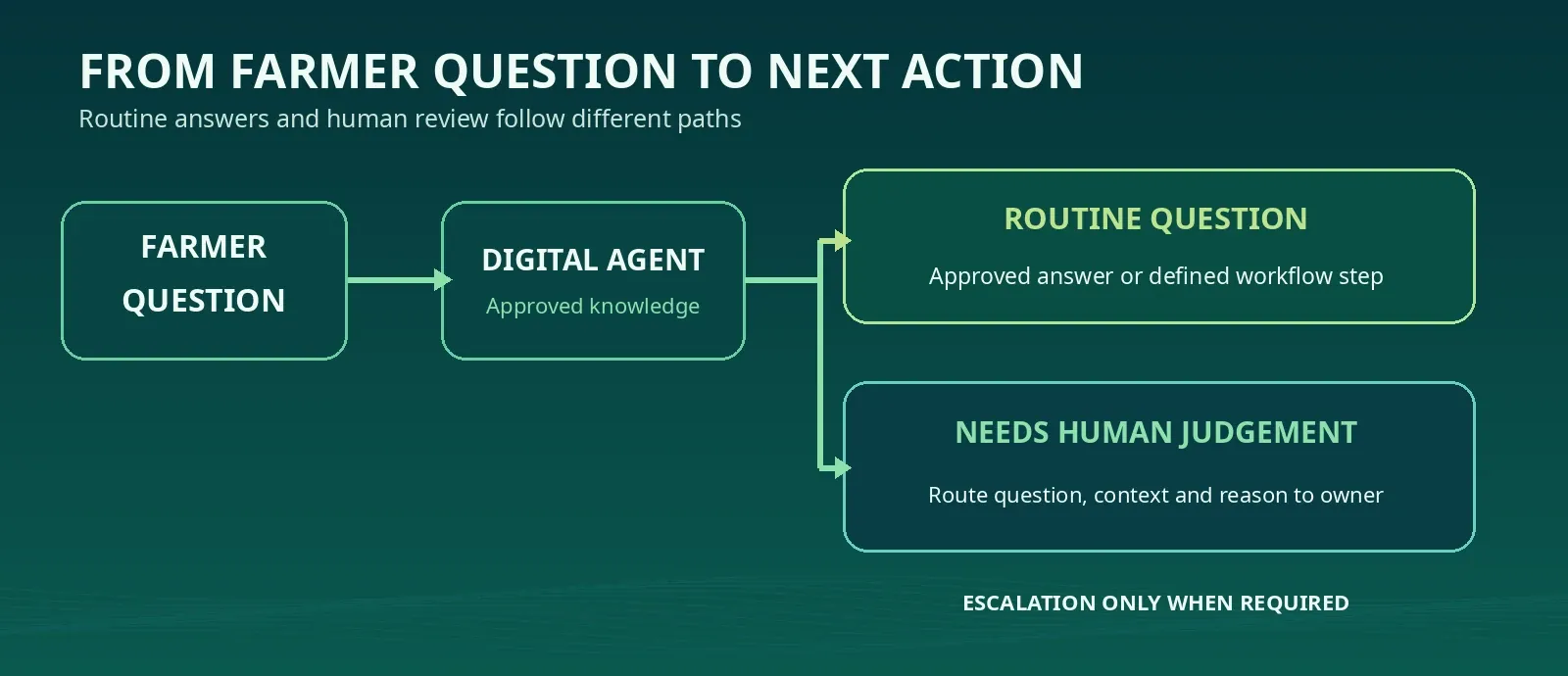
A Digital Agent should escalate when a question falls outside approved knowledge, relevant context is missing, the decision carries significant risk or a human has authority over the next commercial or agronomic step. Routine interactions should continue through the approved response or workflow path without unnecessary escalation.
A useful handoff transfers the question, known farmer or supplier context, the reason for escalation and any action already completed. The recipient also needs an identified queue or owner and a way to record the decision. The farmer should not have to reconstruct the conversation for the second time.
An escalation route is therefore a separate branch of the operating workflow. During testing, check an ordinary answer, an incomplete-context question, an out-of-scope request and a high-value commercial case. Each should reach the correct outcome with a traceable record.
How Business Owners Can Test the Role Before Launch
A practical readiness review uses sample conversations and real business situations rather than a feature checklist alone. The business owner should be able to demonstrate both normal completion and exception cases, with records that show what the agent did and why.
- Agree the role’s measurable objective and the person accountable for its outcome.
- Test approved and unapproved questions from representative crops, regions and languages.
- Check that collected context is accurate, necessary and routed to the intended workflow or team.
- Test an exception end to end, including the destination owner and response expectations.
- Agree who reviews conversation quality, changes in knowledge and recurring unresolved questions.
- Confirm which measures will show improved capacity or business value after launch.
FAO’s Digital Agriculture and AI Innovation programme provides broader context on moving agricultural AI from experimentation into practical adoption. Organisations should test in their own operating context before interpreting pilot activity as a scalable result.
How to Measure Useful Work After Launch
Measurement should be tied to the job the Digital Agent was created to support. Conversation volume is an activity measure. The business also needs evidence that the role answered appropriate questions, completed agreed actions, routed exceptions accurately and contributed to an operational objective.
For a sales-oriented role, that may include qualified intent, follow-up completion and the quality of information delivered to the representative. For supply-chain coordination, it may involve timely grower responses and resolved exceptions. For public advisory, it may include advisory coverage, repeat questions and the share of cases requiring specialist review.
The team-capacity article explains how AI agents can extend sales and agronomy teams. Here the evaluation is narrower: each operational role needs its own scorecard, owner and agreed review rhythm. The relevant AGRIVI product portfolio provides the wider context of Farm Management Software and AI Workforce.
Where AGRIVI AI Engage Fits
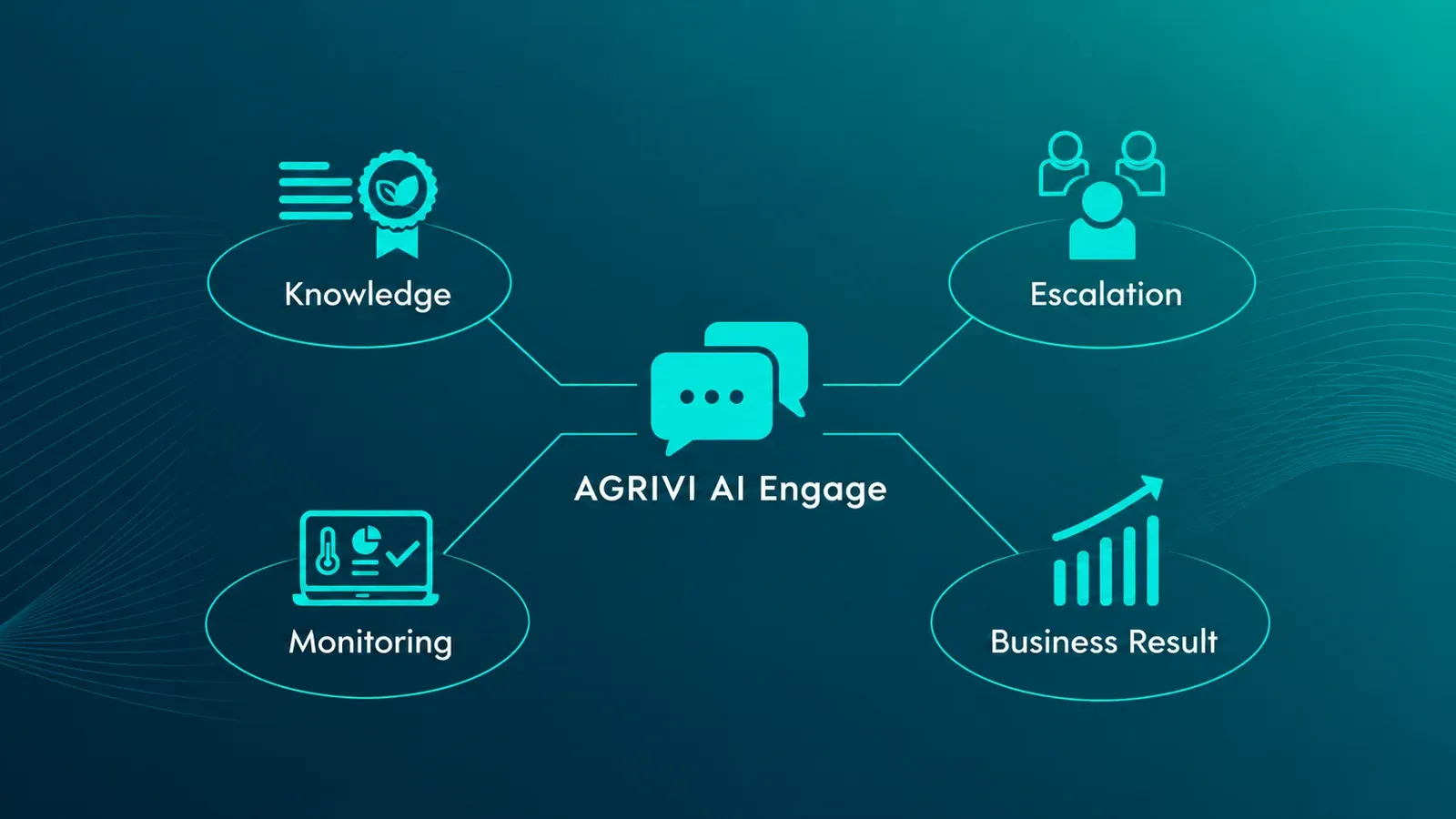
AGRIVI AI Engage is the AGRIVI platform within AI Workforce. It supports the configuration and operation of agriculture-specific Digital Agents around defined knowledge, channels and workflows. AGRIVI operates and supports the platform within the agreed deployment scope, while the customer approves knowledge, assigns internal owners and remains accountable for business decisions.
A Digital Agent may operate using AI Workforce storage, connect to supported existing enterprise systems or use AGRIVI 360 FMS context where relevant. The choice depends on the role and deployment; the category and platform are not interchangeable. For an overview of the architecture and available roles, see AI Workforce for Agriculture.
Frequently Asked Questions About AI Workforce Roles
What Is AI Workforce in Agriculture?
AI Workforce is a category for agriculture-specific Digital Agents that support defined business roles and workflows with approved knowledge, clear boundaries and human oversight.
Is AI Workforce the Same as AGRIVI AI Engage?
No. AI Workforce is the category. AGRIVI AI Engage is AGRIVI’s platform for deploying and supporting agriculture-specific Digital Agents.
What Makes a Digital Agent Operational?
A defined job, approved knowledge, a repeatable workflow, boundaries, an escalation route and measurable outcomes make the role operational. Each element needs an accountable owner.
Which AI Workforce Roles Does AGRIVI Offer?
The current approved roles are AI Agri-Input Sales Representative, AI Supply Chain Manager and AI Public Advisory Officer. Each has its own business tasks, knowledge and escalation requirements.
Does Every Farmer Conversation Need a Human Handoff?
No. Routine questions can follow approved answers or workflow steps. Human handoff is required when a case falls outside scope, lacks essential context or needs qualified judgement or approval.
Who Approves the Knowledge Used by a Digital Agent?
The customer is responsible for the substance of approved agronomy, product, commercial or public-service knowledge. AGRIVI supports implementation and controlled platform updates according to the agreed scope.
How Should a Business Measure an AI Workforce Role?
Track measures connected to the role, such as answer coverage, completed follow-up, qualified sales signals, grower responses, escalation quality or other defined operational outcomes.
Can an AGRIVI AI Engage Agent Work Without AGRIVI 360 FMS?
Yes. Depending on the deployment, an agent can use AI Workforce storage, integrate with supported existing systems or use AGRIVI 360 FMS context when relevant.
Published by AGRIVI. Editorial responsibility: AGRIVI Marketing & Communications.

Ready to digitalize your farm?
See how AGRIVI can help you apply these insights in your own operations.
Book a Meeting