
Pest Trap Detection Timing Decides Spray Economics in Specialty Crops
Key Takeaways – Pest Trap Detection Timing Pest trap detection timing in Mediterranean specialty crops decides whether a pest pressure event requires one spray or three. Pest populations in medfly,…
Barbara Busic
Key Takeaways – Pest Trap Detection Timing
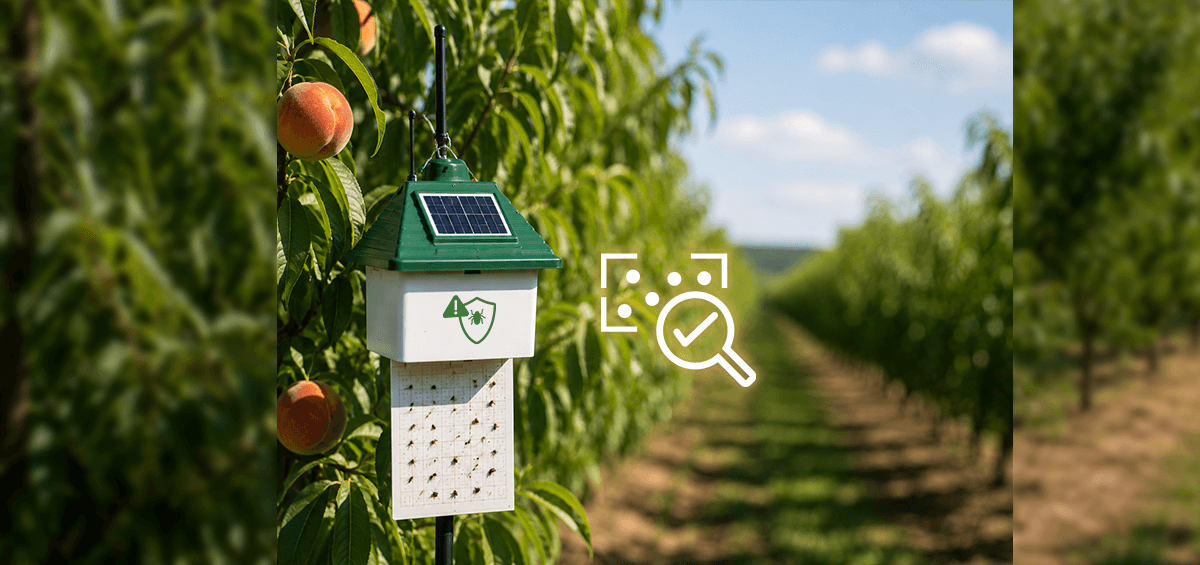
Pest trap detection timing in Mediterranean specialty crops decides whether a pest pressure event requires one spray or three. Pest populations in medfly, codling moth, and oriental fruit moth follow a 3 to 7 day exponential growth curve under warm conditions. Detection on day 3 allows precise, narrow-spectrum treatment. Detection on day 7 forces reactive treatment with broader products, often repeated. Electronic pheromone trap integration shrinks the detection window from days to hours. The economic difference per hectare between early and late detection ranges from 80 to 220 EUR per pressure event, before yield loss.
Pest trap detection timing is the interval between when a pest population begins building in a specialty crop field and when the monitoring system detects the pressure event and alerts the agronomist. According to the FAO Integrated Pest Management framework, detection timing is the single most consequential variable in spray economics for Mediterranean specialty crops. Poor pest trap detection timing determines whether treatment is preventive (one well-timed spray) or reactive (multiple broader-spectrum applications).
In Mediterranean fruit and tree operations across Spain, Morocco, and France, spray economics come down to a narrow window. Pest pressure builds fast under warm conditions. Consequently, the difference between catching it early and catching it late is measured in spray count, product cost, and yield impact.
The question for farm managers is not whether to monitor pest pressure. It is whether the monitoring system detects the pressure event quickly enough to keep treatment precise and economical.
Why Pest Trap Detection Timing Matters in Mediterranean Specialty Crops
Pest trap detection timing matters in Mediterranean specialty crops because the target pests follow exponential population growth curves under warm conditions. Moreover, a 3 to 4 day delay in detection can shift the population from manageable (one spray) to problematic (multiple sprays), and the economic difference per hectare compounds across the season.
Mediterranean specialty crops, including citrus, stone fruit, pome fruit, and olives, face a consistent set of key pests. Medfly (Ceratitis capitata) is the most economically significant pest in citrus and stone fruit across the region. Codling moth (Cydia pomonella) affects pome fruit. Oriental fruit moth (Grapholita molesta) affects stone fruit.
All three species share a critical trait: under warm Mediterranean conditions (sustained temperatures above 20 degrees Celsius), their population growth follows an exponential curve once the first generation begins emerging. Furthermore, the population that is manageable on day 3 is often unmanageable by day 7.
According to EPPO guidelines, the treatment threshold for medfly in citrus is typically 0.5 to 1.0 adults per trap per day. Early detection at or below this threshold allows targeted treatment. In contrast, late detection, when the trap count has already exceeded 2 to 3 adults per trap per day, requires broader treatment and follow-up applications.
The Pest Trap Detection Timing Window That Decides Your Spray Plan
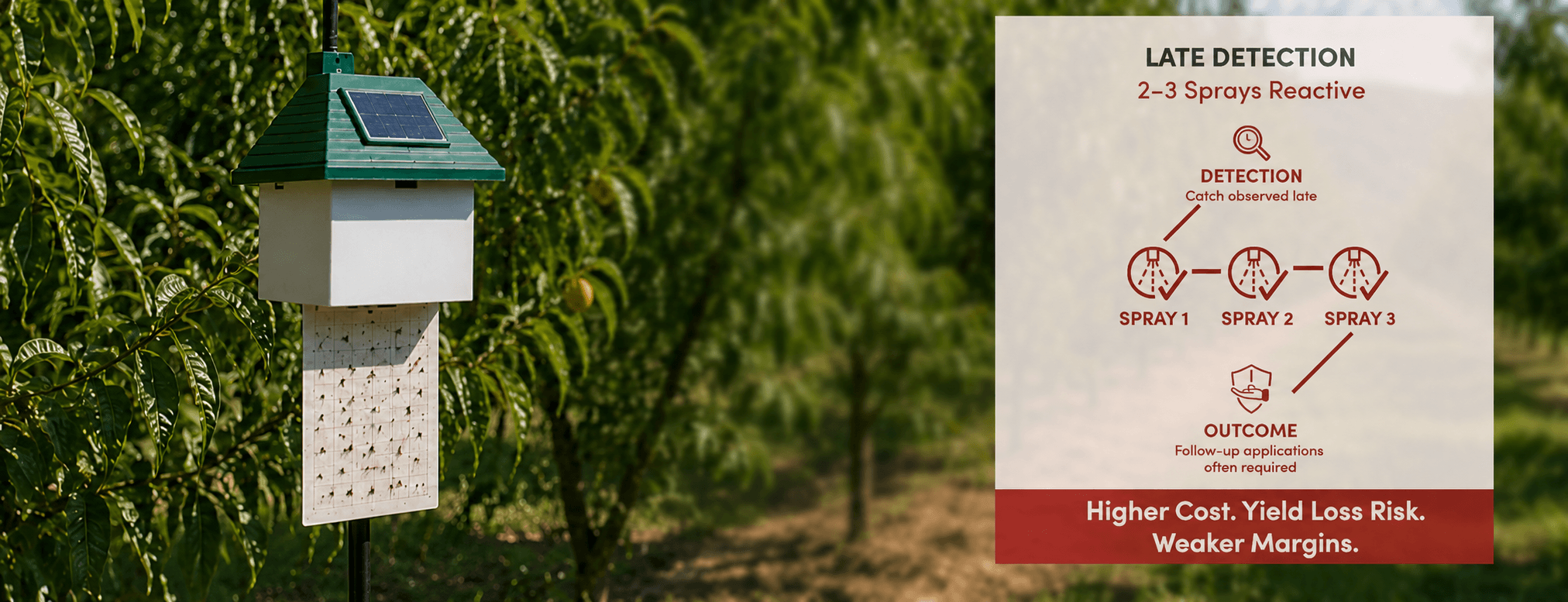
The 3-to-7-day window is the critical period between when a pest population reaches detectable levels and when it exceeds the treatment threshold for precise intervention. Detection within days 3 to 4 allows one narrow-spectrum spray. Consequently, detection after day 7 forces two or three broader-spectrum applications, higher product cost, and potential yield loss.
The growth dynamics follow a pattern documented in the Journal of Pest Science. Under favorable conditions, a medfly population can double every 2 to 3 days. A trap count of 0.5 adults per trap per day on Monday becomes 1.0 by Wednesday, 2.0 by Friday, and 4.0 by the following Monday. Each doubling narrows the farm manager’s treatment options.
At day 3 (0.5 to 1.0 per trap per day), the agronomist can treat with a narrow-spectrum bait spray targeting emerging adults. One application, precise timing, minimal non-target impact. This is the IPM-optimal response.
At day 7 or later (2.0 to 4.0 per trap per day), the population includes multiple life stages. The narrow-spectrum option is no longer sufficient. Therefore, the farm manager treats with a broader-spectrum product, applied at a higher volume. The agronomist frequently needs a second application 7 to 10 days later to catch the next generation. Total spray count: 2 to 3 instead of 1.
How Electronic Pest Traps Improve Pest Trap Detection Timing
Electronic pheromone traps connected to a farm management platform shrink the pest detection window from 5 to 7 days (manual scouting frequency) to 12 to 24 hours (automatic daily trap reads). The trap transmits catch count data daily. Additionally, the platform alerts the agronomist when counts approach the treatment threshold.
Manual scouting for pest pressure typically occurs once or twice per week. A scout walks the orchard, checks sticky traps, and records the catch. Under this system, the fastest possible detection cycle is 3 to 4 days. In practice, the farm detects the pressure at 5 to 7 days because scouting schedules do not align with the pest’s emergence timing.
Electronic pheromone traps (such as TrapView devices) capture and photograph the sticky surface automatically, typically every 6 to 12 hours. Image recognition software counts the target species. The data is transmitted to the farm management platform (such as AGRIVI 360 FMS), where the agronomist sees the count alongside weather data, scouting records, and historical pressure patterns.
This integration does not replace scouting. It adds a forecasting layer. The electronic trap provides early warning. The scout confirms the pressure and assesses the spatial distribution across the orchard. Together, they produce a treatment decision that is both timely and precise.
The Economic Comparison: Early Detection Versus Late Detection
Early detection (day 3) results in one narrow-spectrum spray at approximately 40 to 80 EUR per hectare. Late detection (day 7+) results in two to three broader-spectrum sprays at approximately 120 to 300 EUR per hectare, plus potential yield loss of 5% to 15% from fruit damage. As a result, the economic difference per hectare per pressure event ranges from 80 to 220 EUR.
The cost comparison is conservative. One narrow-spectrum bait spray for medfly in citrus costs approximately 40 to 80 EUR per hectare, depending on the product and application method. This treats the emerging adult population before it establishes itself.
A reactive treatment cycle triggered by late detection typically includes a first broader-spectrum insecticide application (60 to 100 EUR per hectare) plus a follow-up application 7 to 10 days later (60 to 100 EUR per hectare). In severe pressure events, a third application may be necessary. Total treatment cost: 120 to 300 EUR per hectare.
Additionally, late detection means the pest has been active in the orchard for longer before treatment. Fruit damage during this window reduces marketable yield. A 5% to 15% yield reduction in a citrus operation producing 40 to 60 tonnes per hectare at 0.30 to 0.50 EUR per kg translates to 600 to 4,500 EUR per hectare in lost revenue. Consequently, the detection delay is the most expensive variable in the spray plan.
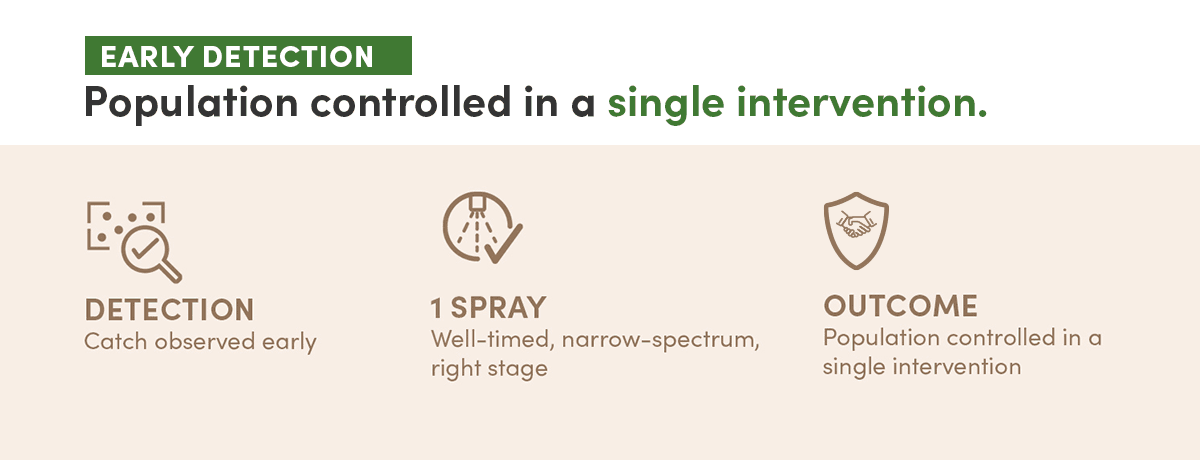
Factor — Early Detection (Day 3) — Late Detection (Day 7+)
Spray count — 1 — 2 to 3
Product type — Narrow-spectrum bait spray — Broader-spectrum insecticide
Treatment cost per hectare — 40 to 80 EUR — 120 to 300 EUR
Yield loss from delayed treatment — Negligible — 5% to 15%
Revenue impact per hectare (citrus) — Minimal — 600 to 4,500 EUR potential loss
IPM compatibility — High (targeted, minimal non-target impact) — Low (broad-spectrum, disrupts beneficial insects)
Pest Trap Detection Timing and IPM Integration
Pest trap detection timing is the foundation layer of an integrated pest management (IPM) strategy. Electronic monitoring provides the early-warning data that makes biological control, mating disruption, and targeted chemical treatment viable. Without timely detection, the farm defaults to calendar-based or reactive spraying, which undermines IPM principles and increases resistance risk.
IPM in Mediterranean specialty crops relies on a layered approach: monitoring for early warning, biological control as a first-line defense, mating disruption for key pests, and targeted chemical treatment only when thresholds exceed the limits. However, when detection is late, the farm bypasses the biological and mating-disruption layers and goes directly to chemical treatment. The treatment is broader than early detection would require, and this cycle, repeated over multiple pressure events, increases resistance pressure.
Electronic pest trap integration supports IPM by providing continuous monitoring data that keeps the agronomist ahead of the pressure curve. The trap data feeds into the farm management platform alongside weather forecasts and historical patterns. Therefore, the agronomist gains a forecasting capability that manual scouting alone cannot provide. The Farm Digitalization Assessment helps farms evaluate their current monitoring maturity and where electronic trap integration delivers the highest return.
Calculate the ROI of Better Detection Timing
The AGRIVI ROI Savings Calculator quantifies the economic impact of precision pest management for specialty crop operations based on your crop, region, and operation size. Use the ROI Calculator.
Frequently Asked Questions About Pest Trap Detection Timing
What Is Pest Trap Detection Timing?
Pest trap detection timing is the interval between when a pest population begins building in a specialty crop field and when the monitoring system detects it. According to the FAO IPM framework, detection timing directly determines spray frequency and economic outcome. Early detection allows for a precise spray; late detection forces multiple broader applications.
What Pests Are Most Affected by Detection Timing in Mediterranean Crops?
Medfly (Ceratitis capitata), codling moth (Cydia pomonella), and oriental fruit moth (Grapholita molesta) are the key pests where detection timing critically affects spray economics. All three follow exponential population curves under warm Mediterranean conditions, with populations doubling every 2 to 3 days.
How Do Electronic Pheromone Traps Improve Pest Trap Detection Timing?
Electronic traps capture and photograph the sticky surface every 6 to 12 hours. Image recognition counts the target species. The data is transmitted to a farm management platform where the agronomist sees counts alongside weather and historical patterns. This shrinks the detection window from 5 to 7 days (manual scouting) to 12 to 24 hours.
What Is the Economic Difference Between Early and Late Detection?
Early detection (day 3) costs 40 to 80 EUR per hectare for one narrow-spectrum spray. Late detection (day 7+) costs 120 to 300 EUR per hectare for 2 to 3 broader sprays, plus potential yield loss of 5% to 15%. Per pressure event, the cost difference alone ranges from 80 to 220 EUR per hectare before yield impact.
How Does Pest Trap Detection Timing Connect to IPM?
Detection timing is the foundation of IPM. Timely detection makes biological control, mating disruption, and targeted treatment viable. Late detection forces the farm to bypass IPM layers, increases resistance pressure, and disrupts beneficial insect populations. Additionally, repeated reactive spraying increases total seasonal input costs significantly.



Ready to digitalize your farm?
See how AGRIVI can help you apply these insights in your own operations.
Book a Meeting