
Farm Data Management: Records the Business Can Act On
Farm records become valuable when teams can use them to decide and act. Here are five tests for making agronomy, operations and economics work from reliable information.
AGRIVI
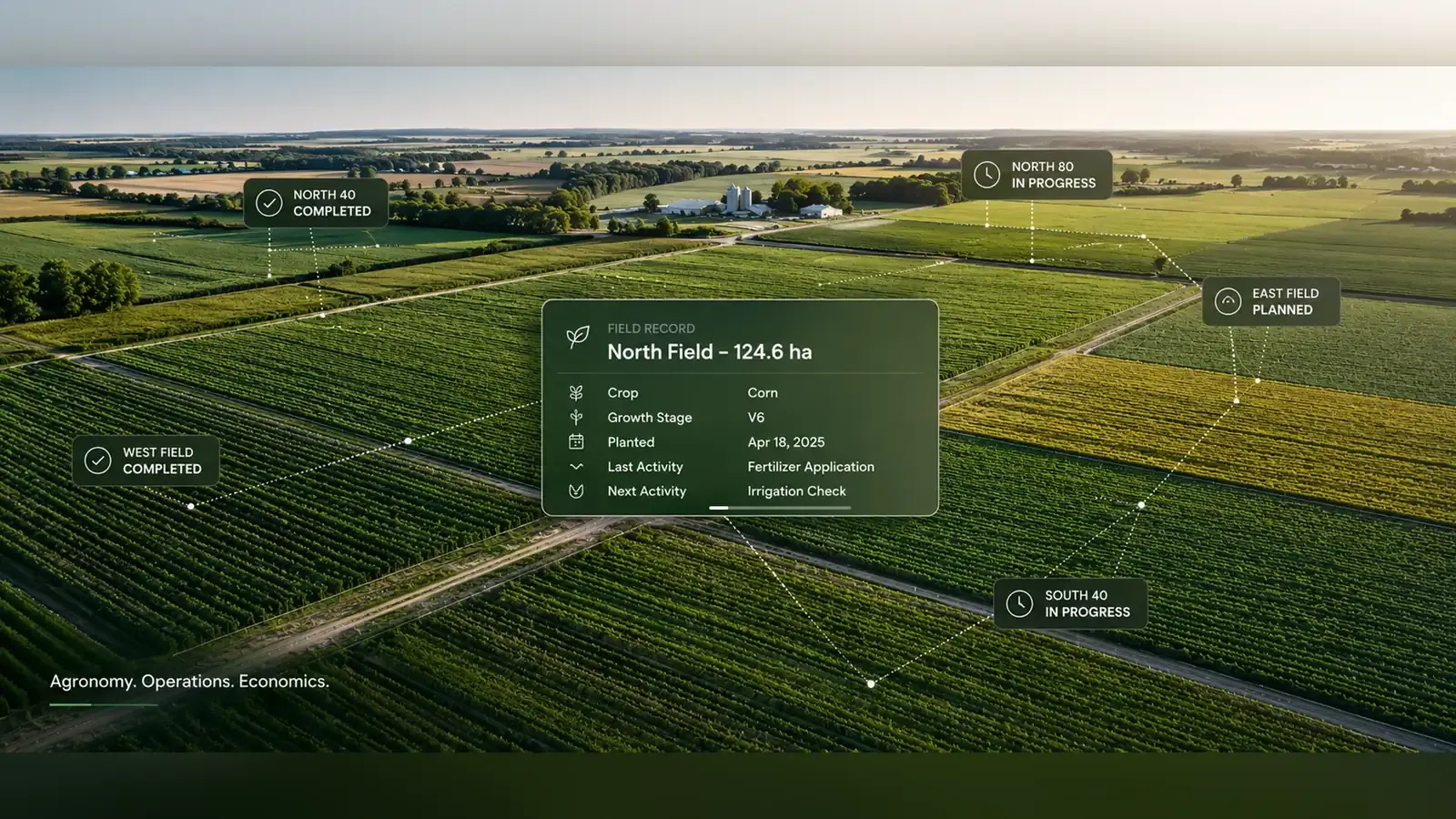
Farm data management connects field activities, crop information, people, machinery, inputs and costs so managers can act during the season. A useful farm record is current, shared, contextual, linked to economics and actionable. Its value lies in the decision or task it improves, rather than in how much information the farm stores.
An enterprise farm can collect thousands of records and still struggle to answer a simple question: Which field needs attention today, who owns the next action, and what will it cost? Reliable data is necessary, but timing, context and ownership determine whether it changes a decision.
At a Glance
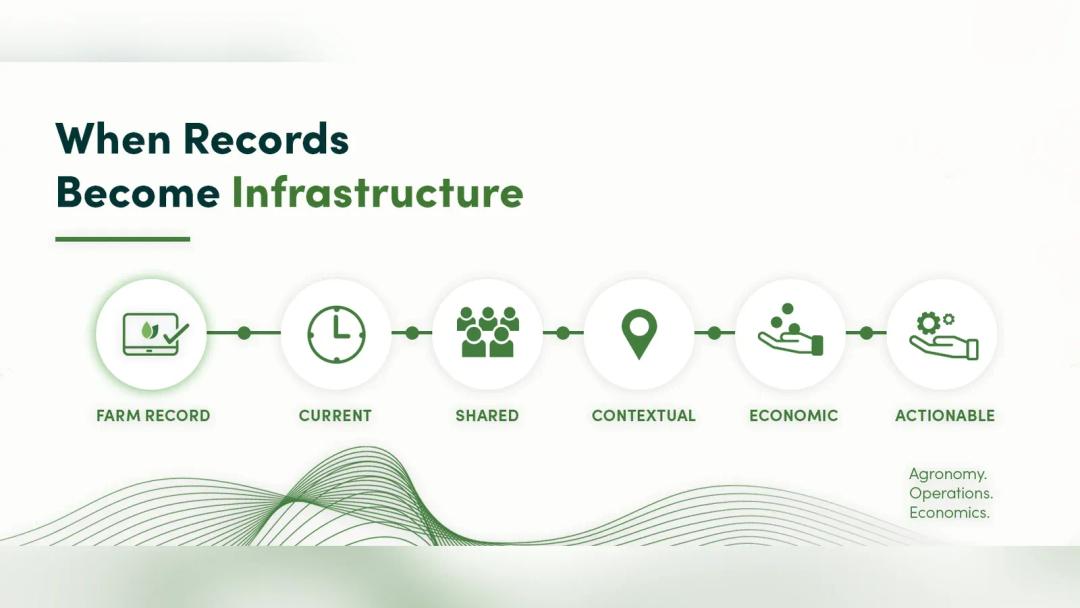
- Current: The record reaches the responsible team before the decision window closes.
- Shared: Agronomy, operations and finance can work from the same underlying event.
- Contextual: A field, crop, activity and date give numbers their operating meaning.
- Economic: Inputs, labour and machinery usage can be interpreted alongside costs.
- Actionable: The record supports a named decision, assignment or follow-up.
What Is Farm Data Management?
Farm data management is the structured collection, organization, maintenance and use of farm information for planning, field execution, analysis and reporting. It includes defining what is recorded, who is responsible for its accuracy, how information relates across teams, and when it becomes available to decision-makers.
The European Commission’s overview of agricultural digitalisation describes the range of data produced in agriculture, including land, crops, agronomy, climate, machines, finance and compliance. Having more sources increases the need to make their meaning consistent. The broad technologies behind this shift are explained in AGRIVI’s digital agriculture guide.
For an enterprise operation, a farm data management system should make the record useful beyond the person who entered it. That is the role of a farm management software platform connecting agronomic work with operational and economic information.
When Does a Digital Farm Record Become an Operating Record?
A digital farm record becomes an operating record when the business can use it to interpret the current situation and decide what happens next. Saving the date and dose of an application is useful for history; connecting that application to field status, remaining work, input usage and costs makes it relevant to in-season management.
Consider a crop-protection application. The original entry may show the product, quantity, field and date. For the operations team, it can also answer whether the assigned task was completed. For the agronomist, it adds context to the next field visit. For finance, it connects material usage and labour to a field or crop. AGRIVI’s guide to tracking farm costs by field explores that economic layer in more detail.
The operating record does not require every employee to see the same screen. It requires each role to work from consistent source information, with clear rules for updates, review and correction. The OECD’s 2020 paper on agricultural data governance identifies trust, access and data-management responsibilities as important considerations in agricultural digitalisation.
Which Five Tests Make Farm Data Management Actionable?
Five practical tests help a manager distinguish records that merely document work from records that support an operating decision. Each test can be applied to a field activity, cost entry, work order or harvest update.
1. Current: Is the Record Available While Action Is Still Possible?
A perfect entry completed several weeks later can support an audit, but it cannot help a farm manager respond to an unfinished irrigation task or an input variance today. Set a realistic time expectation for each critical record, based on the decision it supports.
2. Shared: Can the Right Teams Use One Trusted Version?
Agronomy, field operations and finance often need different views, but conflicting copies of the same activity create reconciliation work. The practical objective is shared source information with access and approval appropriate to each role. See how a shared operating record connects agronomy, operations and finance.
3. Contextual: Does the Record Explain What the Number Refers To?
An entry such as “18 litres used” is incomplete without the field, crop, activity, product and time period. Context makes records comparable across fields and seasons and helps teams investigate why a task or cost differed from plan.
4. Economic: Can Work Be Considered Alongside Resource Use and Cost?
Farm activities use labour, machinery, inputs and time. Linking these to the activity helps management compare planned and actual cost at a meaningful level. AGRIVI’s article on budget versus actual farm management explains why this matters before the season ends.
5. Actionable: Does the Record Lead to an Owner and Next Step?
If a record identifies a missed activity or unexpected expense, someone should be able to review it, assign follow-up and record the outcome. Otherwise the information remains descriptive. The goal is not to automate management judgment; it is to give people evidence and a dependable process.
How Do Agronomy, Operations and Economics Use the Same Farm Data?
One recorded field event can support three different management questions: Is the activity agronomically appropriate? Has the work been completed? What resources and cost did it involve? The information becomes more valuable when those questions can be answered from related records rather than reconstructed across spreadsheets.
This is particularly important in enterprise farming operations spanning multiple farms, crops or teams. A field manager needs task status and people. An agronomist needs crop and treatment history. A finance manager needs usage and cost allocation. Their views may differ, but source definitions should not.
In AGRIVI 360 FMS, the enterprise farm management software proposition connects crop planning, field execution, costs and agronomic context. It is a practical way to make the farm record part of operating work rather than a report assembled after the fact.
Why Does Timeliness Matter More Than Data Volume?
The amount of information collected is less important than whether the relevant information reaches the right person before a decision loses value. A season-end report may explain a cost overrun accurately. Only an in-season view creates an opportunity to adjust the next task, resource allocation or purchase.
For example, a manager reviewing completed work weekly may identify repeated delays in one block, while a month-end comparison may identify the same issue after its operational consequences have accumulated. Neither reporting frequency is universally correct. The right cadence depends on how quickly a decision must be made.
FAO describes agro-informatics as using agricultural information and technology to support targeted interventions and evidence-based decisions. At farm level, that principle translates into relevant, timely information linked to management responsibility.
How Does a Farm Record Turn Into a Decision and Action?
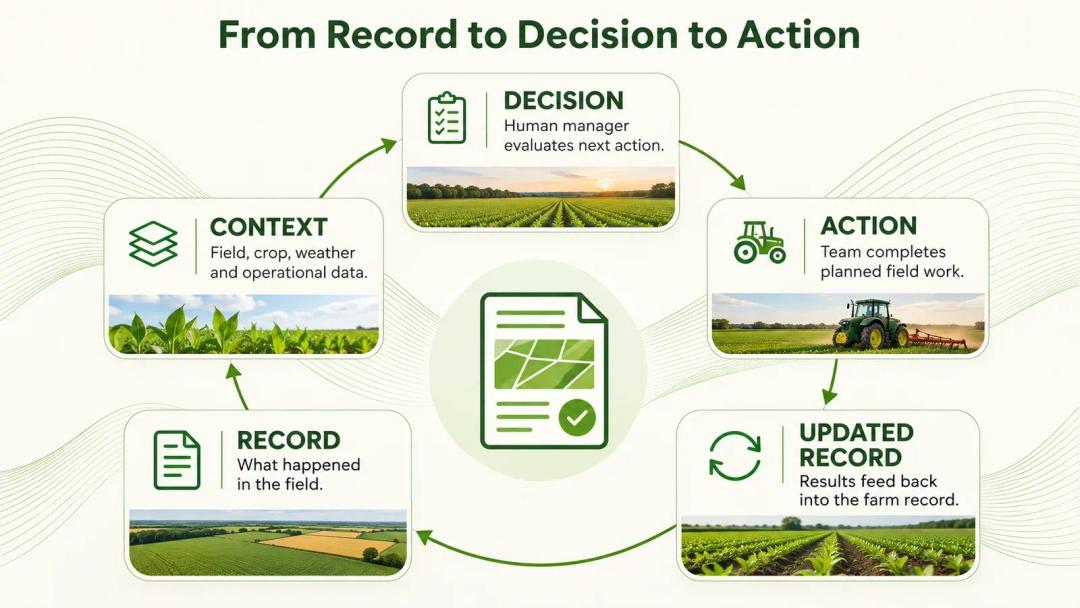
The operating loop is straightforward: Record → Context → Decision → Action → Updated Record. A task is recorded, considered alongside the field and crop situation, reviewed by a responsible person, acted upon, and updated with what actually happened.
- Record: A planned field task is marked delayed or incomplete.
- Context: The farm manager sees the field, crop stage, allocated team and scheduled input requirements.
- Decision: A responsible manager determines whether to reschedule, reassign resources or investigate a constraint.
- Action: The team completes the agreed work and records actual input and labour usage.
- Updated record: Completion and any variance become available for the next plan or review.
This process illustrates why farm work management depends on connected planning, execution and review. The AGRIVI 360 FMS enterprise-farms solution supports the relationship between field work and management visibility, while business owners remain responsible for decisions and approvals.
How Can an Enterprise Farm Assess Its Data Readiness?
Start with one high-value decision rather than an inventory of every spreadsheet or sensor. The readiness question is whether the existing records can reliably support that decision, through the people and processes the farm actually uses.
- Decision and timing: Which decision needs to improve, and when must the information be available?
- Source and definition: Which record supplies the answer, and does everyone interpret the data consistently?
- Ownership: Who enters, reviews and corrects the record?
- Operational handoff: What happens when the record identifies an exception?
- Economic link: Can the activity be related to input, labour, machinery or cost where needed?
For a fast first review, use the AGRIVI Farm Digitalization Score to examine where the operation still relies on paper or disconnected tools. If you are preparing a larger system rollout, the farm management software implementation guide provides a structured next step. These are different exercises: the score identifies gaps, while implementation work defines how to address them.
How AGRIVI 360 FMS Supports Farm Data Management
AGRIVI 360 FMS connects agronomic, operational and economic records in an agriculture-specific system of record and system of action. For enterprise farms, the value comes from keeping information close to planning and execution, so teams can respond while the season is still moving.
The AGRIVI 360 FMS farm management software family includes applications for enterprises managing their own production and, where appropriate, agriculture supply chains coordinating information across contracted growers. These are application areas of AGRIVI 360 FMS, not separate product names.
A practical illustration is AGRIVI’s AG Horticulture customer case study, which describes the use of work orders to capture daily field activities and related material or irrigation-water usage. The case is evidence of a particular customer workflow; it should not be read as a guarantee that every deployment operates identically.
Farm Data Management FAQs
What Is the Difference Between Farm Data Management and Farm Management Software?
Farm data management is the practice of collecting, maintaining and using farm information. Farm management software is a tool that can support that practice by connecting records with planning, field work, costs and reporting. Governance and operating responsibilities still need to be defined.
What Data Should an Enterprise Farm Record First?
Start with the data needed for a priority decision or workflow. Common examples are field and crop identifiers, planned and completed activities, input use, labour and machinery time, and relevant costs. Expand only when the data has a clear owner and purpose.
Does Farm Data Need to Be Real Time?
Not every farm record needs continuous updating. The relevant standard is decision timing: a work-status record may need frequent updates, while some planning or compliance records can be reviewed less often. The key is to avoid missing the window in which action is possible.
What Is a Shared Farm Operating Record?
A shared operating record is one underlying source of information that different teams can use through role-appropriate views. It reduces manual reconciliation between agronomy, operations and finance and makes changes easier to interpret consistently.
How Can Farm Data Improve Cost Control?
When field activities are linked to labour, input and machinery usage, managers can examine costs by field, crop or operation and compare them with plan. The information is most useful when a cost variance can still influence the next decision.
What Happens If Farm Data Is Incomplete?
Incomplete data should be identified explicitly rather than treated as a verified basis for a decision. A named owner can then confirm the missing source, correct the entry or adjust the scope of the analysis. Uncertainty should remain visible to whoever makes the decision.
How Do You Know Whether Farm Data Management Is Working?
Choose a few measurable operational indicators: record completeness, time from event to entry, time spent reconciling reports, completion of assigned actions and availability of cost information at the decision point. Compare these with the farm’s baseline rather than assuming that software adoption alone proves improvement.
Published by AGRIVI. Editorial responsibility: AGRIVI Marketing & Communications.

Ready to digitalize your farm?
See how AGRIVI can help you apply these insights in your own operations.
Book a Meeting