
Farm Management Software Implementation: Priorities for the First 90 Days
A practical 90-day operating framework for enterprise FMS implementation, from agreed farm records and real workflow testing to adoption in management decisions.
AGRIVI
Farm management software implementation can use the first 90 days to turn one agreed farm workflow into a dependable operating routine. The team defines records and ownership, tests actual fieldwork, and brings the results into regular management decisions. A 90-day plan is a practical planning framework, not a universal go-live promise.
For an enterprise managing several crops, locations and teams, this approach keeps attention on what employees actually do and what managers can verify. The aim is one credible change in working practice before the scope expands.
At a Glance
- Days 1-30: agree the first workflow, its records, owners and acceptance criteria.
- Days 31-60: use the workflow with representative teams, including delays and corrections.
- Days 61-90: make managers review current records and agree next actions.
- Measure completed work and decision value, not training sessions or logins alone.
- Expand the rollout only when the first process is reliable enough to repeat.
Why Is a 90-Day Plan a Framework Rather than a Deadline?
Implementation projects vary in data readiness, integrations, approval requirements, locations and scope. The first 90 days in this article describe three management priorities rather than the delivery duration promised by a software provider. A simple configuration may progress faster; a complex enterprise rollout may need a longer pilot or parallel preparation.
Before this operational period begins, the buyer should already have agreed its target business improvement. AGRIVI’s pre-configuration implementation guide explains the readiness decisions that belong before the rollout. Its 10-step implementation guide covers the wider delivery process. This article begins where those decisions turn into everyday farm work.
Choose One Workflow That Management Will Actually Use
A good initial scope has a clear record, a repeatable owner and a decision that needs current information. A crop-protection work order, irrigation maintenance, input use by field or weekly harvest preparation can all qualify. Choose one that the farm team can perform end to end, including exceptions, rather than configuring the largest number of screens.
For a multi-farm business, an initial pilot may operate across a small set of representative fields or sites. The important point is that AGRIVI 360 FMS for Enterprise Farms can be evaluated against the customer’s real farm and crop context, with explicit acceptance criteria. Farm and field definitions also need to be stable enough to support the workflow; see farm data management and record reliability for the underlying data requirements.
Days 1 to 30: Define the Workflow and Record
Start by mapping the selected workflow from the first decision to the final completed record. Identify the current entry points, the information managers need and the manual processes that will be replaced. Do not assume that importing existing spreadsheets fixes inconsistent definitions.
- Workflow owner: appoint the person who approves how work moves from planning to assignment, field completion and review.
- Record owners: agree who maintains fields, crops, activities, inputs, people, machinery, dates, status and exceptions.
- Configuration and permissions: agree what each role can enter, correct, approve and view within the confirmed scope.
- Acceptance test: write one realistic field scenario and specify the record and management decision it must produce.
The exit test for this phase is practical: can the team explain who will record a completed operation, how a change will be corrected and where a manager will see the current status? If those answers are unclear, further feature configuration will only hide the operating gap.
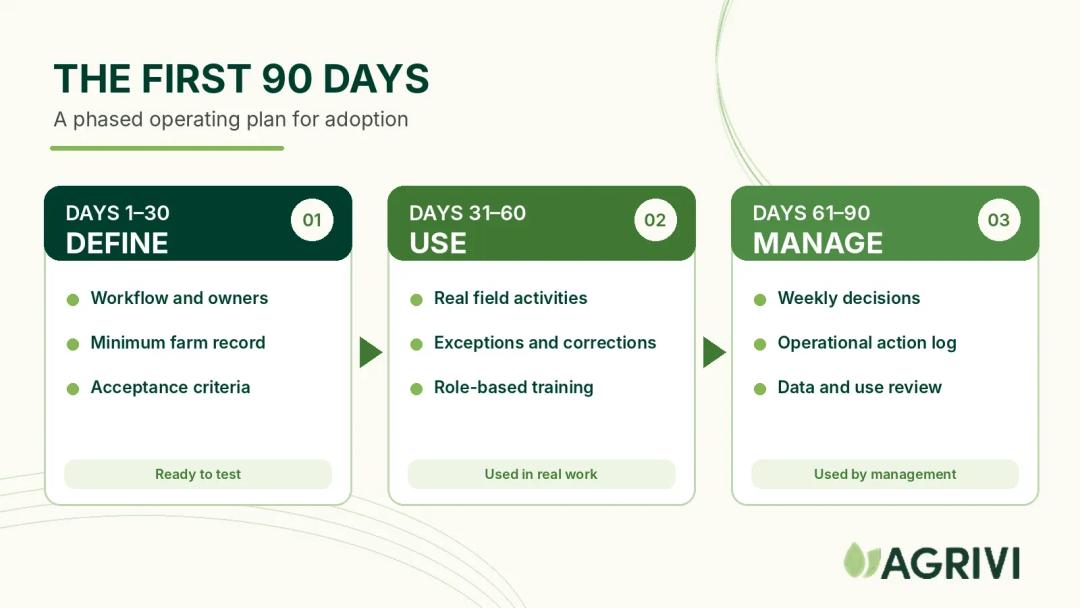
Days 31-60: Use the Workflow in Real Work
The second period tests ordinary field conditions and the exceptions that are usually missing from a demonstration. Representative field supervisors, agronomists and managers should record real activities and try to complete the process without rebuilding it in email or spreadsheets.
Training should be specific to the role and its actions. Field teams need to know how to confirm work and record a deviation. Agronomy needs to know how to review crop context. Operations needs to see the resource and timing effect. Management needs a record reliable enough to make a decision, while the project owner monitors gaps and fixes.
Consider a delayed crop-protection application. The pilot should show who changes the planned date, where the reason appears, what happens to resource assignment and how the changed field record becomes visible. For the management logic behind these decisions, Plan vs. Actual in Farm Management distinguishes between accepted, corrected and escalated variances.
At the end of this phase, the owner should be able to demonstrate complete tasks, genuine exceptions, relevant records and confirmed corrections. Training attendance alone is not evidence that this workflow works.
Days 61-90: Establish the Management Routine
The third period asks whether managers use the system consistently. Put the chosen workflow into a weekly operating review: compare planned and completed work, assess material exceptions, discuss the resource and cost effect where relevant, and assign owners for the next action.
A manager who asks for a separate spreadsheet after every meeting weakens the new process, even if employees have learned the software. Leaders should use the same source record as field and agronomy teams, request corrections where data is incomplete and close open actions at the following review. The shared operating record across agronomy, operations and finance explains the value of that continuity.
The AGRIVI 360 FMS platform can help keep field activity and management reporting connected as the customer builds this routine, within the agreed implementation scope.
For a multi-location enterprise, keep the test small enough for the local team to support while confirming that central management receives comparable definitions. The operational objective is a verified decision cycle, not a perfect-looking dashboard.
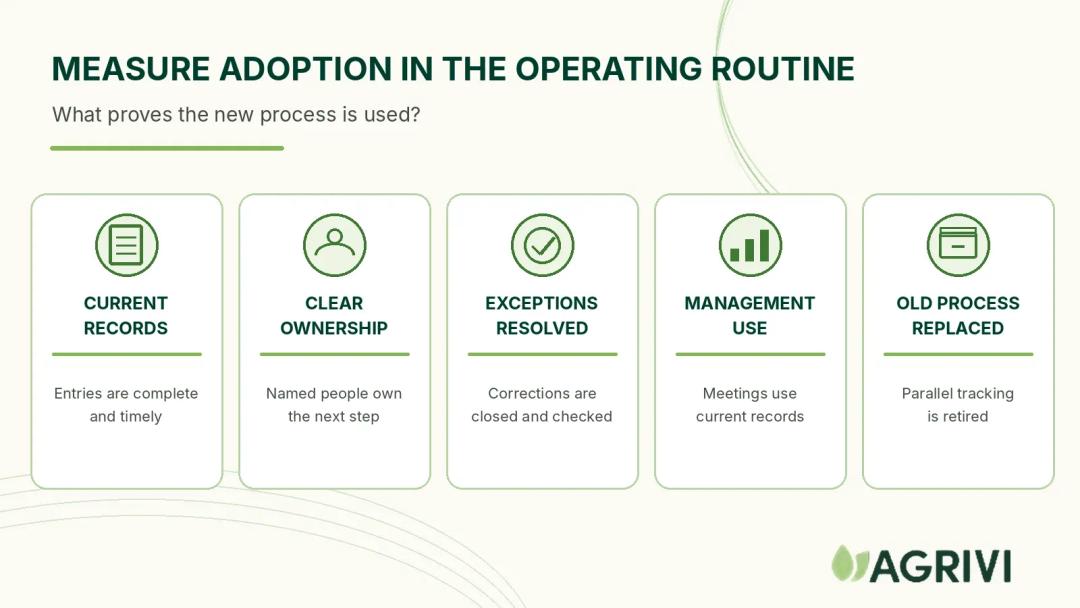
Measure Adoption in the Operating Routine
An implementation scorecard should describe observable behaviour and the person responsible for improving it. Keep the first scorecard short and review it weekly during the pilot.
- Record completeness and timeliness: The operating owner checks whether the activities needed for the chosen decision are recorded correctly and on time.
- Ownership: The process owner confirms that every exception has a named person and an agreed next action.
- Exception resolution: Operations or agronomy reviews which issues were corrected, accepted or left open with an explanation.
- Management use: The executive sponsor or regional manager confirms that recurring decisions use current system records.
- Replacement of old steps: The project lead documents which spreadsheet, email or manual reconciliation step is no longer required.
This focus on skills and operating adoption is supported by the European Commission’s 2025 agricultural digitalisation research, which identifies limited skills among barriers to adoption. The FAO digital agriculture programme likewise emphasizes training, piloting and capacity development. These are broader adoption observations, not evidence that a fixed 90-day rollout guarantees outcomes.
When Should the Next Implementation Phase Begin?
Expansion should be a decision after acceptance, not a date on a slide. A useful rule is that the agreed workflow is repeatable, the necessary records are current, people know who owns exceptions and managers have used the results in real decisions. Next scope may add another farm, crop, activity or economic measure, with its own defined acceptance test.
If the pilot exposes fragmented data or uncertain ownership, resolve that first. AGRIVI’s Farm Digitalization Score can provide a quick assessment of wider digital recordkeeping gaps, while farm management software evaluation standards helps clarify capabilities and delivery responsibilities for organisations still deciding how to proceed.
Where AGRIVI 360 FMS Fits
AGRIVI 360 FMS supports agriculture-specific planning, execution, field records, resources and farm economics. Its enterprise farm management capabilities connect these areas in one farm context, while AGRIVI’s implementation and adoption services support the agreed rollout. Actual scope, integration work, ownership and timetable are confirmed for each enterprise project.
For groups managing several farms or crops, the wider enterprise farms operating model explains how consistent processes and local field context can coexist. Technology provides the shared working environment; people still make decisions, correct records and follow through.
Frequently Asked Questions
What Should Be Implemented First in Farm Management Software?
Begin with one repeatable, management-relevant workflow such as field execution, input use or harvest preparation. Agree its owner and acceptance criteria before expanding.
What Should Happen in the First 30 Days?
Define the workflow, records, responsibilities, configuration and test scenarios. Resolve ambiguous data definitions before relying on them in management reports.
What Should Teams Test during Days 31-60?
Use real field activities and exceptions. Confirm that representative users can complete the workflow and correct records without reverting to parallel manual processes.
What Is the Priority during Days 61-90?
Make the records part of recurring management decisions and confirm that assigned actions are followed through.
Why Are Logins and Training Hours Insufficient Adoption Metrics?
They show exposure to the software, not whether the team enters useful records or uses them to make decisions.
Who Owns the Operating Change?
The customer owns business rules, data meaning, internal decisions and adoption. AGRIVI and any delivery partners support the agreed implementation responsibilities.
Does Every FMS Implementation Take 90 Days?
No. Ninety days is a planning framework in this article, not a standard contractual implementation duration. Actual timing depends on scope, data readiness, integrations and organisational complexity.
When Should the Rollout Expand to More Farms?
Expand when the first workflow meets its acceptance criteria, the team maintains reliable records and managers use those records consistently.
Published by AGRIVI. Editorial responsibility: AGRIVI Marketing & Communications.



Ready to digitalize your farm?
See how AGRIVI can help you apply these insights in your own operations.
Book a Meeting