
Farm Management Software Requirements: Turn Your 2026 Records into a Buying Brief
Turn the gaps in your 2026 farm records into a written requirements brief before speaking to software vendors. Five sections and a practical example show how.
AGRIVI

Farm management software requirements should start with the records and working practices that caused problems in 2026. A buying brief turns those findings into a written scope: what the business needs to do, what information must be available, who owns the process and how improvement will be measured in 2027.
Before contacting vendors, bring operations, agronomy, finance and IT together around a few actual examples from the season. A missing cost record or an incomplete harvest link gives the team a much clearer starting point than a list of attractive software features.
At a Glance
- Start with a real 2026 record, gap or recurring manual task.
- Write each requirement as a business need with an accountable owner.
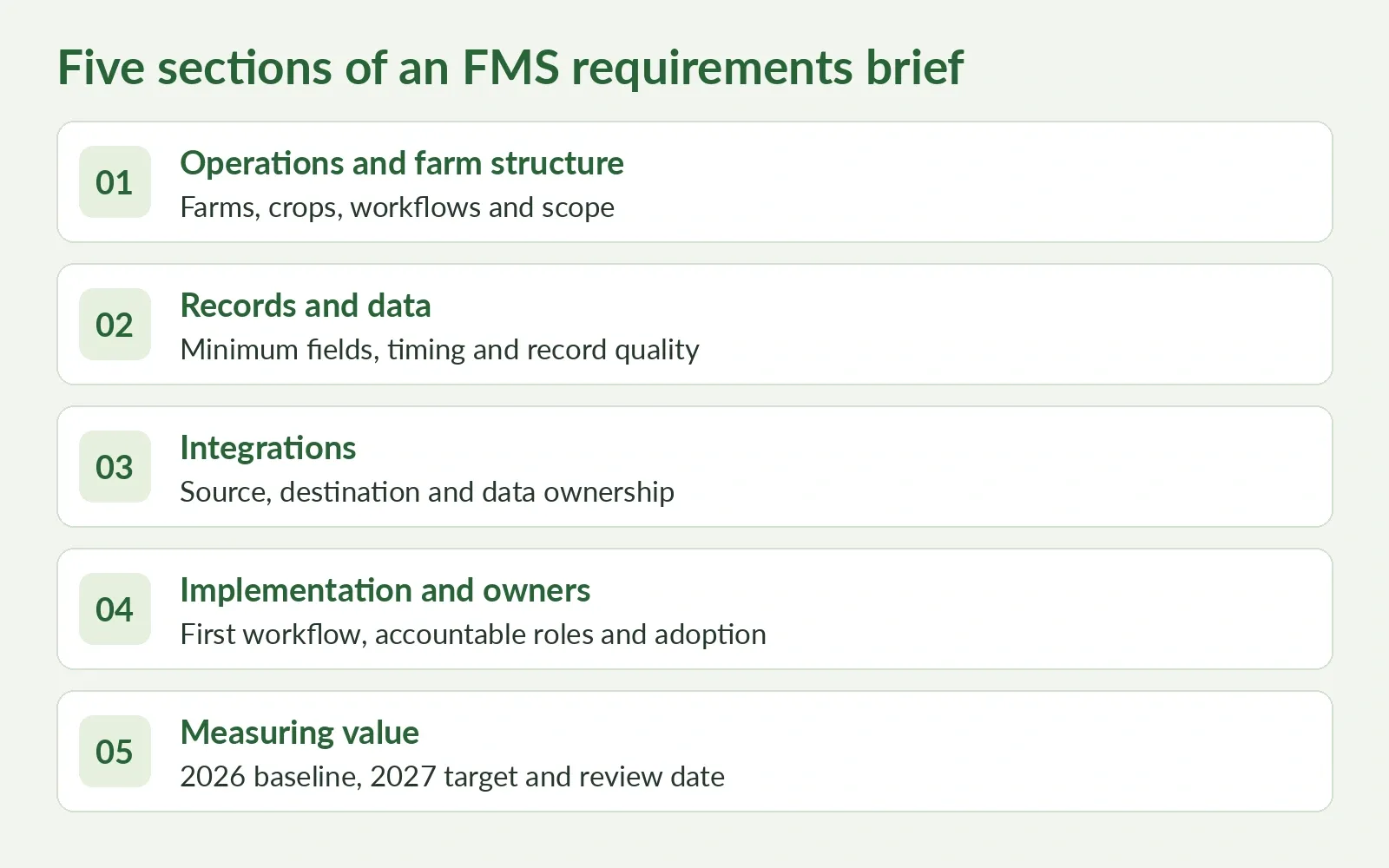
- Organise the brief into five sections: operations, records, integrations, implementation and value.
- Agree the initial scope and measurable outcomes before contacting vendors.
Why a Feature List Is Not a Requirements Brief
A feature list might say “cost reporting” or “mobile app”. It does not explain which cost report is needed, who prepares it, when it must be available or which field records feed it. A requirements brief gives the vendor that operating context and gives the buyer an agreed scope.
For every requirement, describe the current problem, the desired change, its priority, the owner and the evidence that will show the change has been achieved. Keep representative 2026 records alongside the brief. Remove sensitive information before sharing examples externally.
Start from What Your Records Already Showed
Budget preparation: if labour, inputs or machinery costs were reconstructed manually, identify the missing relationship between the activity and its cost. The 2027 farm budget planning article provides the starting records. Specify the reporting level and the time at which finance needs that information.
Traceability: if a sample recall exercise exposed missing links between growers, fields, treatments and harvests, document the records and relationships needed. For businesses with contracted farms, specify which evidence must be supplied through the agriculture supply chain and where traceability and compliance records must be available.
Farmer reach and follow-up: if production updates were missed because a coordinator could not reach every contracted farm, define the required grower update, its timing and the responsible person. Keep broader sales reach and advisory conversations in a separate AI Workforce or communication scope unless they directly support production records.
Five Sections Every FMS Requirements Brief Needs
- Operations and farm structure. List the farms, regions, crops, fields and business units in scope. Describe the workflows that must change, including who plans, performs, checks and approves work. Specify whether the first scope covers own farms, contracted growers or both.
- Records and data. List the minimum records needed for those workflows: activities, inputs, labour, machinery, crop status, harvest and costs where applicable. Define the required detail, timing, correction process, access and retention. Identify which historical records should be migrated.
- Integrations. For each exchange, name the source and destination, record identifier, frequency and accountable data owner. For example, specify how completed field activities relate to cost postings in the ERP. Record what must be connected initially and what can follow later.
- Implementation and owners. Name the sponsor, workflow owners and first user groups. Define which routine must be operating before the next season, the training responsibility and the acceptance conditions. State operational deadlines and dependencies rather than assuming a fixed implementation duration.
- Measuring value. Choose a 2026 baseline and a 2027 target for each priority. Use measures that match the problem: reconciliation hours, late records, completeness of harvest links or time to prepare a report. Assign an owner and a review date.
For the integration boundary, see how ERP and farm management systems work together. For an example of how enterprise operations can be scoped, explore AGRIVI 360 FMS for enterprise farms.
A Practical Example: Write One Requirement
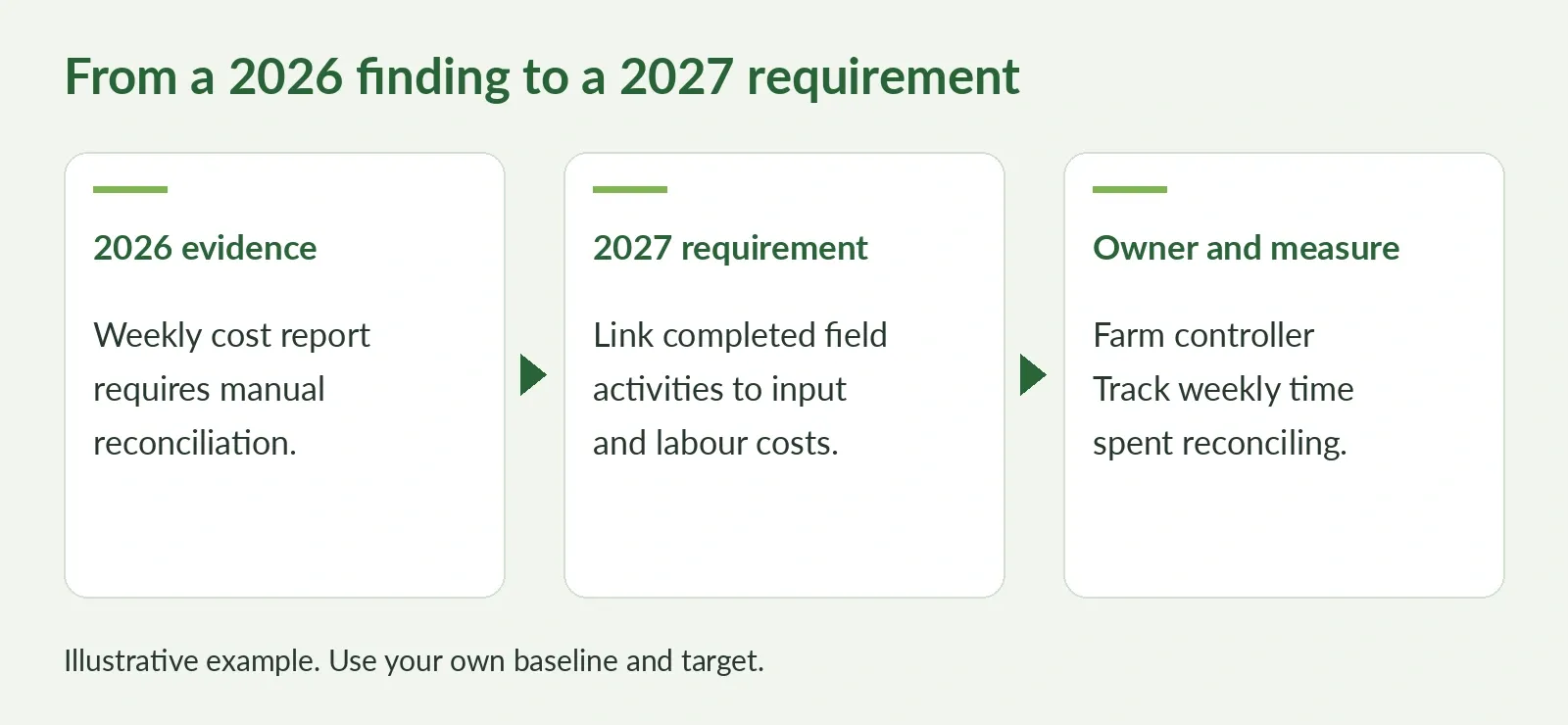
Imagine a farm controller spends part of every weekly review reconciling work records and costs. The example below shows how to turn that finding into a requirement. The figures are illustrative, not AGRIVI customer results.
- 2026 baseline: four hours per week spent reconciling input and labour costs.
- Requirement: completed field activities must be linked to their input quantities and labour costs before the weekly review, with corrections traceable to the original record.
- Owner: farm controller, supported by operations.
- Priority: must have.
- Acceptance: reproduce a weekly cost report from a representative set of completed activities.
- 2027 target: reduce reconciliation to one hour per week, measured over four comparable weeks.
What to Leave Out
Remove generic features with no operating reason, duplicates inherited from an old system and requests with no accountable owner. Separate must-have requirements from later improvements. Keep an open-questions list for genuine uncertainties, such as unavailable historical data or an integration dependency.
Do not turn the brief into a vendor scorecard, a full technical specification or an implementation schedule. Those documents become useful later. The brief should give each of them a consistent starting point.
From Brief to Shortlist
Once the project team has approved the brief, use it to inform the next stage of choosing farm management software. The seven enterprise evaluation standards explain how to test reliability during evaluation. After selection, the first 90 days of FMS implementation describe how agreed workflows can become working routines.
AGRIVI 360 FMS connects agronomy, operations and economics in one agriculture management system. Explore the AGRIVI 360 FMS overview to understand the scope of the platform. The ROI & Savings Calculator can help quantify the potential value of the priorities in your brief using your own figures.
For the full purchasing process, download How to Buy Farm Management Software in 6 Steps. Its requirements chapter helps the project team move from business needs into vendor selection and budgeting.
Frequently Asked Questions
What Are Farm Management Software Requirements?
They are written descriptions of the workflows, records, integrations, responsibilities and business outcomes a farm needs its software to support.
Who Should Write the Requirements Brief?
The project sponsor should coordinate operations, agronomy, finance and IT. Include quality and grower coordination teams where their work is in scope.
How Detailed Should an FMS Requirements Brief Be?
Detailed enough to describe the operating problem, desired workflow, required records, priority, owner and measurable outcome. Leave technical design decisions for later validation.
Can We Write Requirements If Our 2026 Records Are Incomplete?
Yes. Record the missing information and how it affects the business. Use available samples and label uncertain baselines rather than inventing numbers.
Published by AGRIVI. Editorial responsibility: AGRIVI Marketing & Communications.

Ready to digitalize your farm?
See how AGRIVI can help you apply these insights in your own operations.
Book a Meeting