
Farm Traceability: From Field Records to the Supply Chain
Reliable product traceability begins while crops are still in the field. This guide shows how production and harvest records connect to sourcing, lots and buyer evidence.
AGRIVI
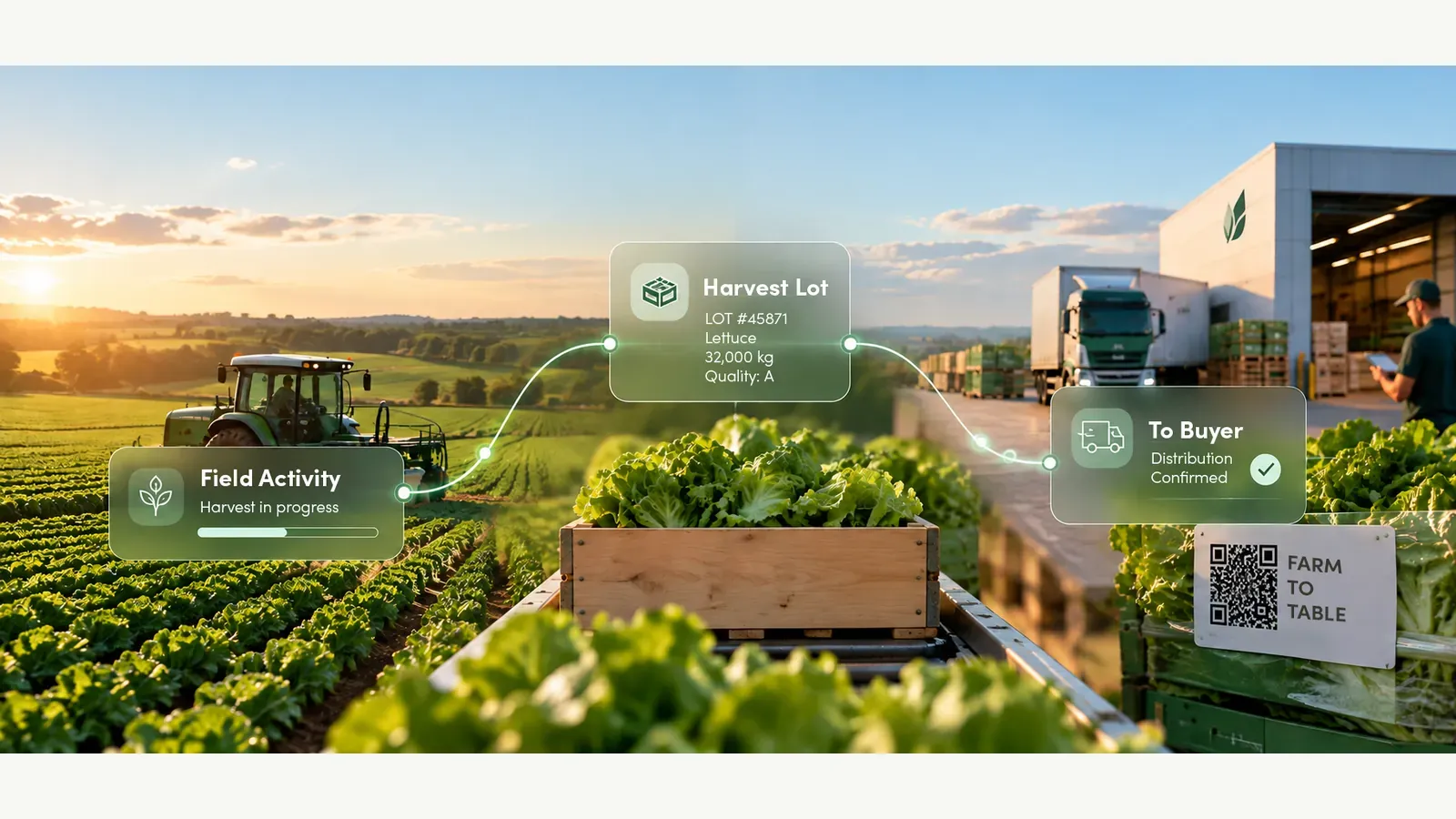
Farm traceability links crops, fields, production activities, input applications and harvest events to the lots that enter the food supply chain. It works when information is captured during farm operations, linked to the correct harvest identity and accessible to the teams responsible for sourcing, quality and product records.
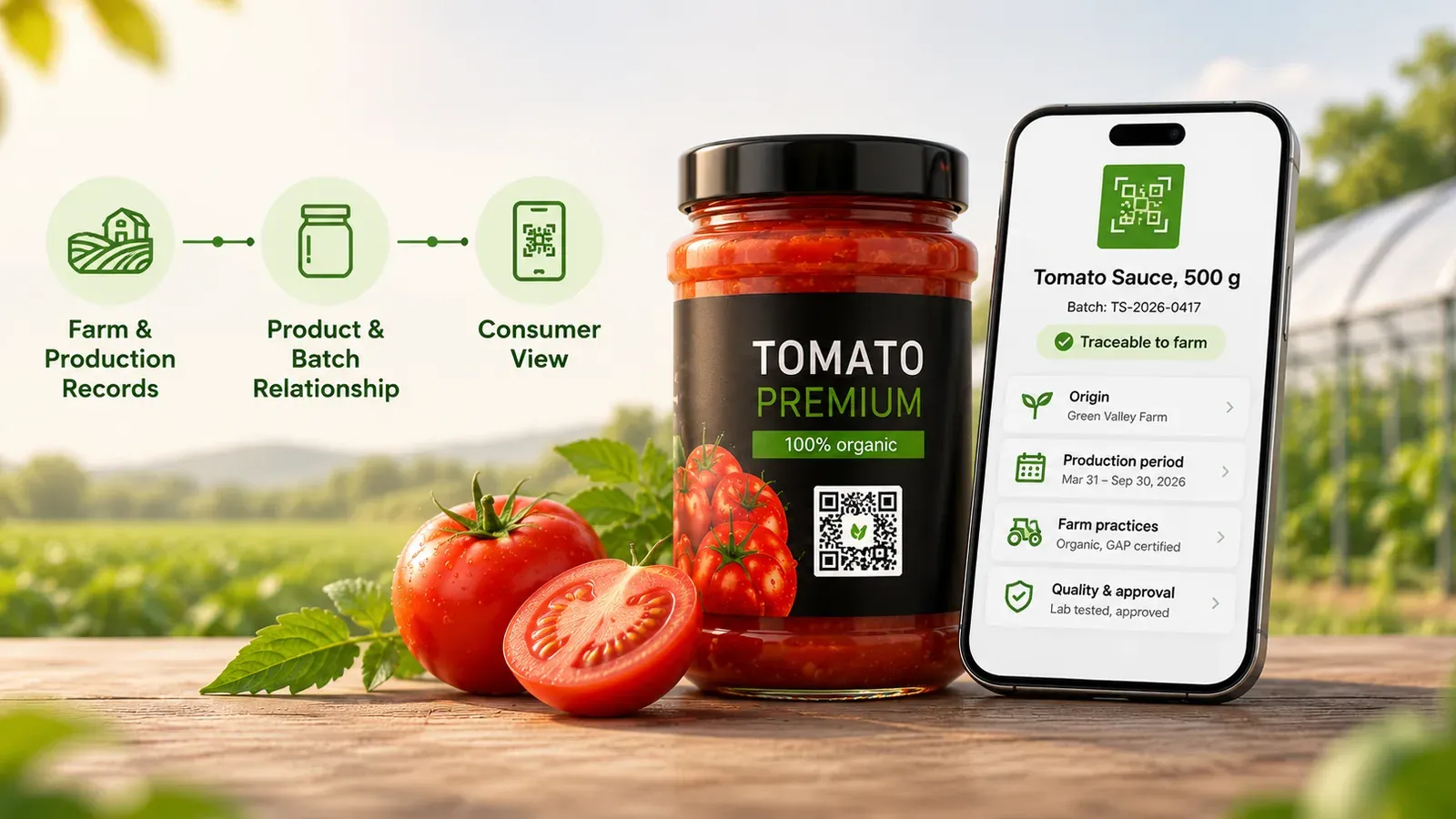
For a food company, tracing a finished lot back to a supplier is only part of the task. The harder question is whether that lot connects to credible production history: where the crop grew, which activities occurred and what the grower recorded before harvest. This guide focuses on that source record and its transfer to buyer systems. For the full product and consumer perspective, see our food product traceability guide.
Farm Traceability at a Glance
- Start at the source: connect farm, field or block, crop, season and grower identity.
- Record relevant inputs, agricultural work, dates and responsible parties during the season.
- Link each harvest event to a lot or other identifier used in the product journey.
- Preserve relationships when produce is pooled, split, processed or repacked.
- Test retrieval from a buyer lot back to the original field and production records.
What Is Farm Traceability, and Where Does It Start?
Farm traceability is the ability to follow agricultural production from an identified source through the farm events that produced a crop and into the harvest record. It starts when a farm or grower establishes reliable identifiers for fields, crops and seasons, then records what actually happens there.
A code applied after harvest can identify a lot, but it cannot recreate missing dates, input applications or grower decisions. That is why an agricultural traceability program depends on everyday field records. The broader agricultural traceability overview explains how the source record fits into a complete farm-to-consumer chain.
The operating question is straightforward: if a processor or retailer asks about one received lot, can the organization locate the corresponding production records without searching separate notebooks, messages and spreadsheets?
Which Farm Records Make Traceability Possible?
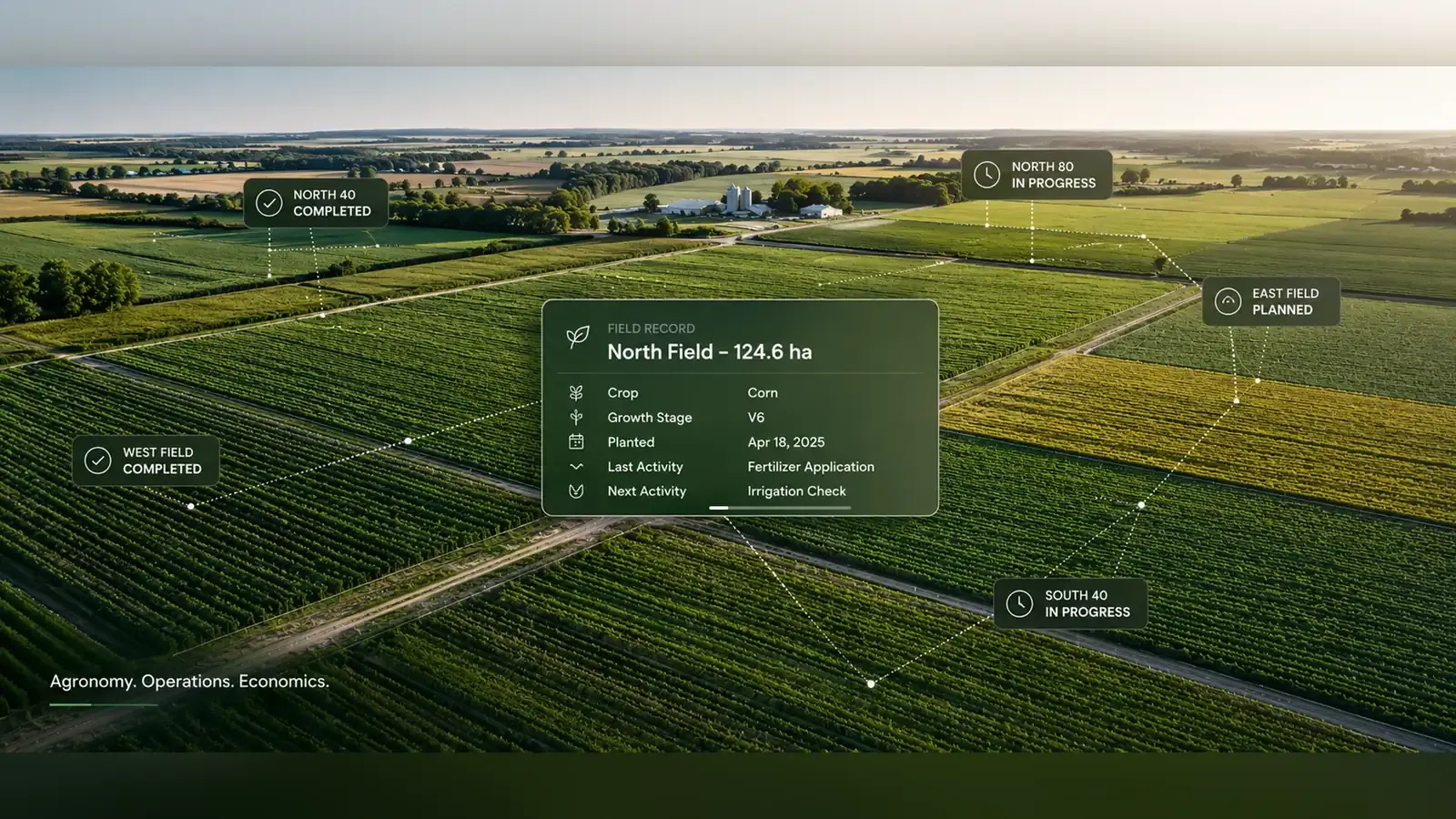
A useful farm-level traceability record connects identity, activities, inputs and harvest. The exact information depends on the crop, market, customer requirements and applicable rules, so no single list should be presented as universally sufficient.
- Source identity: grower or farm identifier, field or block, crop or variety, and production season.
- Production activity: activity type, date, responsible team and the field where the work took place.
- Inputs and use: relevant crop-protection and nutrition applications, quantities and product references, subject to the required detail.
- Observations and evidence: scouting findings, crop condition, applicable documentation and review or approval status.
- Harvest connection: harvest date, field, crop, quantity, receiving point and the lot identifier or mapping rule used by the buyer.
For an enterprise farm managing multiple fields and harvest crews, farm management software for enterprise farms can provide a structured agriculture-specific operating record. The broader challenge of keeping those records current and useful during the season is covered in our farm data management guide.
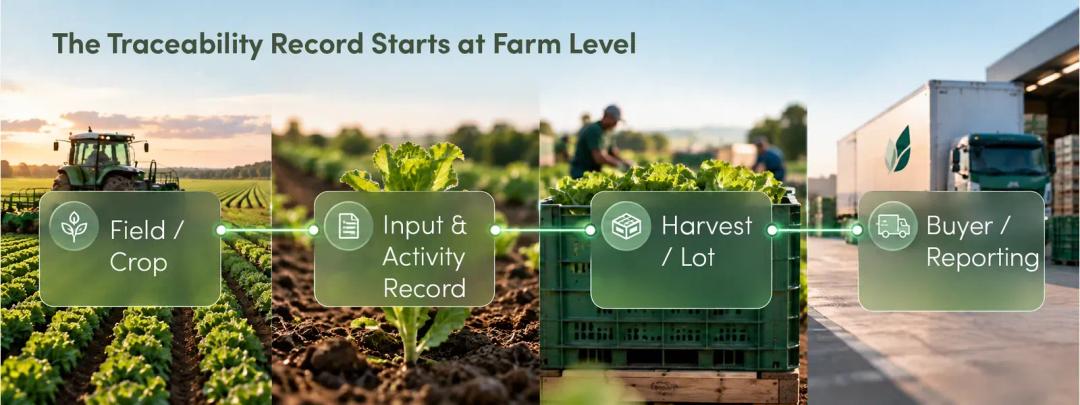
How Do Farm Events Connect to Harvest Lots?
The harvest event is the key relationship between the field record and the product that enters the supply chain. A reliable model associates harvested quantity with its source and establishes the identifier used when that material is received, transported or consolidated.
Consider a grower harvesting tomatoes from two blocks on the same day. If each block is tracked separately, the receiving lot can reference the correct field activity and input history. If the material is combined, the business needs a documented many-to-one relationship rather than an unsupported statement that the lot came from one field.
The same principle applies when one harvest lot is split into several shipments or when a processor combines deliveries. The traceability design needs to retain the connections across those transformations. A one-to-one relationship should never be assumed when physical product flows are more complex.
Where Farm Traceability Breaks
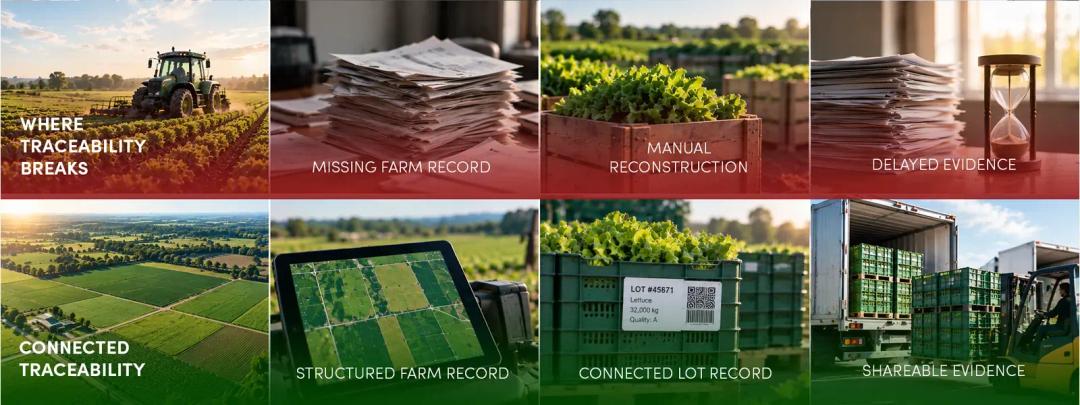
Farm traceability breaks where a product identifier cannot be connected back to a complete, dependable production record. Common causes include missing field identifiers, input entries recorded late, harvest lots created without source mapping and data stored in systems that do not share identifiers.
When the record is incomplete, sourcing teams request spreadsheets, quality teams chase dates and growers reconstruct an event from memory or messages. That can delay evidence retrieval and increase uncertainty. Capturing a record while work happens is generally more dependable than rebuilding it only after a buyer requests proof.
A practical test is to select a real received lot and follow its connections backward. Identify the farm, block, crop, harvest event and relevant activities. Record every missing identifier, manual handoff and unanswered ownership question. Those gaps show where the operation needs a stronger workflow, not simply another reporting format.
What Do GS1, EU and US Rules Mean for Farm Records?
Traceability standards and regulations establish requirements for identifying and retrieving information, but the exact scope depends on the food, market and company role. Farm businesses should distinguish a general traceability architecture from a legal claim of full compliance.
The GS1 Global Traceability Standard provides a framework for identifying traceable objects, recording events and sharing relevant information across partners. In the EU, Article 18 of Regulation (EC) No 178/2002 establishes traceability across stages of food production, processing and distribution, while additional sector rules may apply.
In the United States, the FDA Food Traceability Rule introduces additional event and data requirements for specified foods and covered entities, including harvesting as one of its critical tracking events. The FDA also describes changes affecting the enforcement timetable. Businesses should verify the latest requirements for their own products and market rather than treat a general article as a compliance checklist.
These frameworks reinforce a practical point: a downstream traceability system is only as useful as the source identity and event relationships it can retrieve.
What Should Food Companies Ask Their Grower Networks?
A buyer should test how farm information is created, linked and retrieved before committing to a traceability rollout. The questions below focus on the parts of the system that are easiest to overlook during procurement.
- Which fields, crops, seasons and growers can be identified consistently across all suppliers?
- Who records production activities and input use, and when are those records validated?
- How does a farm harvest record connect to the lot reference used by the packhouse or buyer?
- What happens when several farms contribute to one commercial or processing lot?
- Which records can quality and procurement retrieve without asking growers to enter the data again?
- Who owns corrections, exceptions and missing-data follow-up?
Food and beverage businesses managing contracted growers need a clear route from on-farm events to sourcing decisions. The AGRIVI 360 FMS agriculture supply chain capabilities address this farm-forward coordination, while the Food & Beverage industry overview explains the wider grower network context. For additional operational detail, see our article on agricultural supply chain management.
How Can AGRIVI 360 FMS Support Farm-Level Traceability?
AGRIVI 360 FMS supports farm traceability by connecting field-level production records, inputs, work and harvest information with the traceability processes used by agricultural and food businesses. Its traceability and agriculture supply chain capabilities work within the same FMS environment, so the production record remains connected with the workflows that created it.
Within AGRIVI 360 FMS, production information can be managed in the same agriculture-specific operating environment used for planning and execution. Its traceability and compliance capabilities connect farm and field records to harvest and product relationships. Where companies coordinate multiple growers, the agriculture supply-chain application supports connected sourcing information and production visibility.
A traceability workflow should also support fast retrieval when quality teams investigate an affected product. Our product recall management guide explains the downstream process that depends on accurate source and lot connections.
How to Start with One Crop and One Traceable Lot
A practical implementation begins with a narrow, testable journey rather than a company-wide documentation project. Choose one crop and buyer flow, map its actual records and prove the source-to-lot connection before expanding.
- Define the product journey: grower, farm, field, harvest, receiving point and buyer lot.
- Identify the information that quality, sourcing and customer teams need at the end of that journey.
- Map each required fact to the person and system that creates it during normal work.
- Specify the identifiers and rules for pooling, splitting or transferring material between lots.
- Test a backward trace from a received lot to its field and input records, and record the gaps.
- Agree how missing data is corrected and how the workflow will scale to more growers and crops.
When the source record works, the company can extend it to broader supplier assurance, retail sourcing and transparency and selected product information.
Farm Traceability FAQs
What Is Farm Traceability?
Farm traceability links an identifiable farm, field, crop and season to the production activities and harvest lots associated with that source. It supports retrieval of origin and production history when the product moves downstream.
What Records Are Needed for Farm-Level Traceability?
Typically, the record includes farm and field identity, crop and season, relevant input and activity entries, and a harvest-to-lot relationship. The exact required fields depend on the product, market, customer and applicable rules.
Why Must Traceability Begin Before Harvest?
Production activities and inputs occur before harvest. If they are not recorded as part of routine work, a lot code created later cannot reliably reconstruct them.
How Should Harvest Lots Connect to Farm Records?
Each harvest lot should be linked to its source field, crop, date and the production history that applies to the material. When produce is pooled or split, the system must preserve the relevant source-to-lot relationships.
Can Several Fields Be Connected to One Lot?
Yes, if the physical product flow is documented and the lot record retains the connections to all contributing sources. Treating a combined lot as if it came from one field would misrepresent its history.
How Does Farm Management Software Help Food Buyers?
Farm management software can create structured agricultural records as work occurs and make relevant history available for harvest, supplier and quality workflows. Buyer systems still need clear identifiers and responsibilities for exchanging those records.
Does Farm Traceability Software Guarantee Regulatory Compliance?
No. Software can support required records and retrieval, but legal obligations vary by market, product and role. Businesses must validate their own requirements, controls and evidence with qualified advisers.
Published by AGRIVI. Editorial responsibility: AGRIVI Marketing & Communications.
Ready to digitalize your farm?
See how AGRIVI can help you apply these insights in your own operations.
Book a Meeting