
AI Agronomy: How to Scale Farmer Advice with Expert Control
How can agri-input companies and public advisory programmes reach more farmers without adding the same number of one-to-one expert conversations? This guide defines the operating model, safeguards and metrics.
AGRIVI
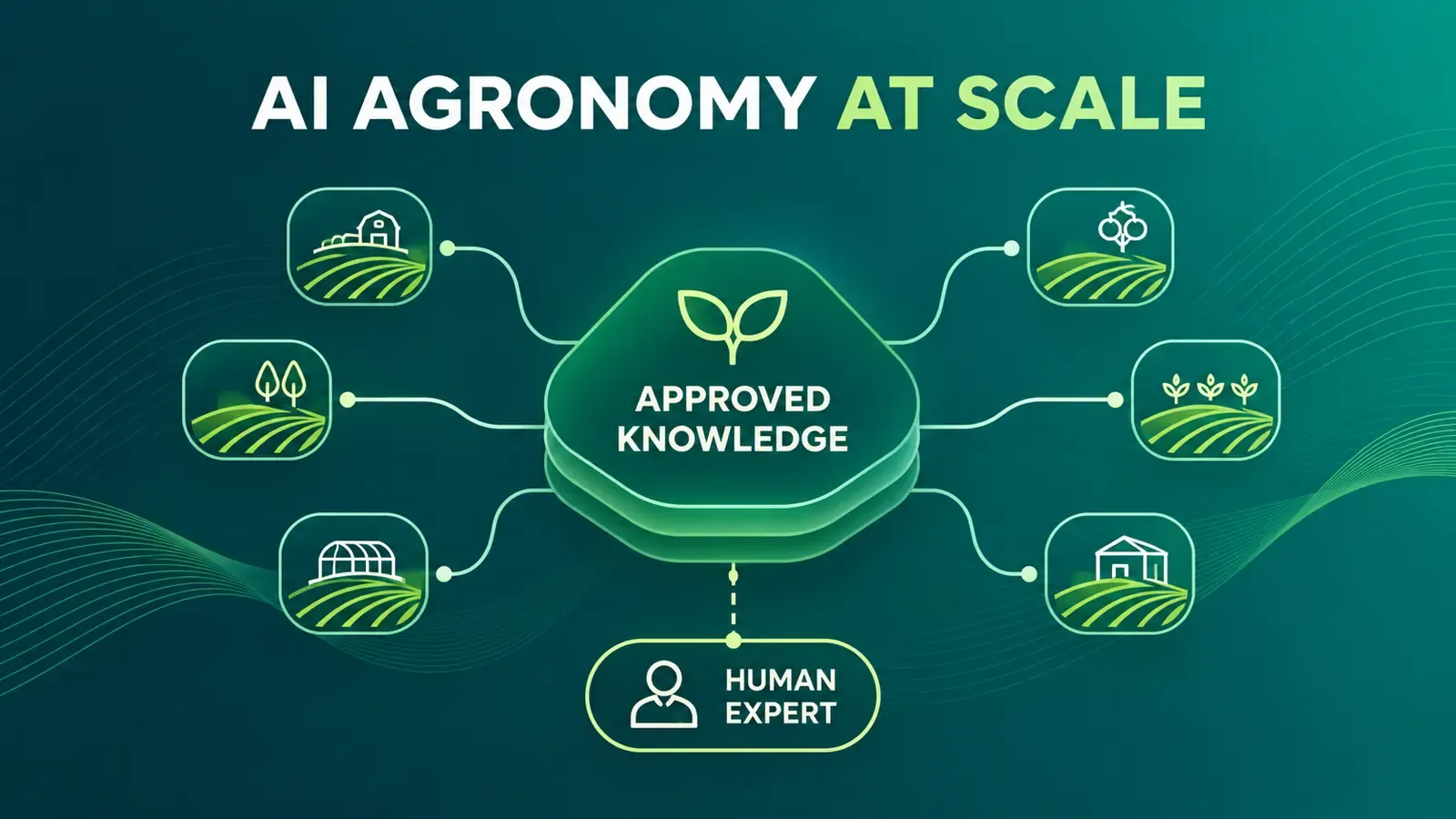
AI agronomy can expand the number of farmer conversations an organisation supports by making approved knowledge available through Digital Agents. The capacity gain depends on reliable sources, local context, clear workflow ownership and a defined human escalation route. It should be measured through farms reached and follow-up completed, not message volume alone.
A field team can visit only so many farms in a week. Questions about product suitability, crop development, application timing and availability continue between those visits. The opportunity is to improve access to approved information without assuming that every question can or should be decided by AI.
This article focuses on how an enterprise can plan advisory capacity and test whether its AI deployment is actually reducing gaps between farmer demand and expert availability. For the broader commercial team-capacity model, see AGRIVI’s guide to agricultural AI agents and team capacity.
At a Glance
- Start with the size of the farmer network and the questions teams cannot cover consistently.
- Define which routine queries the Digital Agent may answer from approved knowledge.
- Keep agronomy judgement, exceptions and commercial decisions with named human owners.
- Measure farms reached, useful answers, human handoffs and follow-up completion together.
- In selected AGRIVI AI Engage deployments, customer results include 3x farm reach within existing sales areas. Individual outcomes vary.
Why Does AI Agronomy Need a Capacity Model?
AI agronomy needs a capacity model because the main constraint is often the availability of qualified people at the moment a farmer needs information. A large farmer network produces frequent questions, but a field visit or phone call cannot always happen within the same decision window.
The service gap is visible in several places: unanswered questions between visits, product guidance that reaches growers too late, repeated basic queries consuming expert time, and relevant farmer information that is never recorded. More chat messages are useful only if they improve those operating conditions.
FAO describes digital advisory services and the extension network as part of the wider effort to make agricultural expertise accessible through multiple organisations and channels. Its 2026 update on last-mile barriers to AI adoption also stresses the importance of human capacity and trusted, locally useful services.
Which Farmer Conversations Can a Digital Agent Answer?
A Digital Agent can cover repeatable information and structured interactions when the content, boundaries and required context are approved. It can provide product information, answer frequently asked questions, explain a documented protocol, collect farmer needs and route a case to the correct next step.
For agri-input companies, an AI Agri-Input Sales Representative can connect product and agronomy knowledge with commercial workflows, such as buying-intent recognition and follow-up. This does not make the agent a replacement for an agronomist who must evaluate a complex field situation.
The most common farmer questions often emerge between field visits. AGRIVI’s article on what farmers ask agricultural AI agents gives examples of how those questions connect with advisory content and the sales process.
What Must Stay Under Expert Control?
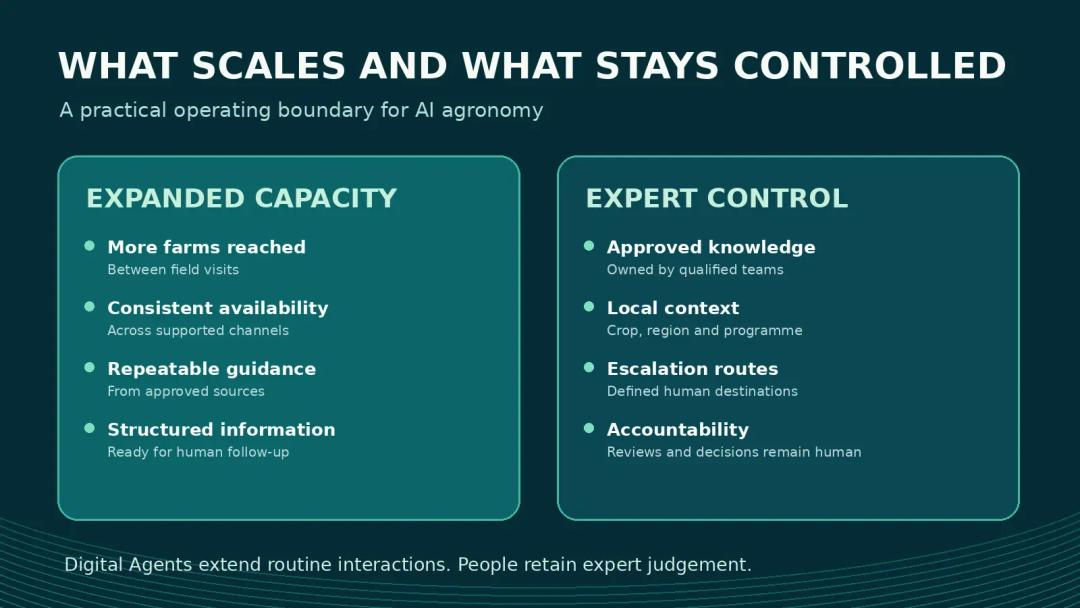
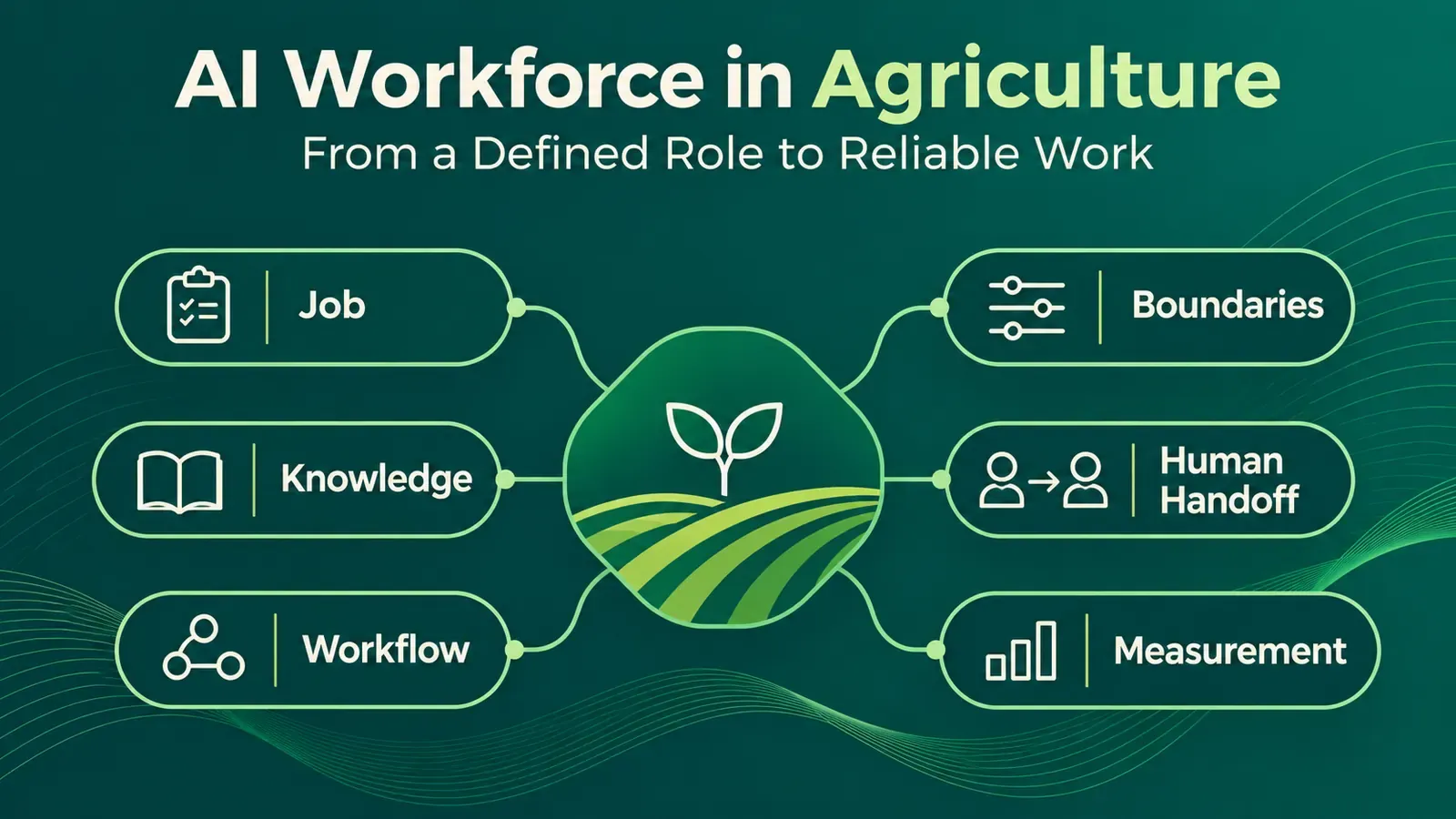
Expert control must cover the knowledge the agent uses, the context required before an answer, actions it is permitted to initiate, and the circumstances that require human judgement. Deploying a conversational interface without those decisions does not produce a dependable advisory service.
An organisation should appoint an owner for approved sources, including product labels, agronomy protocols, regional recommendations and seasonal changes. A versioned knowledge process matters because farmers may ask about a product long after its instructions have changed. AGRIVI explains these components in its agricultural AI knowledge architecture guide.
The NIST AI Risk Management Framework offers an established reference for risk governance, evaluation and ongoing monitoring. In agricultural advisory, that translates into practical controls over source updates, uncertain questions, escalation and quality review.
When Should an AI Agronomy Conversation Go to a Person?
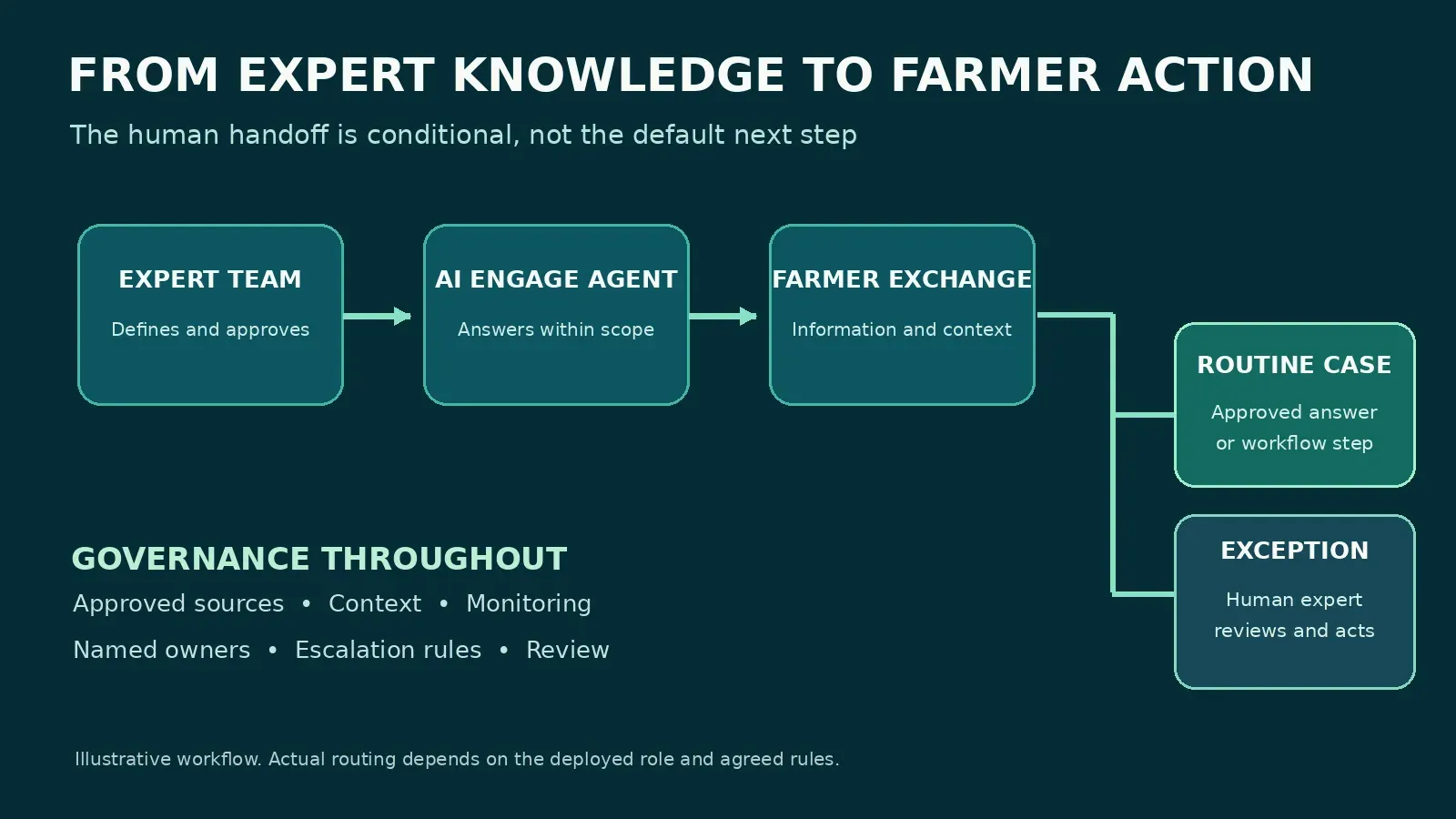
Human escalation is needed when a case falls outside the agent’s approved knowledge, lacks essential context or requires a qualified agronomic or commercial decision. The goal is a relevant handoff with the farmer’s previous information attached, rather than an automatic escalation of every interaction.
Consider two questions. A farmer asking for the approved product catalogue can receive a routine answer. A farmer reporting unusual crop damage after an application may require an agronomist to review additional evidence and determine the next step. The system should treat these as different workflows.
The customer appoints the relevant expert or business owner. AGRIVI AI Engage supports the configured workflow and routing according to the agreed deployment. AGRIVI’s AI governance and operating ownership guide explains how those responsibilities remain active after launch.
How Do You Calculate and Measure Advisory Capacity?
Advisory capacity should be measured against a defined baseline: the number of distinct farms actively reached, the questions resolved within approved scope, the proportion correctly escalated and the time taken for human follow-up. Counting conversations alone can exaggerate progress when the same few farmers send many messages.
For a practical baseline, record how many farms each field team currently engages within its usual territory and during one comparable period. Then compare unique farms reached through the combined human and digital model in the same area and period. Add quality measures so broader reach does not conceal poor answers or neglected escalations.
- Coverage: unique farms with meaningful interaction, compared with the pre-deployment baseline.
- Usefulness: percentage of sampled answers supported by approved and relevant knowledge.
- Escalation: cases routed correctly, with adequate context and a named owner.
- Follow-up: percentage of handoffs that result in the required human action.
- Business contribution: qualified interest, resolved advisory needs or programme outcomes, according to the role.
Selected AGRIVI AI Engage deployments have reported 3x farm reach within existing sales areas and 20% upsell in relevant programmes. These are customer results, not guaranteed improvements, and are not directly comparable across every advisory or public-sector use case. Individual outcomes vary.
How Should Different Organisations Design the Role?
An agri-input manufacturer, a food buyer and a public advisory programme may all need broader farmer access, but the underlying workflow and success measure differ. The common foundation is controlled knowledge, relevant context and a clear owner for the next action.
- Agri-input manufacturers: an AI Agri-Input Sales Representative can combine approved advisory, product questions, buyer-intent qualification and follow-up.
- Food and beverage companies: an AI Supply Chain Manager supports grower communication, reminders, production information and sourcing coordination.
- Governments and development programmes: an AI Public Advisory Officer can distribute approved public advice and collect structured information across farmer populations.
All three are roles within the AGRIVI AI Workforce category, delivered through the AGRIVI AI Engage platform. The difference between roles should remain explicit in both the business case and the project design.
What Should an Enterprise Confirm Before Launch?
Before launch, the enterprise should establish a specific farmer problem, a measurable coverage baseline, an approved knowledge owner, the agent’s permitted tasks, the human escalation route and a review rhythm. Channel choice follows these decisions rather than substituting for them.
- Describe the first audience by region, crop, customer type and current service gap.
- Assign owners for agronomy sources, business rules, monitoring and human review.
- Test routine and exception cases in the relevant language, including missing context.
- Confirm the farmer data required and how it will be used or transferred to existing systems.
- Set adoption, coverage and quality measures, then review and revise the deployment.
AGRIVI’s 6-Step Guide to Launch Your AI Agent provides a structured introduction to use-case definition and deployment. For an overview of agriculture-specific Digital Agent roles, see the AGRIVI AI Engage platform.
AGRIVI AI Engage was named 2026 “Agronomy Solution of the Year” by AgTech Breakthrough. The official AGRIVI award announcement describes the recognition and the wider agriculture-specific approach. The award does not replace the need to validate the operating model for each deployment.
AI Agronomy FAQs
What Is AI Agronomy in an Enterprise Advisory Programme?
AI agronomy uses artificial intelligence to make approved agricultural knowledge and repeatable advisory workflows accessible through digital channels. Enterprise deployments also need context, governance, monitoring and qualified human escalation.
Does AI Agronomy Replace Field Agronomists?
No. Digital Agents can support routine information and data collection, while agronomists retain responsibility for complex diagnoses, expert judgement, exceptions and relationships.
Can an AI Agent Give Product Recommendations?
It may deliver product information or recommendations within the rules and sources approved for that deployment. Cases requiring additional agronomic assessment or an authorised commercial decision should be escalated.
How Do You Measure Farmer Reach Accurately?
Count unique farms with meaningful interactions over the same period and geography as the baseline. Review response quality and follow-up performance alongside reach, rather than relying on message volume.
How Does Escalation Work in AGRIVI AI Engage?
The deployment defines escalation triggers and responsible human recipients. When a case crosses an approved boundary, the agent can route the relevant conversation context to the appropriate team.
Does AGRIVI AI Engage Require AGRIVI 360 FMS?
No. AI Engage can operate as a standalone AI Workforce solution and connect with supported enterprise systems. AGRIVI farm and field context can be used when relevant and configured.
Which Organisations Benefit from AI Agronomy Capacity?
Agri-input manufacturers, food companies working with growers, and public advisory programmes may all benefit. Each requires a different workflow, governance model and outcome measure.
What Proof Exists That AGRIVI AI Engage Can Increase Reach?
Selected deployments reported 3x farm reach within existing sales areas, compared with field teams alone. Individual outcomes vary, and quality and human follow-up must also be measured.
Published by AGRIVI. Editorial responsibility: AGRIVI Marketing & Communications.
Ready to digitalize your farm?
See how AGRIVI can help you apply these insights in your own operations.
Book a Meeting