
AI Farmer Engagement Metrics: What Agri-Input Teams Should Measure
A practical AI farmer engagement scorecard for agri-input teams, from reach and request resolution to human follow-up and carefully defined sales outcomes.
AGRIVI
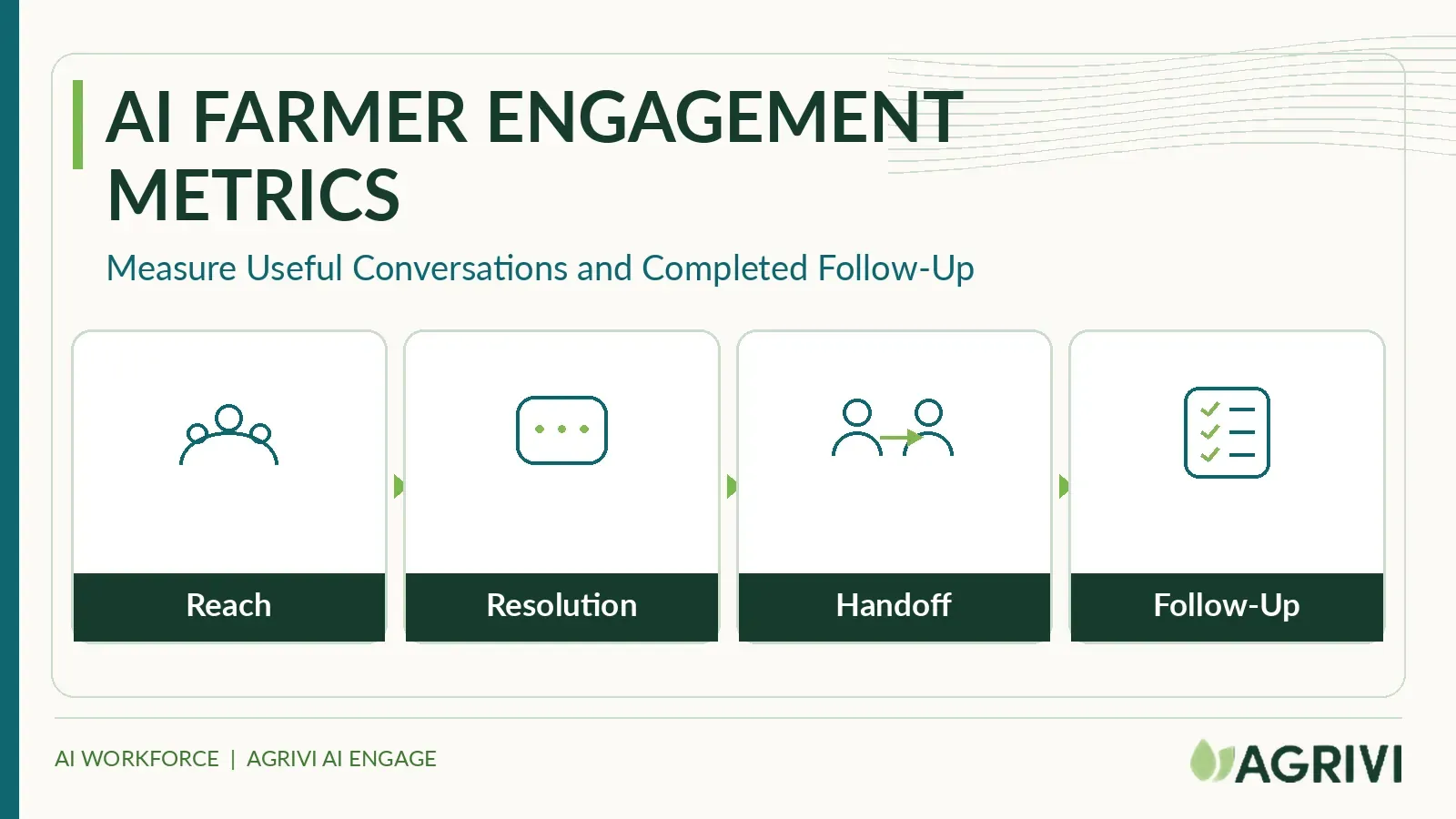
AI farmer engagement metrics should tell an agri-input company whether its Digital Agent is providing useful answers, preserving farmer context and helping the appropriate human team complete follow-up. Reach and message volume are useful distribution measures, but neither proves that a farmer received support or that a sales opportunity progressed.
A practical scorecard follows the journey from contact to a resolved request, an appropriate handoff when needed and a documented outcome. The measures depend on the Digital Agent's job, its approved knowledge and the team accountable for the next step.
At a Glance
- Start with the Digital Agent's role and define what a resolved request means.
- Measure distribution separately from useful conversations and request resolution.
- Review handoff quality, time to human response and completed follow-up.
- Connect commercial results only where qualification and attribution are clear.
- Give every metric a definition, an owner and a review cadence.
Start with the Digital Agent's Job
A Digital Agent supporting approved agronomic information should not be judged by the same outcome as one configured to identify product interest or qualify sales requests. In AGRIVI's architecture, AI Workforce is the category and AGRIVI AI Engage is the platform for agriculture-specific Digital Agents. The AI Agri-Input Sales Representative is one defined role, with responsibilities spanning farmer engagement, approved guidance, commercial signals and human sales follow-up.
Before selecting KPIs, document the role, the question types it may answer, the information it can collect and the situations that need a person. The article on what makes an AI Workforce role operational explains why boundaries and ownership belong in the workflow from the beginning.
Separate Distribution from Useful Engagement
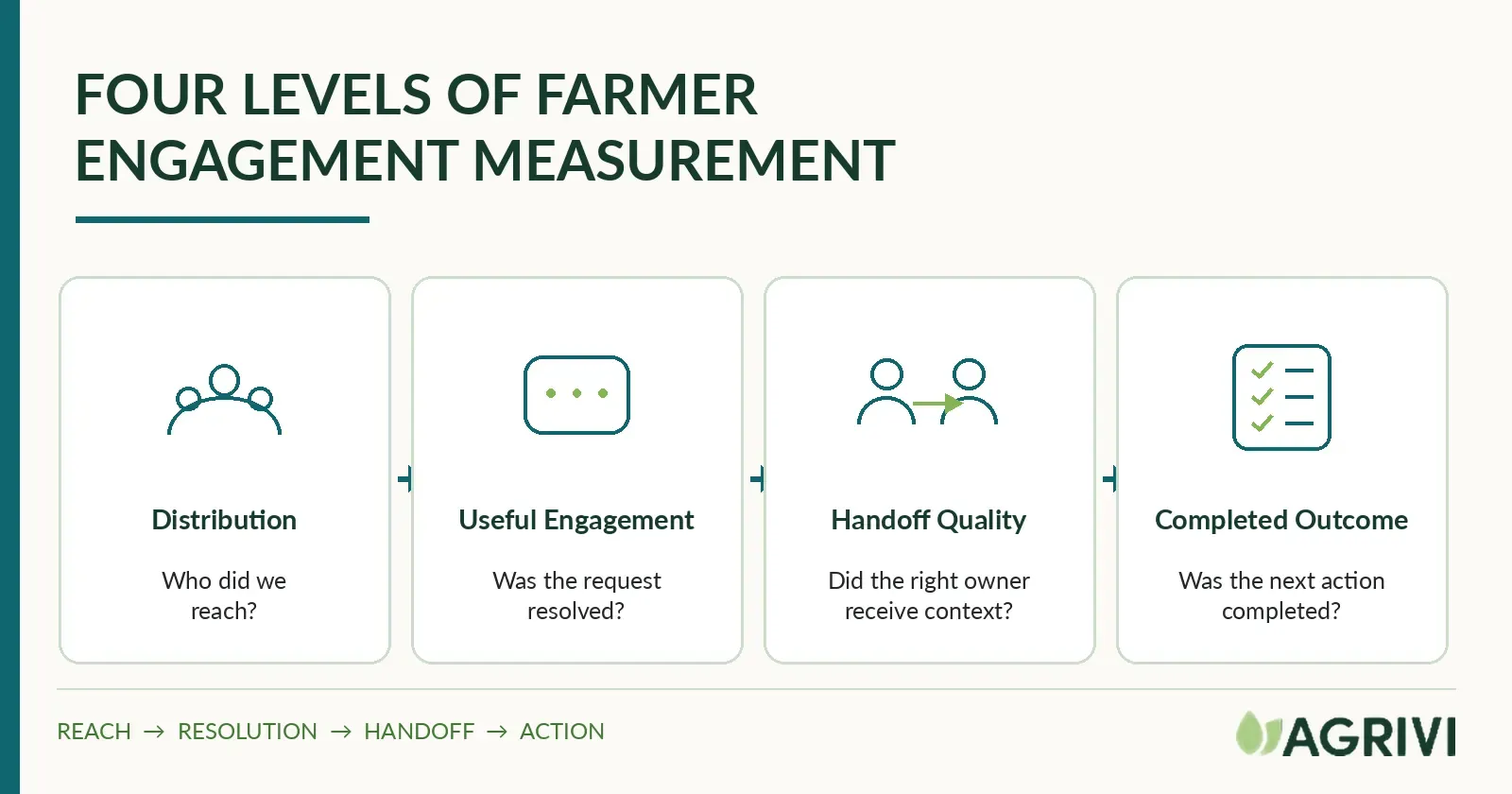
Messages sent, contacts reached and delivery or open rates indicate distribution. They are relevant when teams need to understand coverage by territory, crop, campaign or farmer segment. They do not tell you whether the message helped the farmer or whether the conversation moved forward.
Useful engagement begins with a meaningful interaction. Was an approved answer provided? Did the farmer share the crop, location or timing required for a relevant response? Was a next step agreed when one was needed? The AGRIVI article on what farmers ask agricultural AI agents illustrates why timing and local context matter as much as the number of conversations.
For a comparison across markets, keep the denominator stable. A count of engaged farms is different from conversations per farm, and a higher message count may simply reflect more reminders or repeat questions.
Measure Request Resolution and Conversation Continuity
Define a resolved request as one completed within the Digital Agent's approved job, with no unresolved issue left in that interaction. Report the resolved share by request type, not only a single overall number. Product availability, agronomic information and a request for a representative have different completion conditions.
Conversation continuity is the other test. A farmer who returns with the same unresolved question or must repeat the crop and problem after a transfer has experienced friction. Teams should review repeated questions, missing context and whether an answer was based on the current approved source. This connects measurement with the practical governance questions addressed in AI governance after launch.
A low resolution rate does not automatically mean the agent performed poorly. It may signal deliberately narrow boundaries, outdated knowledge or a crop issue that correctly requires an expert. The trend and underlying reasons matter more than a headline percentage.
Measure Handoff Quality and Human Follow-Up
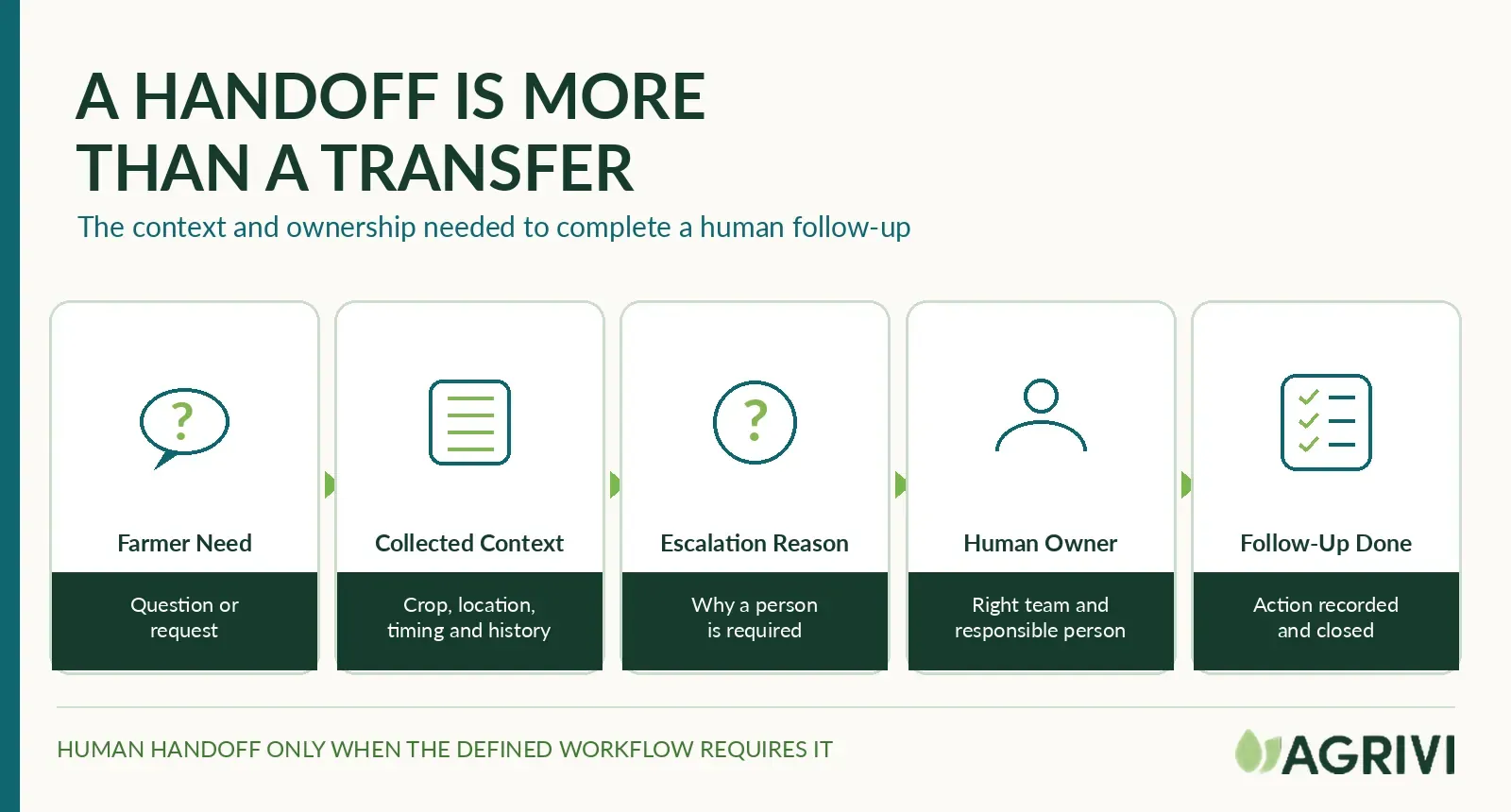
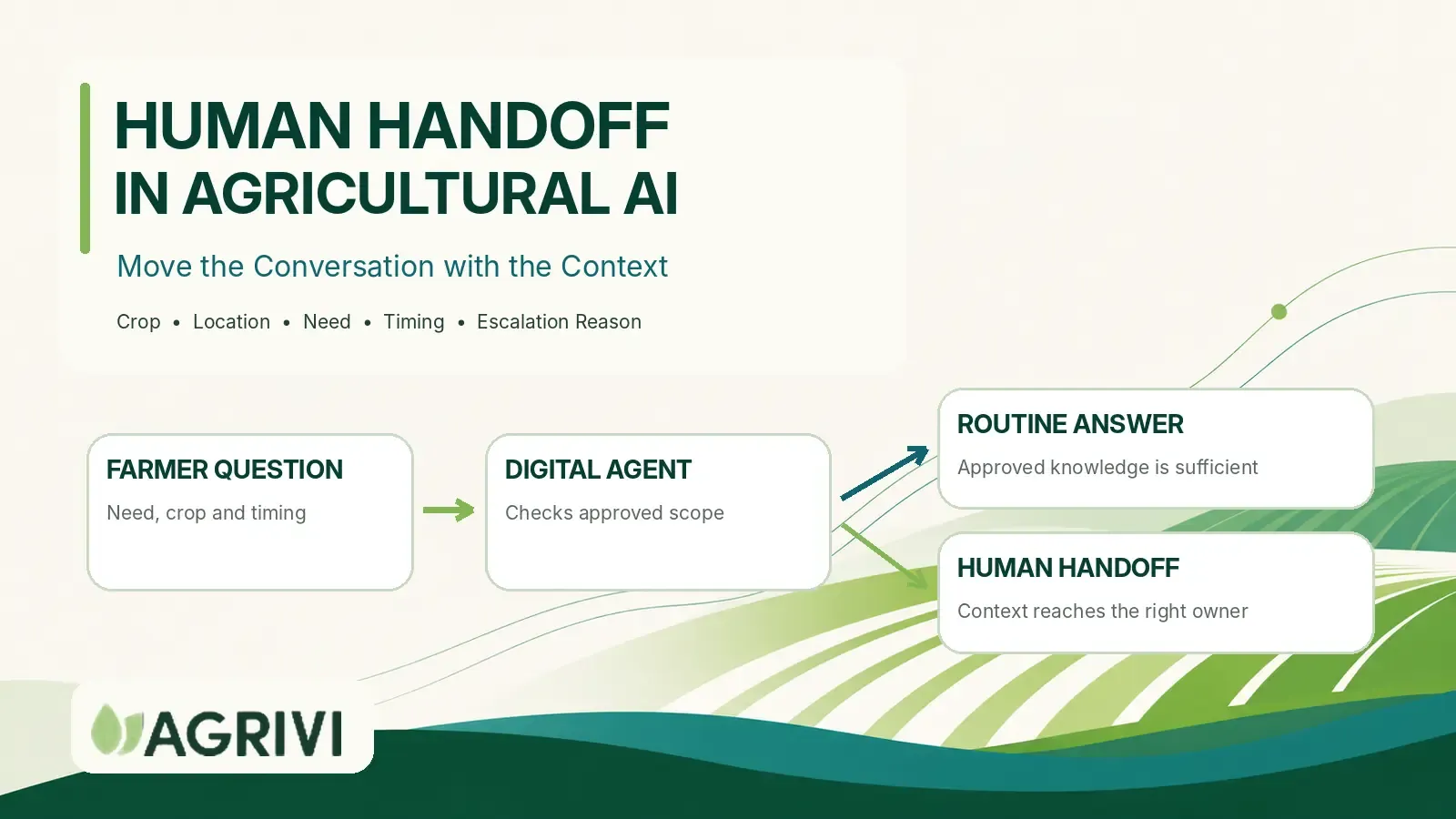
A handoff is useful when a farmer's question reaches the right person with enough context to continue. Not every interaction should escalate. Routine questions can finish with an approved response; defined exceptions and qualified requests move to sales, agronomy or another responsible owner.
For each transfer, assess the reason, destination, context completeness, elapsed time to first human response and whether the next action was completed. The receiving team should know the crop and location where relevant, the farmer's stated need, what the Digital Agent already answered and why the conversation moved.
An increase in human handoffs is not inherently good. It could indicate stronger buying-intent recognition, but also a knowledge gap or broad escalation rule. The AI Agri-Input Sales Representative role provides a concrete example of how qualification and sales handoff fit together.
Connect Commercial Metrics without Overclaiming
Agri-input companies may track qualified product enquiries, accepted sales follow-ups, opportunities and sales involving farmers first engaged through the AI programme. These are distinct measures. A product question is not automatically a qualified lead, and first contact does not establish that the Digital Agent caused the final sale.
Selected AGRIVI AI Engage deployments have reported 3x farm reach within existing sales areas. Individual outcomes vary. Separately, selected deployments report that 70% of new sales originate from farmers first engaged by the AI agent. Individual outcomes vary. These are deployment-specific outcomes, not guaranteed performance levels or benchmarks for every programme.
For commercial attribution, specify the definition of new sales, the measurement period, the covered farmer population and what qualifies as a first contact. The existing AGRIVI discussion of ROI measurement for AI advisory programmes goes further into pipeline and economic evaluation.
Build a Small Operational Scorecard
Begin with four groups of metrics. Give each one a consistent denominator, an accountable owner, a review cadence and a clear action when the result changes. This makes the scorecard useful in a weekly operating review rather than a static dashboard.
- Distribution: reach by territory and farmer segment. Owner: marketing or programme team.
- Useful engagement: request resolution and conversation continuity. Owner: knowledge or agronomy team.
- Handoff quality: context completeness, response time and follow-up. Owner: sales or agronomy.
- Completed outcomes: accepted leads, closed actions and attributed sales. Owner: commercial leadership.
Keep definitions and denominators consistent across reporting periods.
Review resolution, knowledge gaps and handoff bottlenecks weekly during an active deployment. Evaluate qualified interest and commercial outcomes on a longer cycle that matches the buying process. For teams expanding from a pilot, operational lessons from AI advisory programmes can help distinguish early activity from sustainable pipeline development.
Where AGRIVI AI Engage Fits
AGRIVI AI Engage within AI Workforce supports the configuration and operation of Digital Agents with approved knowledge, channels, workflows and escalation rules. Within the agri-input industry use case, the objective is to connect useful farmer interaction with a defined commercial or advisory next step. Reporting should reflect what the deployed role has actually been configured to do.
The organisation retains ownership of the approved knowledge, qualification rules and business outcomes, while AGRIVI supports the platform within the agreed scope. For the implementation sequence, the 6-Step Guide to Launch Your AI Agent provides a useful next resource.
Frequently Asked Questions
What Are the Most Useful AI Farmer Engagement Metrics?
Start with resolved requests, conversation continuity, context-complete human handoffs, response time and completed follow-up. Add commercial outcomes only when the Digital Agent has a defined commercial role.
Should Reach Remain Part of the Scorecard?
Yes. Reach describes coverage across farms or territories, but should be assessed alongside the share of useful conversations and completed actions. It is not a stand-alone indicator of engagement quality.
What Counts as a Resolved Farmer Request?
A request is resolved when the Digital Agent completes the task within its approved scope. Cases requiring human judgement remain open until the responsible person completes the agreed follow-up.
Is Every Product Question a Qualified Sales Lead?
No. The commercial team should define buying-intent signals and distinguish information requests, product interest and explicit requests for human sales contact.
How Should Human Handoffs Be Measured?
Record the escalation reason, responsible person, completeness of transferred context, time to human response and completion of the next action.
How Can Teams Measure Conversation Continuity?
Monitor repeated unresolved questions, missing context after transfer, and whether follow-up uses the information already collected rather than asking the farmer to start again.
How Often Should AI Engagement Metrics Be Reviewed?
Review operational quality weekly during active deployment and consider commercial outcomes monthly or over the relevant campaign or season, depending on sales-cycle length.
Does AGRIVI AI Engage Replace Human Sales or Agronomy Teams?
No. The platform adds capacity for approved interactions and defined workflows. Human teams retain responsibility for expert judgement, negotiations, relationship decisions and follow-up.
Published by AGRIVI. Editorial responsibility: AGRIVI Marketing & Communications.
Ready to digitalize your farm?
See how AGRIVI can help you apply these insights in your own operations.
Book a Meeting