
Human Handoff in Agricultural AI: What Context Should Move with the Conversation?
How to move farmer questions from a Digital Agent to the right expert, preserving useful context, a clear owner and follow-up through to completion.
AGRIVI
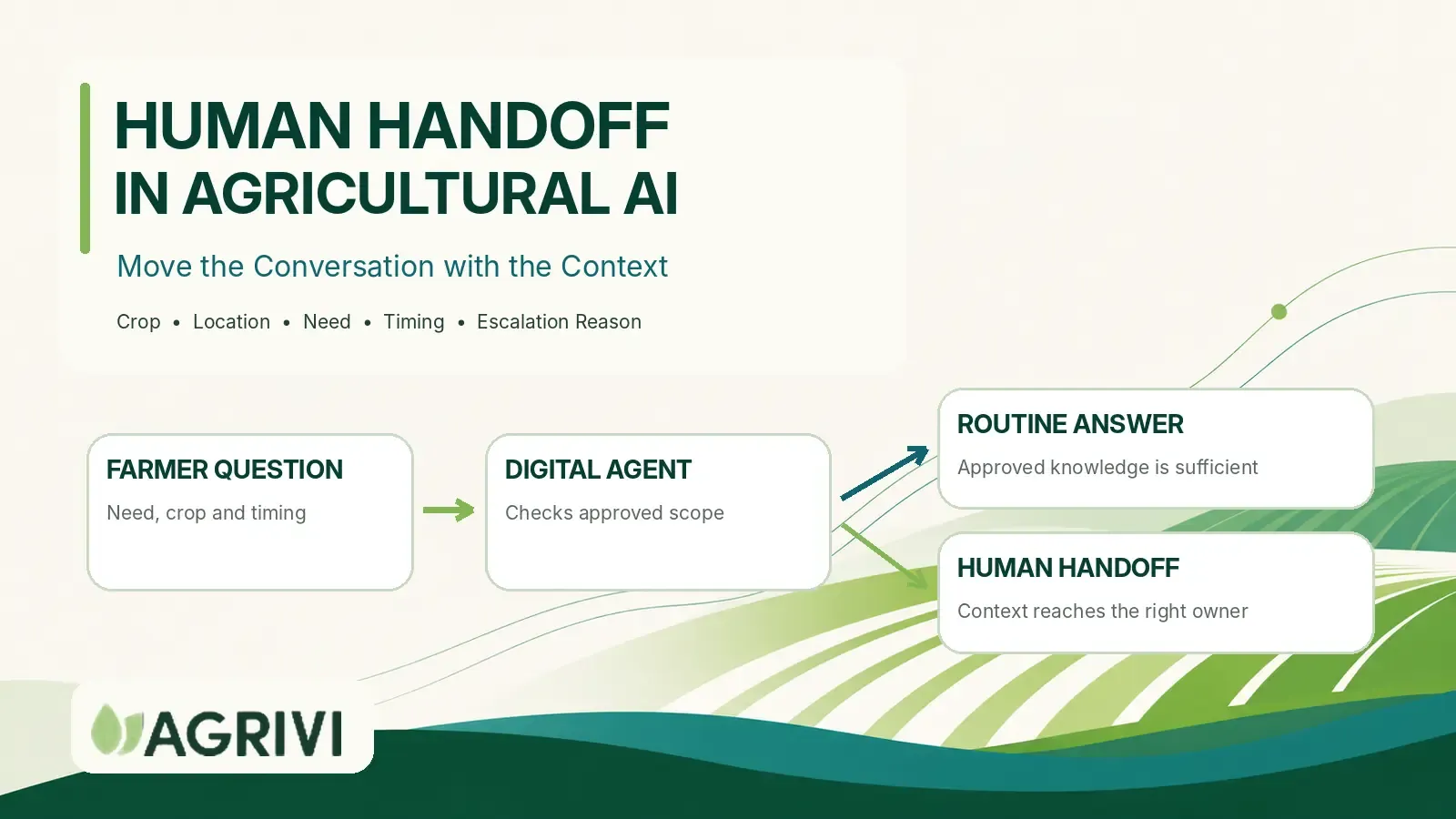
Human handoff in agricultural AI is the transfer of a farmer request to a named person when approved knowledge, expert judgement or commercial boundaries require a human decision. A useful handoff preserves the farmer’s need, crop, location, timing, what the Digital Agent has already shared, the reason for escalation and the expected next action.
Farmers may ask about a product, crop condition or urgent field decision at any hour. Some requests can be answered from approved information. Others require an agronomist, salesperson or programme owner. The operating model needs to distinguish those outcomes before the Digital Agent begins interacting with the network.
At a Glance
- Routine approved questions can be answered without involving a person; escalation is reserved for defined reasons.
- Five escalation triggers are knowledge boundaries, expert judgement, safety or compliance, commercial decisions and an explicit farmer request.
- The recipient needs a concise context package, a clear reason for referral and a specific next action.
- A transfer is complete only when the human owner accepts the case and the follow-up is recorded.
- Measure handoff quality using correct routing, context completeness, response time and completion, rather than transfer volume alone.
Why the Farmer Should Not Start Again
A Digital Agent may have already collected the crop, location, question and urgency before the farmer needs a person. If the receiving colleague gets only a contact name and a notification, the farmer must explain the situation again. That creates delay and weakens continuity precisely when a difficult question needs attention.
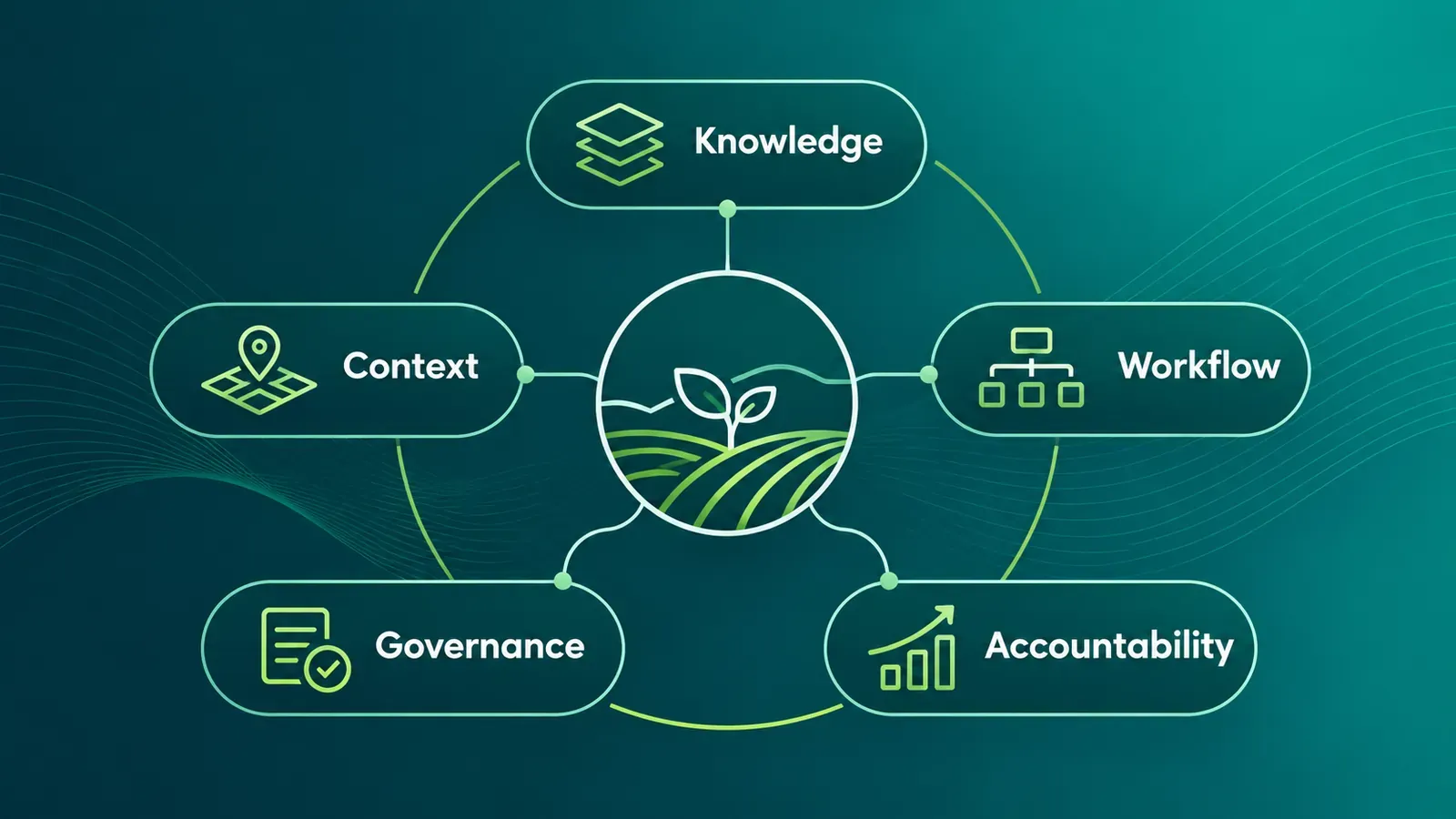
The relevant information should travel with the case, subject to the organisation’s permissions and data-use rules. The goal is a useful continuation of the same conversation, not unrestricted access to every previous message. This is an operational requirement of an AI Workforce role, alongside approved knowledge, defined workflows and accountability.
The NIST guidance on human-AI interaction also emphasises that responsibility and human oversight must be defined for the people who work with or supervise AI systems.
When Should a Person Take Over?
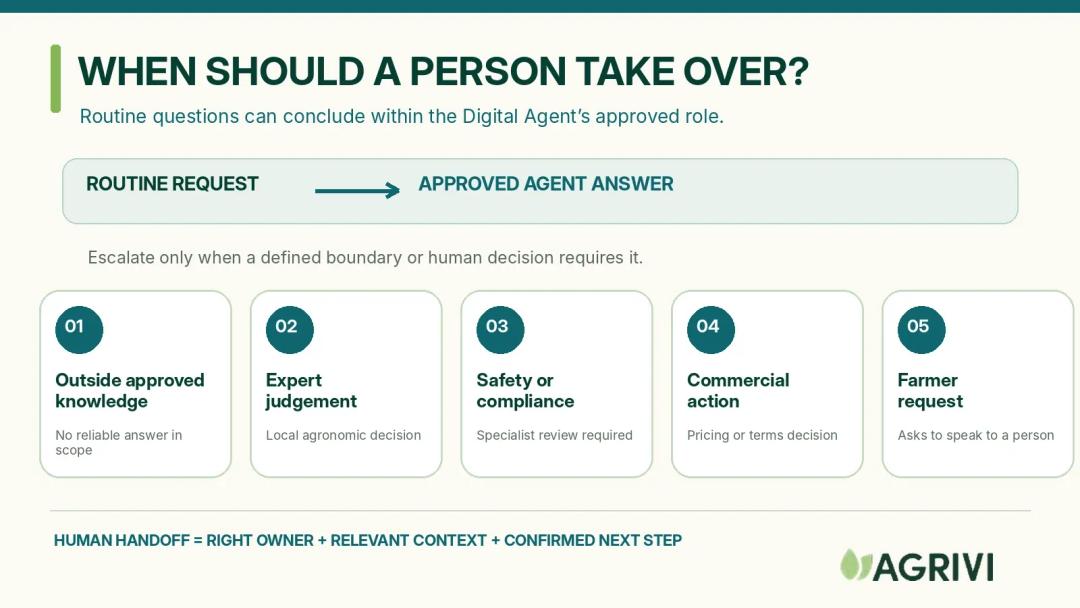
Escalation rules should be agreed before launch. These five categories offer a practical starting point for an agri-input, grower coordination or public advisory programme:
- Outside approved knowledge: The agent cannot find a sufficiently reliable answer in its approved sources or the requested guidance exceeds its permitted scope.
- Expert judgement: A crop-specific recommendation depends on uncertain conditions, an inspection, diagnosis or specialist review.
- Safety or compliance: The request raises product-use, regulatory, label, safety or other issues requiring a designated specialist process.
- Commercial action: A farmer requests pricing, commercial terms, a binding commitment or a decision reserved for sales.
- Farmer request: The farmer explicitly asks to speak with a person, even if the original question was routine.
The rules should be consistent with the approved knowledge architecture and the organisation’s AI governance responsibilities. A handoff is one possible outcome. Many routine requests should end with an approved answer or the next configured self-service step.
What Information Should Move with the Conversation?
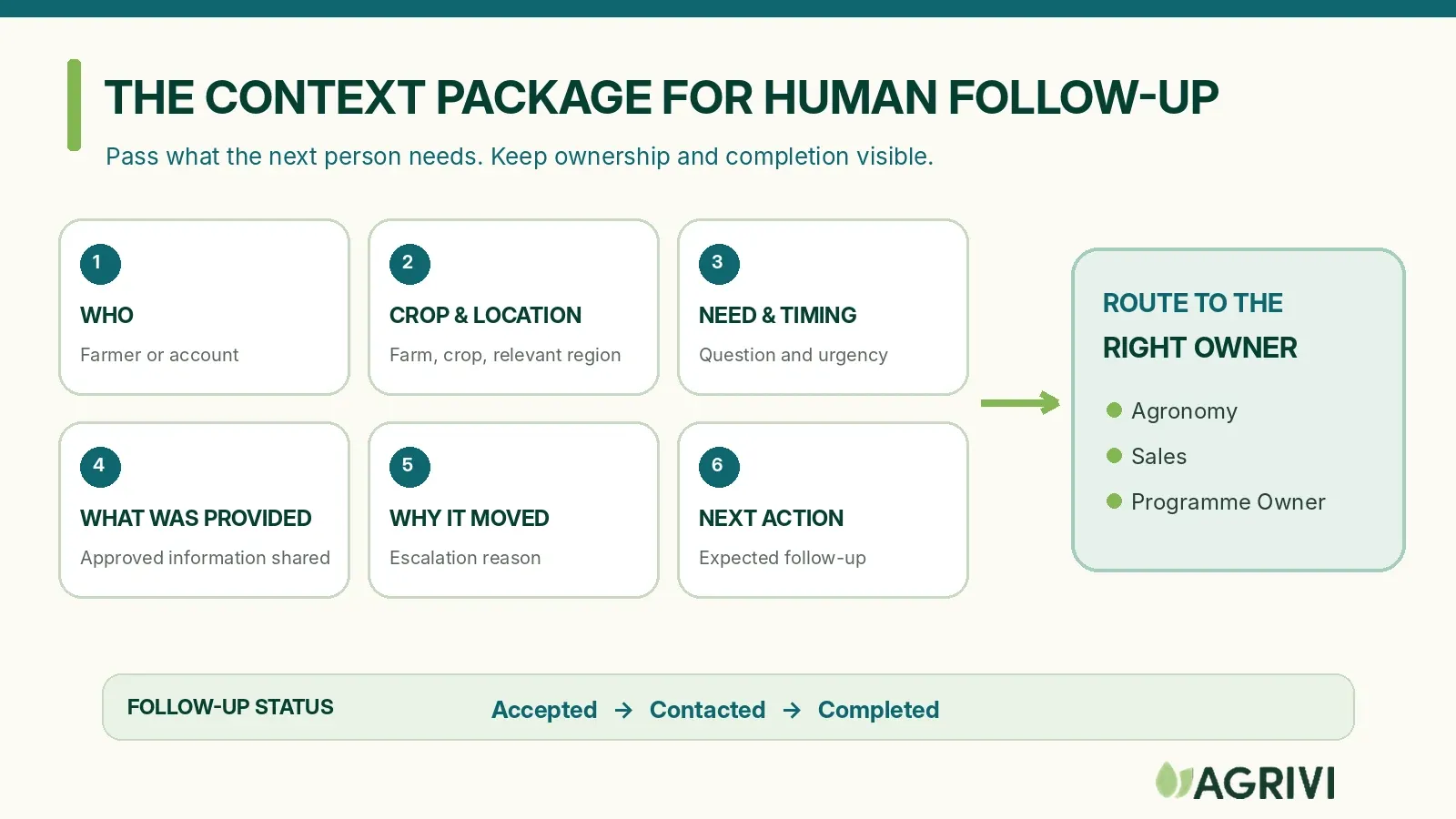
A useful handoff record is short enough for the receiving person to understand quickly, but specific enough to avoid a second discovery interview. Agree a minimum context package for each role:
- Who: Farmer or account identifier and the permitted contact channel.
- Crop and location: Relevant crop, production location or region and any known local context.
- Need and timing: The question, objective, urgency and when a response is useful.
- What was provided: A concise conversation summary and the approved guidance already shared.
- Why it moved: The escalation reason or boundary that prevented completion by the Digital Agent.
- Next action: The intended recipient, expected decision or follow-up and any agreed commitment.
Do not ask the farmer for every possible detail. The right package depends on the case, the channel, the available permissions and the decision the human owner needs to make. FAO’s responsible AI work highlights oversight and evidence-grounded operation as important safeguards.
Route to the Right Human Owner
The best recipient depends on the question, not on which team is easiest to notify. A Digital Agent needs routing rules that account for subject, region, language and responsibility, together with a fallback when the primary owner is unavailable.
For an AI Agri-Input Sales Representative, qualified purchase interest may need the territory salesperson while a complex application question goes to agronomy. An AI Supply Chain Manager may route a production exception to the grower coordinator or sourcing owner. An AI Public Advisory Officer may refer a specialised request to the responsible advisory service.
The configured workflow should not promise a response time that the receiving team cannot meet. When multiple teams could receive the same request, one owner must remain accountable for the next step.
Close the Loop with a Confirmed Outcome
A handoff notification does not prove that the farmer received help. The process needs to record whether the owner accepted the case, made contact and completed or explicitly reassigned the action. If the farmer’s situation changes, the follow-up record should be updated rather than leaving the original request marked as resolved.
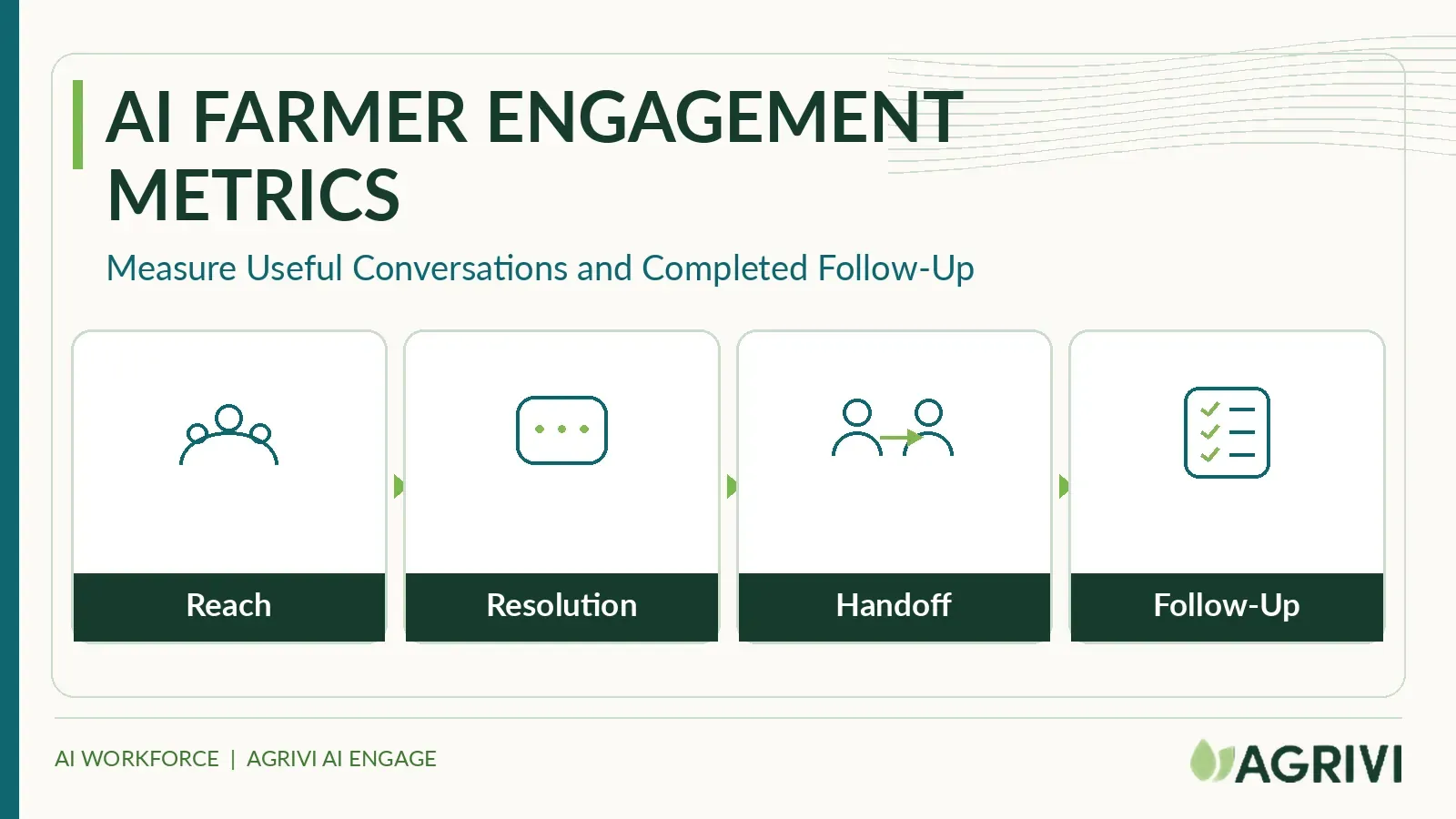
Review the percentage of cases with sufficient context, correct routing, time to first human response, completed follow-up and requests that return unresolved. A high escalation count may reflect healthy qualification, missing knowledge or unclear boundaries. It is not automatically a performance success. For the wider scorecard these measures belong to, see AI farmer engagement metrics for agri-input teams.
This operational view complements AGRIVI’s guidance on extending sales and agronomy team capacity, where human expertise is reserved for situations requiring judgement and relationship ownership.
A Practical Example: A Product-Use Question
Consider a farmer who asks whether a specific input can be applied to a crop in an unusual local situation. The Digital Agent can clarify the crop, location and question and provide any relevant information within its approved scope. If the answer requires product-label interpretation or specialist judgement beyond that scope, the agent refers the case.
The agronomist receives the question, crop and location, available timing, what information was already given and the reason for escalation. The organisation’s workflow assigns the case and records the response. This is an illustrative scenario, not a claim that AGRIVI automatically makes a regulatory decision or guarantees a particular agronomic outcome.
What Should Teams Define Before Launch?
A deployment plan should specify the escalation triggers, minimum data fields, named receiving teams, routing and availability rules, and a review process for cases that were not completed. The rules need to be tested using realistic crop, product and commercial questions before a broader rollout.
For buyer evaluation, see the enterprise agricultural AI criteria. The 6-Step Guide to Launch Your AI Agent offers a structured resource for defining the use case, knowledge and operating workflow.
Where AGRIVI AI Engage Fits
AI Workforce is the AGRIVI solution category. AGRIVI AI Engage is the platform used to configure agriculture-specific Digital Agents with approved knowledge, defined roles, workflow boundaries and human follow-up. It can operate as a standalone deployment, connect with supported existing systems or use AGRIVI farm context where the use case requires it.
For agri-input companies, the practical value of a well-defined handoff is continuity between the farmer conversation and the sales or agronomy team responsible for the next step. Knowledge ownership, commercial decisions and expert judgement remain with the organisation.
Frequently Asked Questions
When Should Agricultural AI Transfer a Conversation to a Person?
When a request exceeds approved knowledge or boundaries, requires expert judgement, raises safety or compliance concerns, needs a human commercial decision or the farmer requests a person.
What Context Should Accompany a Human Handoff?
The farmer or account, crop and location, need and timing, summary of information already provided, escalation reason and expected next action. Only relevant and permitted information should transfer.
Does Every Farmer Conversation Need a Human Handoff?
No. Routine questions can be answered through approved Digital Agent workflows. Human referral is reserved for situations meeting the agreed criteria.
Should the Digital Agent Collect All Available Farmer Data?
No. Collect the minimum useful information for the next decision and follow the organisation’s permissions and data rules.
Who Should Receive an Agronomic or Commercial Escalation?
A qualified agronomist, salesperson, grower coordinator or programme owner, selected according to the request, territory, language and assigned responsibility.
How Do You Measure Handoff Quality?
Track correct routing, context completeness, owner acceptance, response time, completion and repeated unresolved requests.
What Happens If the Assigned Person Is Unavailable?
The operating workflow should define reassignment or another approved fallback and avoid promising response times that cannot be met.
Can Human Handoff Be Added after Launch?
It can be refined later, but initial boundaries, receiving roles, escalation reasons and a basic follow-up process should be defined and tested before launch.
Published by AGRIVI. Editorial responsibility: AGRIVI Marketing & Communications.

Ready to digitalize your farm?
See how AGRIVI can help you apply these insights in your own operations.
Book a Meeting