
Multi-Farm Management: Standardise Records Without Losing Local Context
A practical framework for consistent farm records and meaningful cross-location comparisons without losing crop and field context.
AGRIVI

Multi-farm management works when every location records the same core operating facts using agreed definitions, while preserving the crop, field, season and local conditions that explain differences. A central view is reliable only when managers can trace every comparison back to the farm activity behind it.
The challenge is rarely a lack of dashboards. More often, farms are describing different events with the same label. A regional manager sees a completed activity at one site, a partially completed activity at another and a delayed record at a third. If those statuses were entered under different rules, the comparison looks precise but supports a weak decision.
At a Glance
- Agree on shared identifiers and definitions for farms, fields, crops, activities, resources and exceptions.
- Keep local production context so identical metrics are not mistaken for identical operating conditions.
- Set update timing, record ownership and review routines before building central reports.
- Use enterprise comparisons to identify a question, then follow the record to the farm-level cause.
- Start with one cross-farm decision and test the operating model before expanding it.
Why Multi-Farm Management Starts Below the Dashboard
A holding company may run vineyards, orchards and vegetable production across several regions. Each site can have valid local practices, yet central management still needs consistent answers to questions about work completion, available resources and in-season costs.
An enterprise dashboard cannot resolve a definition problem. If “completed” means fieldwork physically finished at one farm but administration approved at another, the same indicator compares different events. The wider challenge of tracing enterprise signals to farm events is covered in Farm Management Visibility for Enterprise Leaders. This article focuses on the data and operating rules required before that comparison can be trusted.
For digital adoption, the OECD review of agricultural digitalisation identifies relevance, ease of use and operating capabilities as important factors. A central data model therefore needs to work for the people recording farm activity, not only the executives reading the report.
Define the Shared Operating Record First
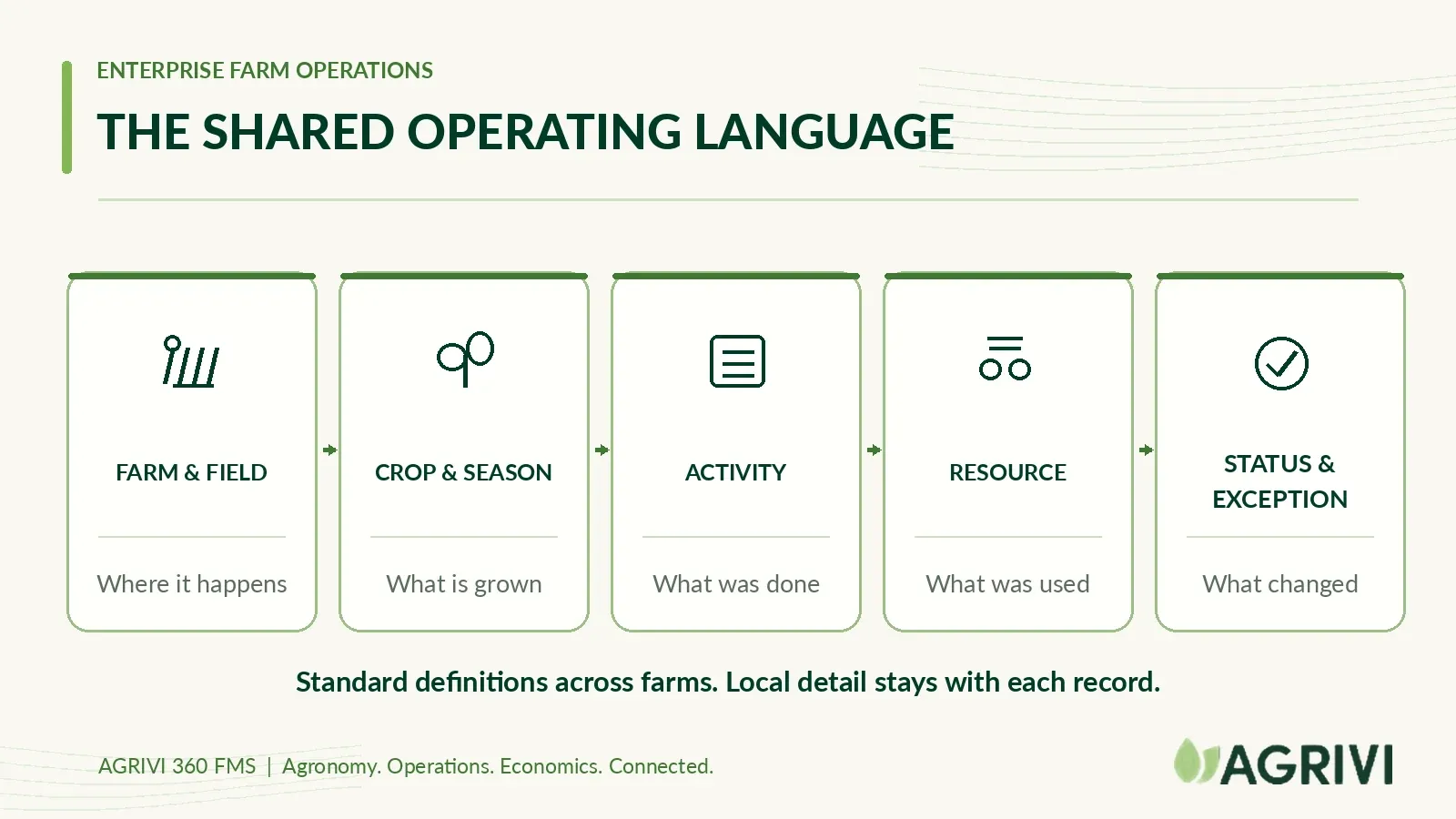
The minimum shared record is a set of fields and rules that every location recognises. It should identify where work happened, what crop and season were involved, which activity was planned or completed, what resources were actually used and whether an exception changed the plan.
There are five groups of information worth standardising first:
- Farm and field identifiers. Use stable identifiers for farms, blocks and production units, with clear parent relationships.
- Crop and season context. Connect a record to the crop, variety where relevant, production cycle and applicable unit of measure.
- Activity definitions. Agree on the difference between planned, assigned, partly completed, completed and cancelled work.
- Resource measurement. Record actual inputs, labour, machinery and external services with consistent quantities and units.
- Status, exception and ownership. Specify who updates the record, when it is due, what qualifies as an exception and who approves corrections.
For a deeper explanation of record quality, see Farm Data Management: Records the Business Can Act On. The AGRIVI 360 FMS platform provides the agriculture-specific record structure that can connect these operational facts across farms and roles.
Preserve the Context That Explains Differences
Standardisation does not mean identical agronomy. A spray operation, harvest task or irrigation cycle can have different timing, cost and significance depending on crop, terrain, weather, equipment and production objectives. A comparable record needs a common structure without stripping away those differences.
Consider two farms reporting higher machinery hours. One may have changed field passes because rain shortened the work window. Another may be repeating work after an equipment problem. The totals look alike, but the appropriate responses are different. Farm and field context is what separates a justified adjustment from avoidable rework.
A useful cross-farm view should therefore preserve the activity reason, affected block, crop, timing and resource quantities alongside any consolidated measure. The single-event crop-protection example illustrates how the same source activity supports different operational and economic decisions.
AGRIVI 360 FMS for enterprise farms connects field execution and management views in an agriculture-specific context. The decision about which distinctions matter, however, remains with the customer’s operating and agronomy leaders.
Create Common Review Routines, Not Identical Daily Practices
A shared record becomes useful when regional and central teams use it in a recurring management routine. Agree which statuses require local action, which exceptions should appear in the regional review and which decisions require enterprise approval.
For example, a farm manager can reschedule a routine task within an approved window. A regional manager may need to resolve competing machinery requests across locations. Enterprise leadership may intervene only when cost exposure, harvest timing or resource availability passes an agreed threshold.
The shared operating record for agronomy, operations and finance describes how different teams can work from one source while viewing their own responsibilities. In a multi-farm setting, that discipline must also extend across locations.
The FAO’s guidance on agricultural data interoperability supports the broader principle that consistent meaning and data structures matter when information moves between systems. A central farm report depends on that same discipline at enterprise scale.
Follow an Enterprise Signal to Its Farm-Level Cause
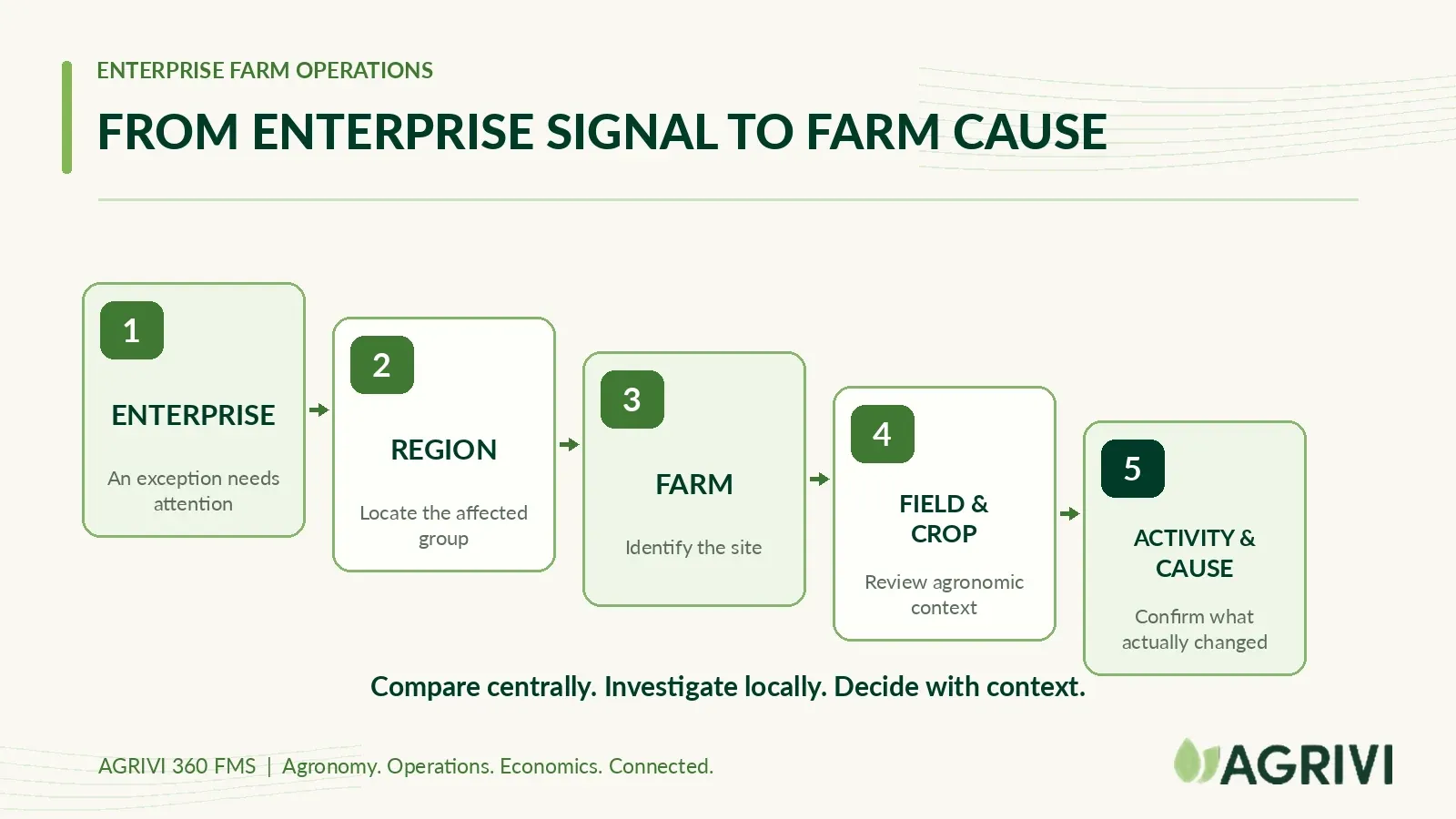
Suppose weekly input use is above plan for one region. The enterprise view should identify the signal without declaring its cause. Management then needs to locate the affected farms and blocks, review actual work and determine whether the change reflects a legitimate agronomic decision, a recording error or an execution problem.
That investigation moves through five levels: enterprise, region, farm, field and crop, and the activity or reason behind the change. The Farm Economics During the Season article explains why actual costs need to stay connected to field activities rather than appear only as a month-end total.
Start with One Cross-Farm Decision
The fastest way to expose inconsistent definitions is to test one decision that already needs input from more than one farm. Labour allocation, machinery availability, harvest preparation and input purchasing are suitable candidates when they are material to the business.
- Choose one decision. Define when the decision is made, who makes it and which farms contribute information.
- Agree on the minimum record. List the core identifiers, statuses, resource units and local qualifiers that decision requires.
- Assign record ownership. Name the field, agronomy and operations owners, including correction and approval rules.
- Run the review on a fixed cadence. Use the same definitions across locations and record every management decision and follow-up.
- Check whether comparisons are explainable. Ask managers to trace a central exception to an actual field record before expanding the model.
These tests align with the need for explicit data and workflow ownership discussed in Farm Management Software Implementation: Define the Outcome First. An enterprise buyer should also include such evidence in a farm management software evaluation rather than rely on a generic feature checklist.
Where AGRIVI 360 FMS Fits
AGRIVI 360 FMS is AGRIVI’s Farm Management Software product for agriculture-specific planning, field execution, resource use and operational economics. Its enterprise-farm capabilities can support multi-farm structures and role-based views while preserving crop and field context behind the management picture.
For groups managing several crops and locations, AGRIVI’s enterprise-farms industry overview describes the relationship between farm operations, costs and central decision-making. Product scope, integration needs, record ownership and adoption routines should still be defined for the individual implementation.
Frequently Asked Questions
What Is Multi-Farm Management?
It is the coordination of farm operations, records, resources, performance and decisions across multiple agricultural sites while retaining local production context.
Which Farm Records Should Be Standardised First?
Begin with farm and field identifiers, crops and seasons, activity definitions, actual resource use, statuses, exceptions and record ownership.
Does Every Farm Need the Same Production Workflow?
No. Comparable data requires shared definitions, not identical agronomic schedules or field practices. Local methods and conditions can remain different.
How Should an Enterprise Compare Different Crops and Regions?
Use comparable measures for a specific management decision, together with crop, season, area, unit and operating context. Avoid treating a single score as a complete explanation.
What Is the Difference Between a Shared Record and a Dashboard?
The shared record defines what happened and how it was recorded. A dashboard presents selected measures drawn from that information. A dashboard cannot correct incompatible source definitions.
Who Should Own Multi-Farm Data Quality?
The business should assign field and activity record owners, local reviewers, shared-definition owners and people authorised to resolve exceptions. Responsibilities can vary by organisation.
Where Should a Multi-Farm Rollout Begin?
Choose one valuable cross-farm decision, agree the minimum records, run a short repeatable review and test whether every exception can be traced to its source.
How Does AGRIVI 360 FMS Support Multi-Farm Operations?
It provides agriculture-specific structures for farms, crops, field activities, resources and economics. The configured processes, reporting definitions and adoption model determine how the organisation uses those capabilities.
Published by AGRIVI. Editorial responsibility: AGRIVI Marketing & Communications.

Ready to digitalize your farm?
See how AGRIVI can help you apply these insights in your own operations.
Book a Meeting