
Farm Management Visibility for Enterprise Leaders
Enterprise farm leaders need to see what is off plan, why it happened and what can still be changed. A five-part visibility framework connects status, variance, economic impact, operational cause and next action.
AGRIVI
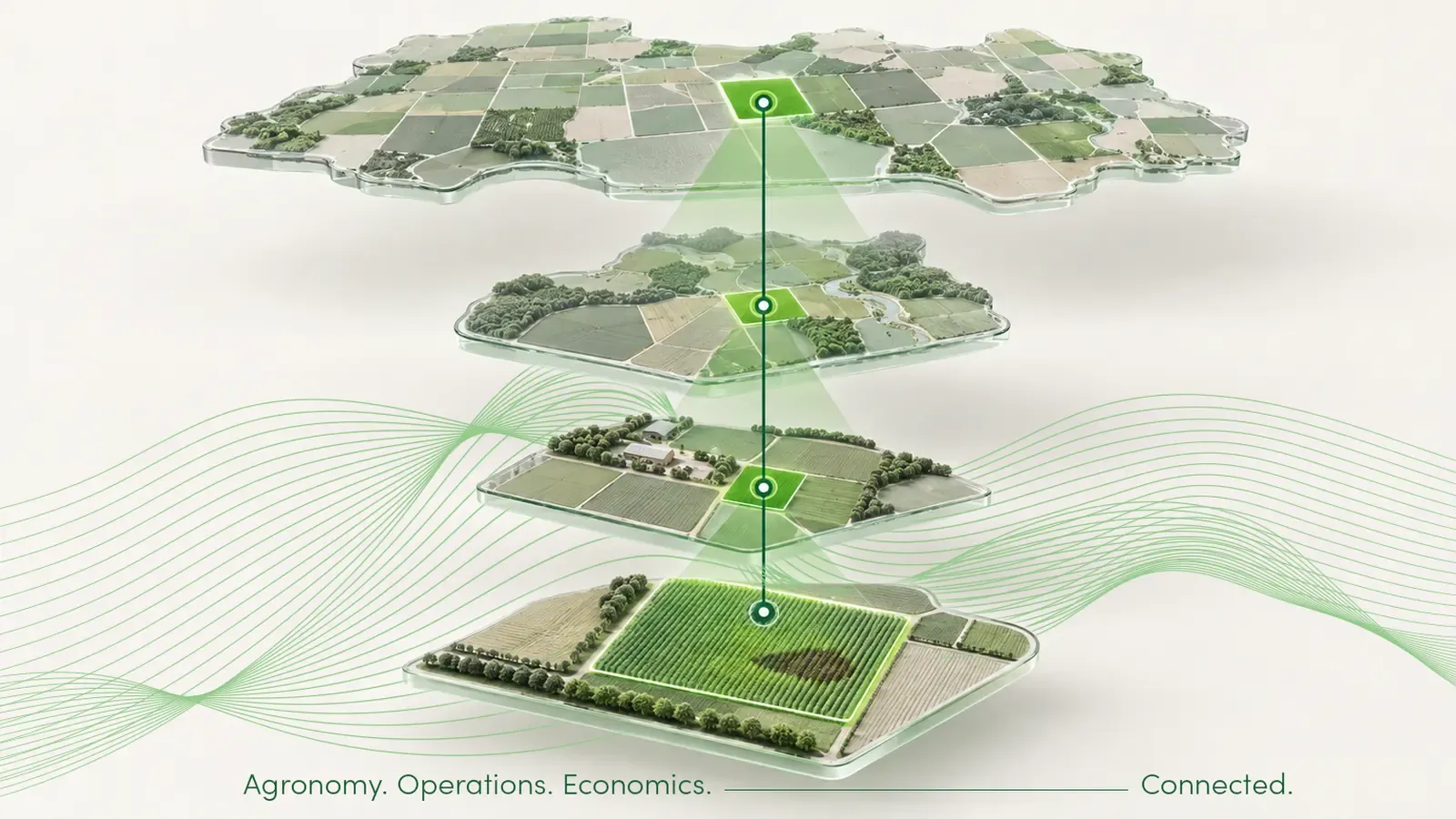
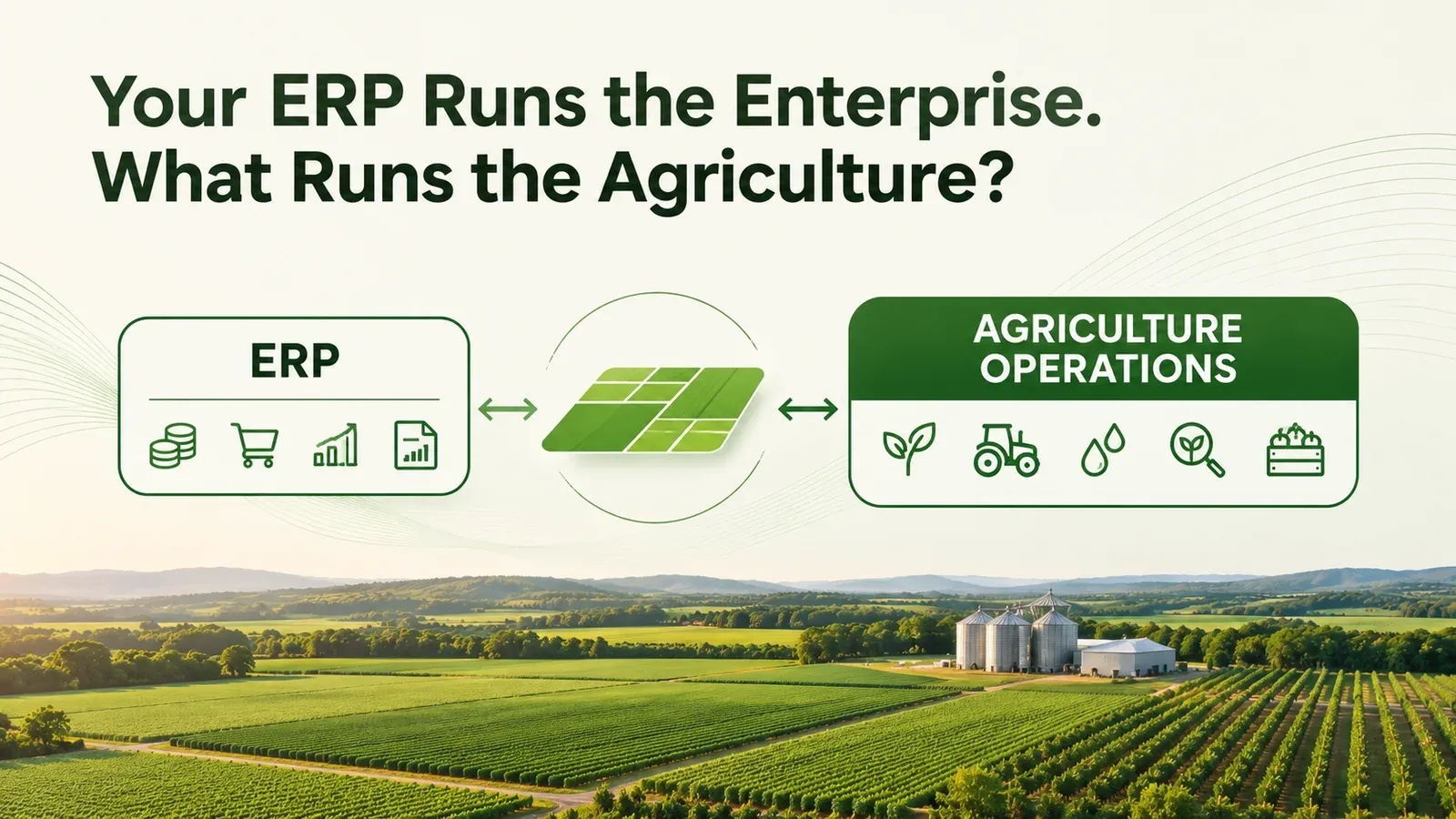
Farm management visibility connects current work status, deviations from plan, financial impact, operational causes and the next action across an enterprise farm business. Leaders need to trace a portfolio-level signal back to the region, farm, crop or activity that explains it, while there is still time to change the outcome.
Enterprise teams can collect detailed reports without knowing what needs management attention this week. An input cost above budget, an incomplete crop protection programme or a harvest forecast that slips may appear in different reports. The decision becomes harder when those signals cannot be connected to the records behind them.
For an enterprise managing several farms, the practical question is whether its information supports timely intervention. The enterprise farm management software view must connect agronomy, operations and economics, while retaining the local detail needed to explain each variance.
At a Glance
- An executive view should show material exceptions first, with clear ownership and timing.
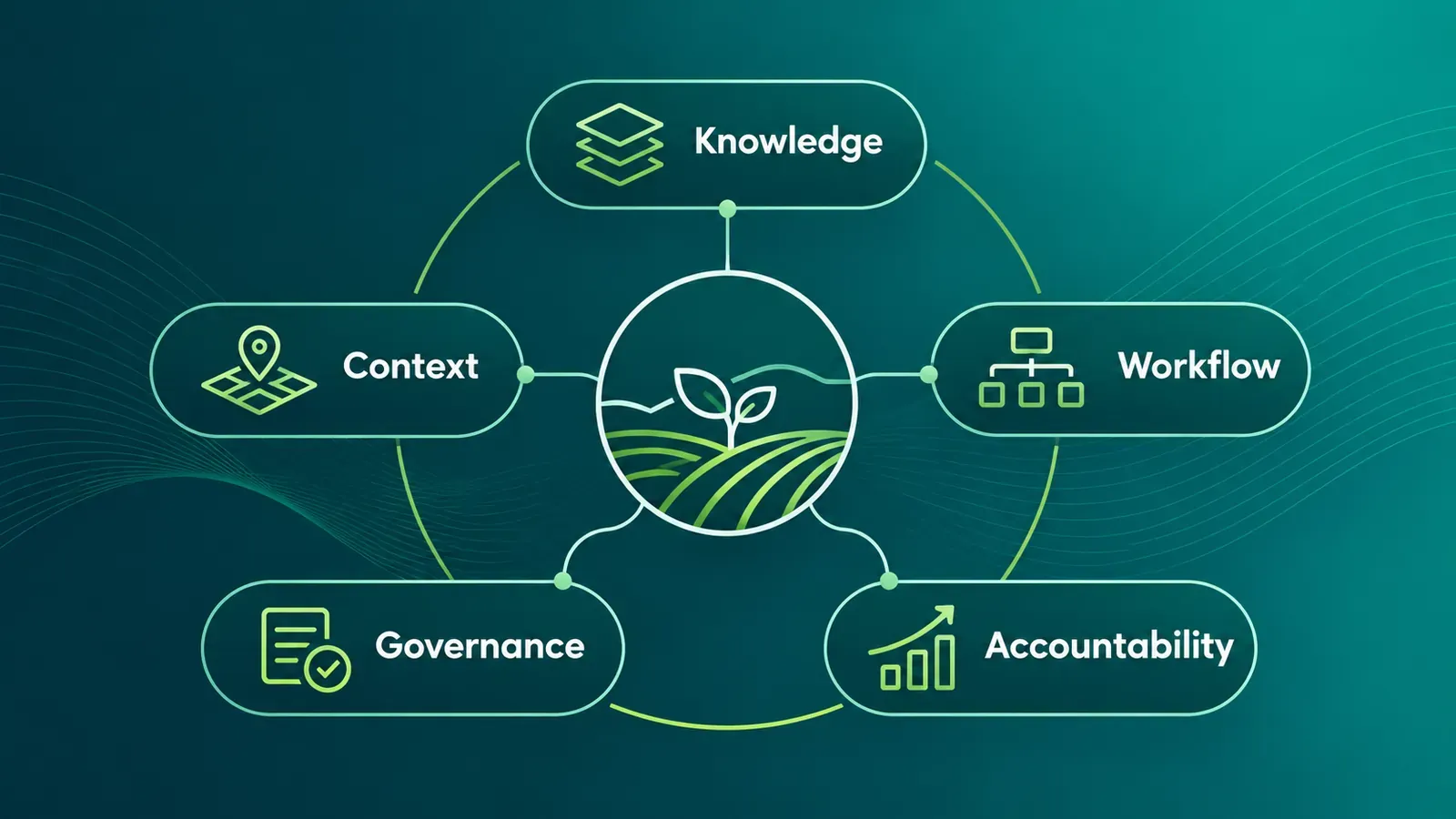
- Five connected elements matter: status, variance, economic impact, cause and next action.
- A regional alert is useful only when teams can trace it to a specific operational record.
- Plan-versus-actual comparisons create value during the season, while action remains possible.
- The purpose is shared decisions across leadership, agronomy, operations and finance, with role-appropriate detail.
Why Enterprise Visibility Needs More Than a Dashboard
Executive visibility requires a connected explanation of performance, not simply a collection of charts. A leadership team needs to see where work and spending deviate from the plan, whether the deviation is material and who can respond.
On a multi-farm operation, information often arrives at different speeds. Field teams record work, agronomists review crop conditions and finance closes costs on another schedule. Each view has a legitimate purpose, but separate records make it difficult to explain what changed without manual reconciliation.
This is why farm operations visibility and enterprise-level management visibility are related but different questions. Operations teams need a precise view of field execution. Enterprise leaders need to compare exceptions across farms and identify which issues deserve attention, resources or a change in priorities.
The OECD’s review of agricultural digitalisation discusses relevance, usability and adoption barriers in digital agriculture. Those questions matter in management reporting: a view that is too late or disconnected from an operating decision has limited practical value.
The Five Signals Enterprise Leaders Need
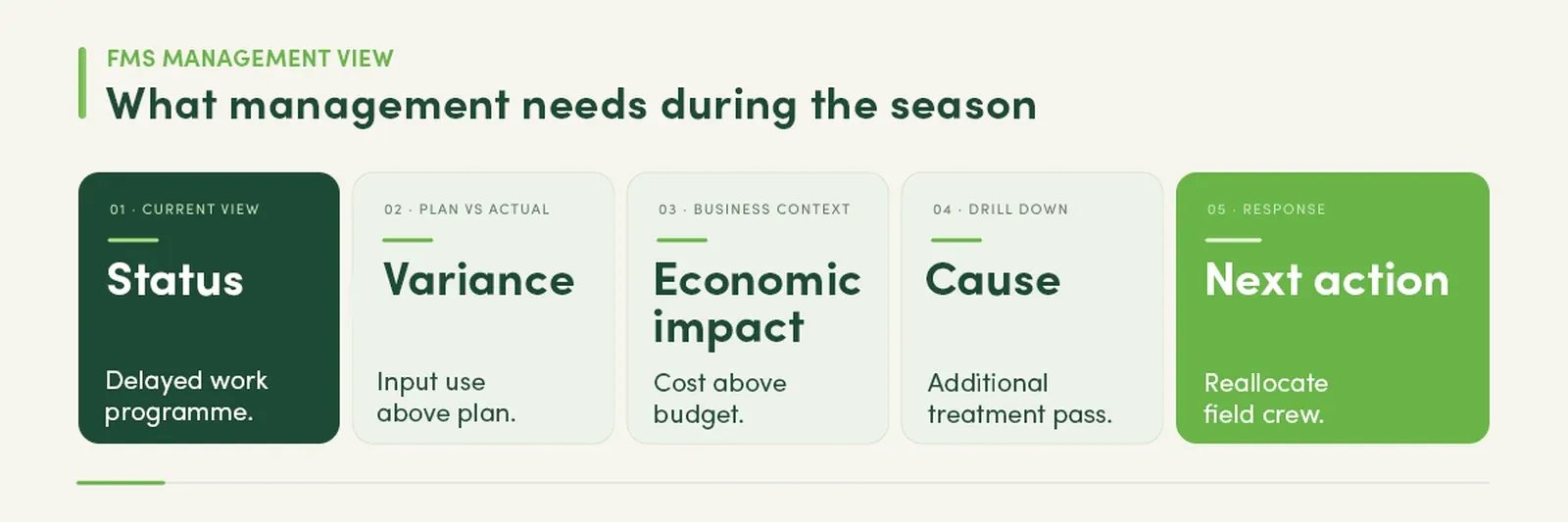
A useful enterprise view brings five connected signals into the same management process. Together they turn a general performance alert into a decision that someone can own.
- Status. What is planned, in progress, completed or blocked across farms, crops and teams? For example, a delayed crop protection programme matters more when management can see the affected area and timing.
- Variance. Where does actual work or resource use differ from the plan? This may concern input quantity, labour hours, planned activity, cost per hectare or harvest progress.
- Economic Impact. What does the deviation mean for cost, forecast output, resource availability or delivery? A variance with no economic context is difficult to prioritise.
- Operational Cause. Which activity, resource, field condition or change in plan explains the difference? An additional treatment pass and a price increase require different responses.
- Next Action. Who will investigate, approve, reallocate or update the plan, and by when? The decision should return to the operating record.
These signals also require different levels of detail. A regional director may need a comparison of farms; a farm manager needs the affected fields and resources. AGRIVI 360 FMS brings field activities, planned work and economics together so management can examine those relationships using the same agricultural context.
Follow an Input Variance from Portfolio to Field
A farm input variance should be investigated through the activity that created it. A consolidated report can show spending above budget, but the next question is whether the cause is a larger treated area, a higher application rate, a changed product price, an additional pass or an incomplete plan.
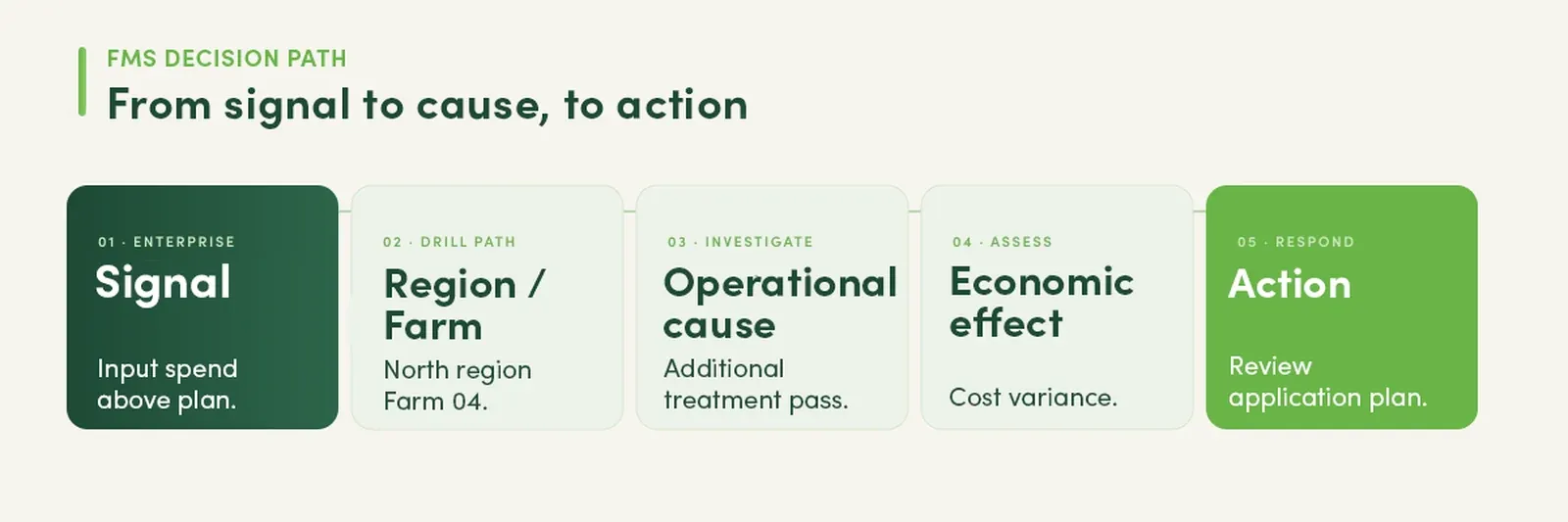
Consider an illustrative management review. The portfolio view flags input spend above plan. The regional view identifies the farms contributing most to the deviation. The farm view leads to a crop protection work record that shows an additional application. The economic view then estimates the cost consequence and compares it with the approved plan.
The management response depends on the cause. Agronomy may need to confirm the reason for the extra treatment. Operations may need to revise available labour or machinery. Finance may need to update a forecast. AGRIVI’s budget-versus-actual guidance explains why a useful comparison should be available during the season, rather than only after period-end reporting.
This investigation uses a common event, but each function asks a different question. For a concrete field example, see how one crop protection activity creates agronomy, operations and economic decisions.
Why Plan Versus Actual Is an In-Season Management Discipline
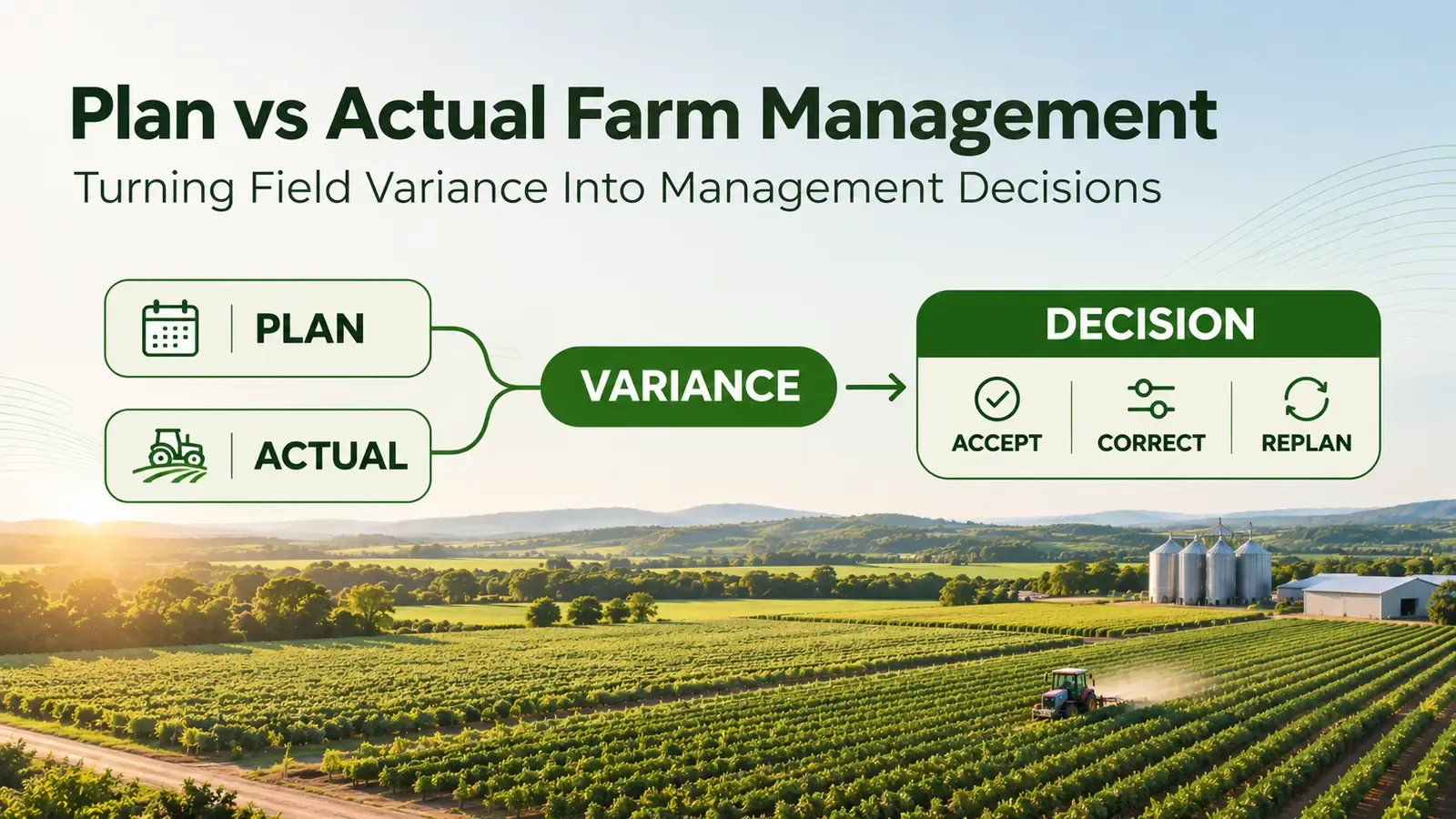
Plan-versus-actual visibility matters while managers can still change work, timing, resources or cost. A complete final report explains the outcome, but it cannot recover an earlier decision window.
Useful comparisons may include planned versus completed area, scheduled versus actual labour hours, expected versus used inputs, planned versus actual cost, and expected versus current harvest progress. Each variance requires a baseline, a defined update rhythm and an owner for the source record.
For example, a manager reviewing costs per hectare may see that work on one crop is progressing on schedule but input use is rising. Those two signals are more informative together than separately. How to track farm costs gives the underlying economics context, while the shared operating record model explains how agronomy, operations and finance can work from the same event.
The aim is to make exceptions visible soon enough to review the cause. That does not mean every metric must be reported continuously. Some require daily attention; others can be reviewed weekly or monthly, depending on the action they support.
What Leaders and Field Teams Should See Differently
Leaders and field teams should use different views of consistent underlying records. Executive reporting needs a concise picture of material risk, progress and economics; local teams need the activity detail and practical context required to respond.
A COO may compare completion rates or cost variances across regions. A regional manager may compare farms and identify a recurring resource bottleneck. A farm manager needs the specific field, crew, equipment, input and timing. Agronomy may need crop stage, observations and previous treatments. Finance needs consistent cost allocation and a reference to the source event.
Role-based views prevent unnecessary duplication when they use one connected source. The AGRIVI 360 FMS platform describes this connection across agronomy, operations and economics, including budgets, work orders, input use and crop performance. The enterprise-farm solution also places those workflows in the wider context of farm holdings and multi-site operations.
How External Data Adds Context to an Executive Signal
Weather, satellite imagery, farm sensors and pest monitoring can help explain deviations when the information is connected to a field or workflow. More data sources are useful only when someone can interpret their relationship to the action under review.
A delayed operation may reflect weather conditions rather than labour performance. A crop-risk alert may change the timing of an approved treatment. A satellite signal may call for field inspection before another action is scheduled. The operational record should allow managers to connect those observations with work, resources and costs.
The European Commission’s overview of digital agriculture describes connected technologies and agricultural data exchange across the sector. The FAO’s Agro-informatics programme focuses on using agricultural information and analysis to guide targeted interventions. Both reinforce the value of context, although neither source establishes a particular AGRIVI performance claim.
From Enterprise Signal to Farm-Level Action
A useful decision path starts with a portfolio-level exception and ends with a recorded owner and action. It should allow leadership to investigate without replacing the operational decisions of the responsible farm team.
- Identify the Signal. Prioritise a deviation that affects delivery, cost, risk or the operating plan.
- Locate the Source. Move from enterprise to region, farm, crop, field or activity record.
- Confirm the Cause. Review the actual work, agricultural context and resource changes behind the alert.
- Assess the Effect. Establish the cost or operational consequence and whether intervention is still possible.
- Assign the Next Action. Record who will act, when the decision will be reviewed and what information must change.
In-season adjustments may involve a different input plan, moving a crew, changing machinery allocation or reviewing a treatment decision. The mid-season input reallocation example illustrates why an updated operating record matters after the decision is made.
What Enterprise Buyers Should Test in an FMS Evaluation
Enterprise buyers should test a real decision path, not only whether a dashboard displays attractive figures. A practical evaluation uses one recent variance and asks the vendor to show where it started, which records explain it and who can act.
- Can management compare the same operating and economic indicators across regions, farms and crops?
- Can a regional exception be traced to the field, work order, input and responsible team?
- Can the system compare planned and actual work and cost while the season is underway?
- Can agronomy, operations and finance use role-specific views without creating competing versions of the event?
- Can an assigned action and its resulting changes be reviewed in the next management cycle?
During implementation, data ownership and reporting definitions must be agreed before configuration. The related farm management software implementation guide covers the operational decisions needed to establish reliable workflows and acceptance criteria. For procurement, AGRIVI also provides a farm management software buying guide for comparing requirements and building the business case.
Where AGRIVI 360 FMS Fits
AGRIVI 360 FMS is AGRIVI’s Farm Management Software platform for connecting agricultural plans, field execution, crop context and farm economics. Its enterprise-farm capabilities include field and production records, work management, resource use, monitoring and budget-versus-actual cost visibility.
For the leadership team, the business value is the ability to review exceptions with the source records still connected. The software cannot replace management judgment or guarantee a particular outcome. The organization must define its reporting standards, record ownership, review cadence and response processes.
The same principle applies beyond software configuration. Reliable farm data management keeps information current, shared, contextual, economic and actionable so each reporting cycle reflects the operating reality of the farms.
Frequently Asked Questions About Farm Management Visibility
What Is Farm Management Visibility?
Farm management visibility is the ability to review current agricultural work, risks and economics using connected farm records. At enterprise level, it also means tracing a portfolio-level deviation to the region, farm, crop or activity that explains it.
What Should an Enterprise Farm Dashboard Show?
It should prioritise work status, material variance, economic impact, operational cause and next action. Users should be able to move from summary indicators to the records needed to investigate a decision.
Why Is Plan Versus Actual Important During the Season?
It reveals whether work, inputs, labour and costs are changing relative to the approved plan while managers can still respond. The useful frequency depends on the decision, not on a universal real-time reporting requirement.
How Can Farm Economics Improve Operational Visibility?
Activity-linked input, labour and machinery costs help explain what caused a budget variance. This makes the economic effect of field decisions visible to the teams that can act on them.
How Does Farm Visibility Work Across Multiple Farms?
Management compares consistent indicators across regions or farms, then investigates material exceptions through local records. The operating definitions and data ownership must be consistent enough for those comparisons to be meaningful.
Should Field Teams and Executives Use the Same Dashboard?
They need different levels of detail, but the views should derive from connected records. Field teams work with tasks and local conditions; executives review exceptions, economics, ownership and the next decision.
Can External Data Improve Farm Management Visibility?
Yes, when weather, sensing or crop-monitoring information provides context for a specific farm decision. External observations should be connected to work and field records rather than presented as unrelated indicators.
What Does AGRIVI 360 FMS Add to Enterprise Reporting?
AGRIVI 360 FMS brings farm planning, operational activity and economic context into a connected agricultural record. Its value depends on agreed workflows, data quality, user adoption and a management process that acts on the information.
Published by AGRIVI. Editorial responsibility: AGRIVI Marketing & Communications.
Ready to digitalize your farm?
See how AGRIVI can help you apply these insights in your own operations.
Book a Meeting