
How to Scope Your First Agriculture AI Agent from Recurring Farmer Questions
A first Digital Agent needs a clear question scope, approved sources and an accountable human owner. Use topic, frequency and risk to decide what belongs in its first role.
AGRIVI
A first agriculture AI agent should be scoped around recurring farmer questions that the company can answer from approved knowledge. Define the topics, check seasonal frequency and risk, then assign a person to requests that need expert or commercial judgement. Start with one clear role before expanding.
An agri-input company does not need to begin with a broad list of AI capabilities. It needs to know which questions arrive between visits, which responses its agronomy and commercial teams already approve, and when a farmer needs a person. That makes the first role useful and accountable from the start.
At a Glance
- Select an initial question scope using topic, frequency during the relevant season and answer risk.
- Give the Digital Agent only the knowledge, products, markets and actions approved for its role.
- Keep routine questions with the agent; route out-of-scope requests to a named human owner.
- Measure answer quality, repeat requests and completed follow-up before widening the scope.
Start with Questions Your Field Team Already Receives
Use a recent sample of sales, dealer and agronomy interactions to identify repeat questions. Product availability, crop-stage timing, label instructions, seasonal reminders and requests for a local representative are useful categories to review. Include different regions and stages of the crop season; one month may not reflect the full pattern.
The related AGRIVI article on what farmers ask AI agents between sales visits explores the information needs behind those interactions. This article takes the next step: selecting a limited first role from those questions.
The commercial reason for careful scoping is trust. In McKinsey’s Global Farmer Insights 2026, agronomists remained a top purchasing influence for 56% of surveyed farmers, while only 6% cited generative AI or AI search as a trusted decision source. A Digital Agent should therefore extend approved expertise, not present itself as an independent authority.
Choose the First Scope by Topic, Frequency and Risk
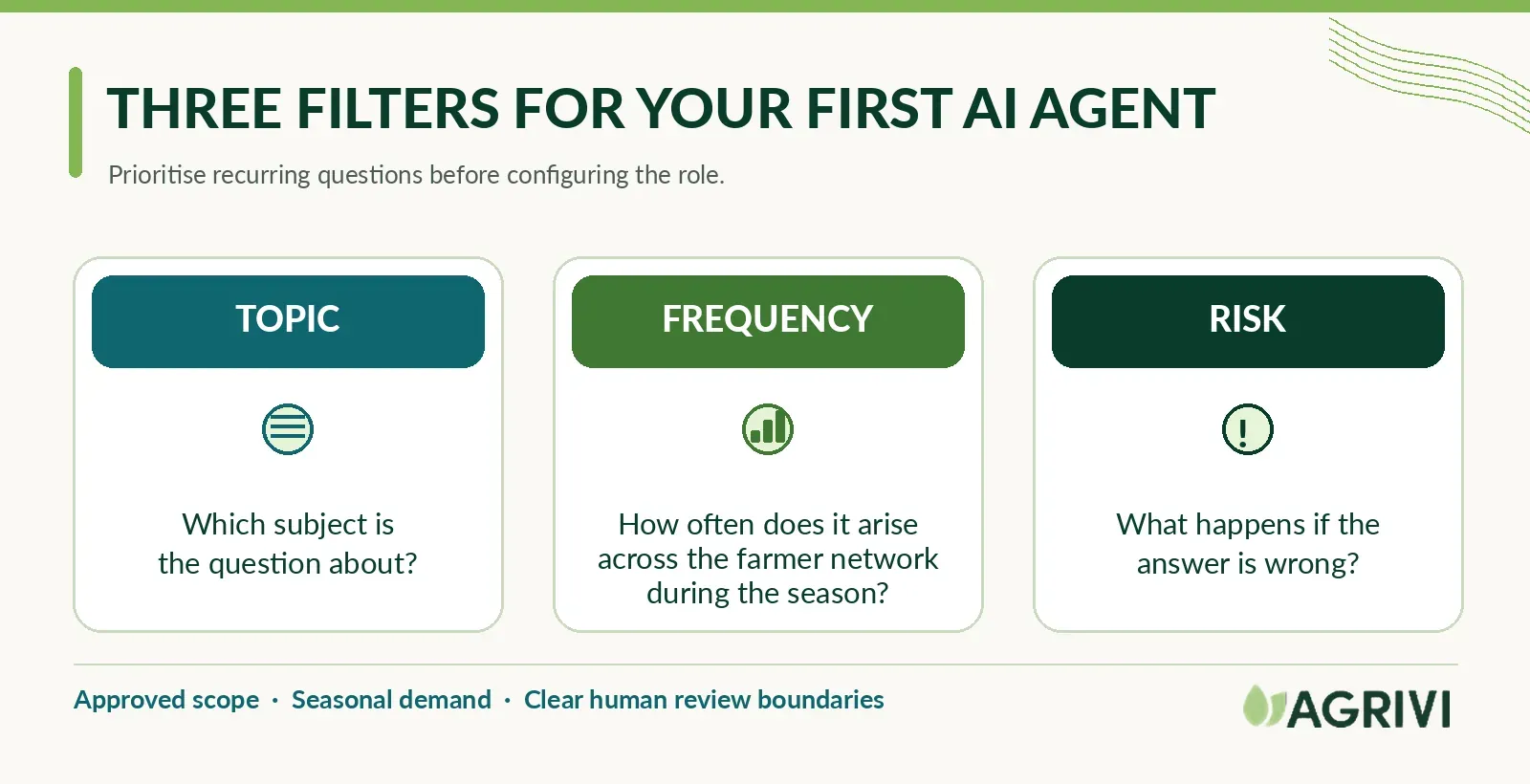
A useful first scope passes every candidate question through three checks. Do not rank questions on frequency alone: a less common question with safety implications may require a stricter boundary than a frequent routine enquiry.
Topic
Group questions by subject, such as portfolio information, product availability, crop-stage reminders and requests for follow-up. Start with one or two topics that are both useful to farmers and supported by reliable approved sources.
Frequency
Assess how often each question arises across the farmer network during the relevant season. A query asked only twice per farmer can still be material across hundreds of farms. Note seasonal peaks rather than assuming a flat weekly average.
Risk
Ask what could happen if an answer were incorrect, outdated or missing local context. Product labels, regulatory restrictions, application decisions and safety-sensitive questions require source controls. Some must be assigned directly to a qualified agronomist or other authorised specialist.
Write Down What the Digital Agent May Answer
Translate the shortlist into a role definition that your teams can check. For each approved topic, specify the permitted source, geographic or crop conditions, what the agent may communicate, and the point where a person must decide.
In scope: answer a question about available pack sizes from the current approved product catalogue, or provide a published event date for a regional demonstration. Outside scope: invent a crop-protection dose, interpret a restricted label beyond approved wording, approve an exceptional price or make a diagnosis that needs expert review.
This distinction also prevents the first role from becoming an informal collection of every possible sales and agronomy task. AGRIVI’s guide to operational AI Workforce roles explains the broader role architecture; the present article is focused on deciding the initial question boundary.
Approve Knowledge Before Launch
An agent should use approved product labels, technical sheets, relevant agronomic protocols, current commercial information and region-specific instructions. A named owner needs to validate the sources and approve updates when regulations, product ranges or advice change.
For each topic, identify a source owner, date of approval and review trigger. Test how the agent responds when a question is not covered or the source is uncertain. A confident-sounding answer cannot replace missing evidence. For a deeper explanation, see knowledge architecture in agricultural AI.
Name the Human Owner and Escalation Route
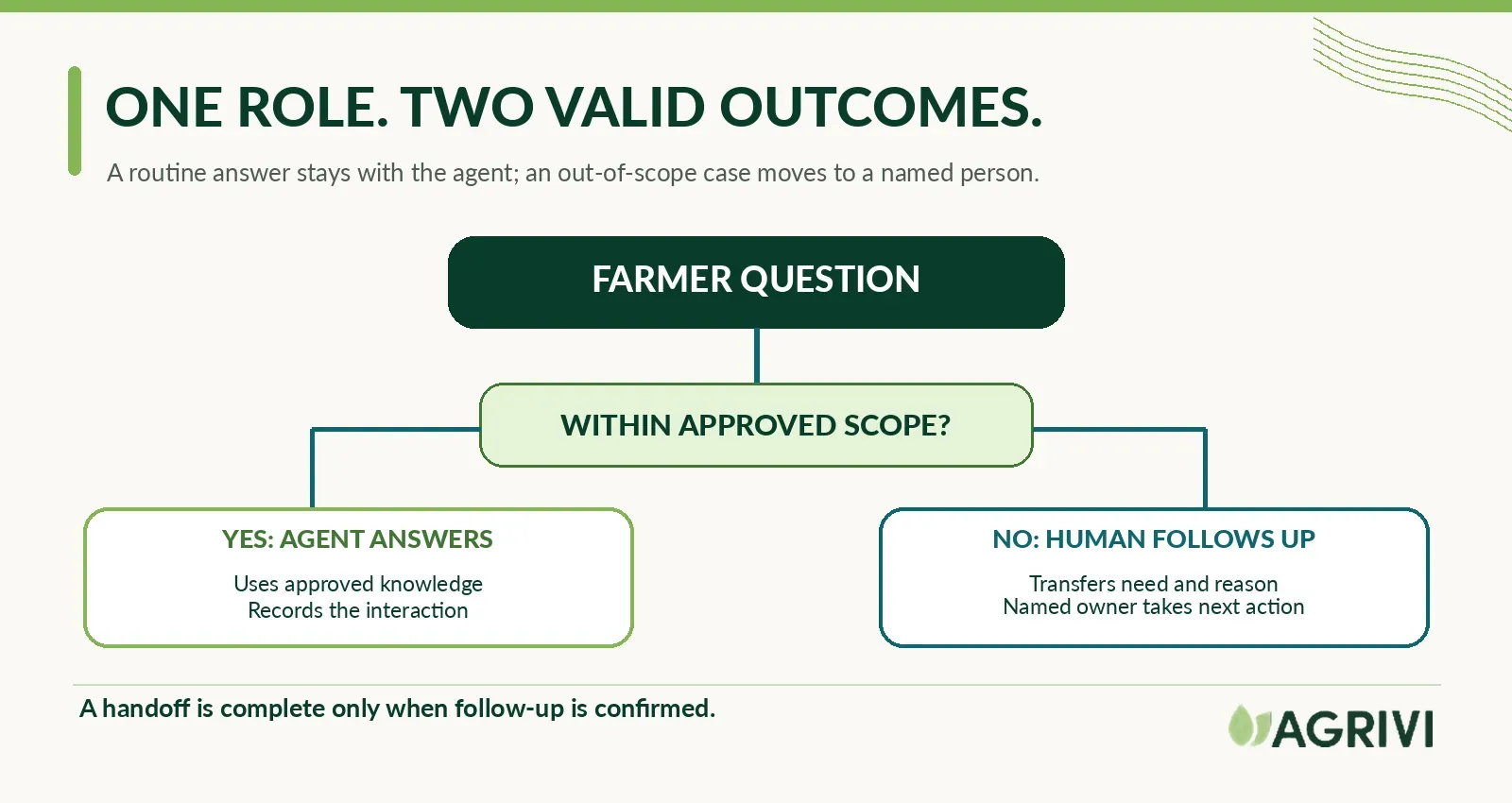
The role must have two possible outcomes. A routine question can be answered from approved knowledge and recorded in the agreed workflow. A case outside scope or requiring human judgement must move to the right person with the farmer’s need, relevant crop and location context, the reason for escalation and the next expected action.
Define who receives agronomic questions, commercial requests and unresolved issues. The receiving team should confirm follow-up, not simply count the transfer. For the context that should move with each case, see human handoff in agricultural AI. AGRIVI’s article on ownership and AI governance after launch explains the continuing oversight responsibilities beyond the initial scope.
Where AGRIVI AI Engage Fits
AI Workforce is the AGRIVI category. AGRIVI AI Engage is the platform for agriculture-specific Digital Agents. For agri-input manufacturers, the AI Agri-Input Sales Representative can be configured around defined agronomy, product and sales workflows using approved knowledge and human follow-up. It can operate independently or connect with supported existing systems as appropriate to the deployment.
Selected AGRIVI AI Engage deployments have reported 3x farm reach within existing sales areas. Individual outcomes vary. AGRIVI AI Engage also received the 2026 Agronomy Solution of the Year award. These references are context, not a substitute for agreeing the performance measures of a new deployment.
For an overview of how the wider market applies these roles, see AGRIVI’s agri-input company solutions.
Measure the First Role Before Expanding
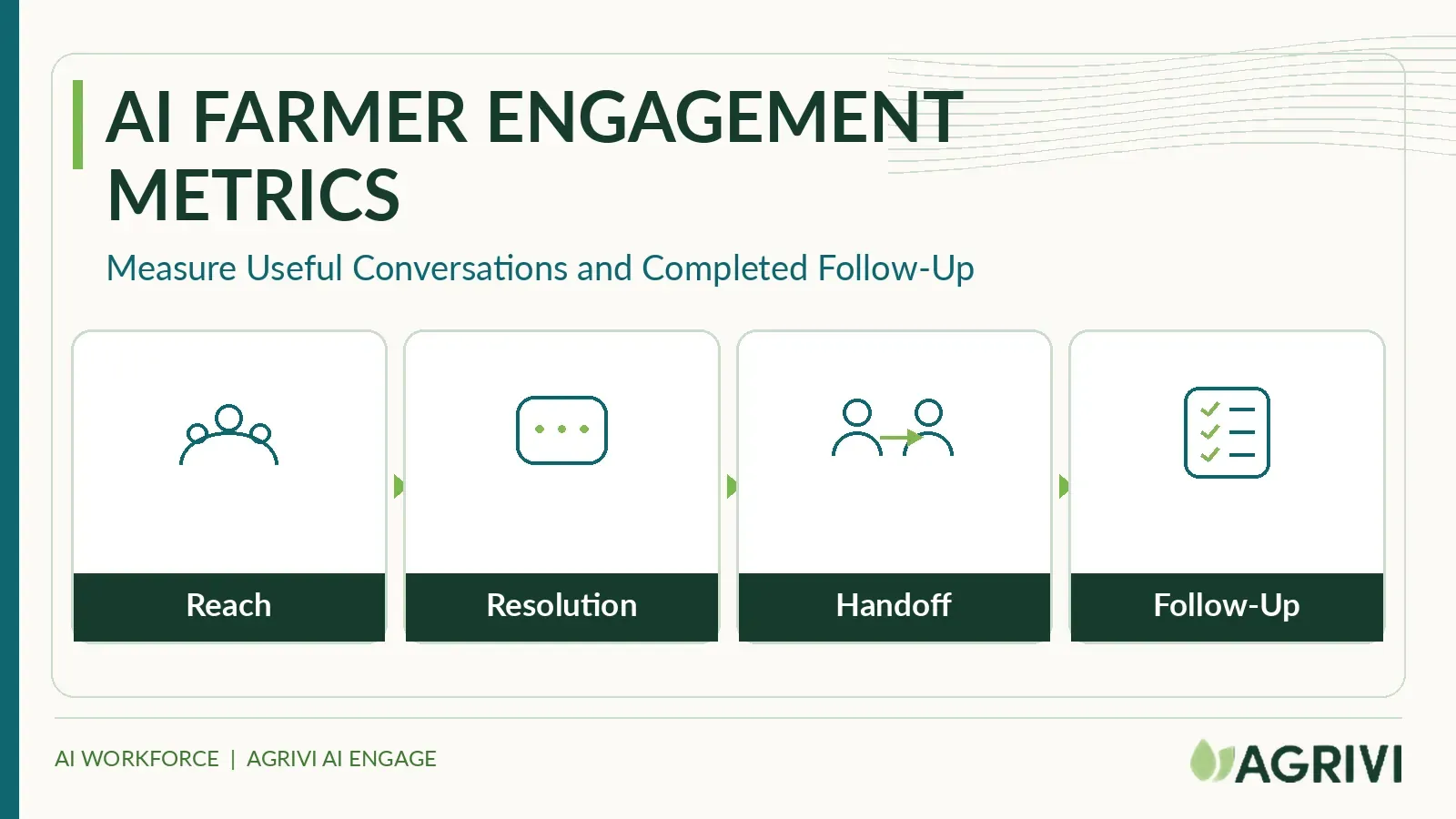
The first review should be about whether the role works, not simply how many conversations it generated. Four categories are enough for an initial operating scorecard:
- Demand and reach: how many relevant farmers ask questions in the selected categories, and when demand peaks.
- Answer usefulness: which requests are resolved within scope, which require clarification and which return unresolved.
- Human handoff: whether the case reached the correct owner with sufficient context.
- Completed follow-up: whether the next human action happened and what the team learned from recurring exceptions.
Review the open questions and knowledge gaps with agronomy and sales. Expansion should follow evidence that approved information is current, routing works and users receive a useful response. Do not treat a rise in handoffs or message volume alone as proof of commercial success.
A Practical Starting Sequence
- Collect recurring farmer questions across sales, agronomy and dealers, including seasonal and regional context.
- Classify each question by topic, frequency and risk, then select one or two initial topics.
- Approve the knowledge sources, define out-of-scope cases and name the person responsible for follow-up.
- Test real questions and escalations, review the first interactions and expand only when the workflow is reliable.
For background use cases, download AI Advisors 101. For an end-to-end launch framework, see the 6-Step Guide to Launch Your AI Agent. If your team has already selected its first questions, you can review the proposed scope with AGRIVI.
Frequently Asked Questions
What Is an Agriculture AI Agent?
It is a Digital Agent assigned a defined agricultural business role, working from approved knowledge and workflows with specified human decision boundaries.
Which Farmer Questions Should the First Agent Answer?
Start with recurring questions that have a clear business purpose, current approved answers and limited risk. Assess seasonal frequency rather than using an arbitrary threshold.
Can the Digital Agent Give Application Recommendations?
Only within the agreed and approved knowledge and regulatory boundaries. Questions needing unapproved dosage, safety or expert judgement must be referred to an authorised person.
Who Is Responsible for Updating the Knowledge?
The organisation needs named owners for agronomic, product and commercial sources and a review process for changed labels, availability or guidance.
When Should a Question Go to a Human?
When it is outside approved scope, lacks essential context, requires a specialist decision, requests commercial terms or explicitly asks for a person.
How Should the First Role Be Measured?
Track relevant demand, resolution quality, routing accuracy and completed follow-up before expanding to other topics or regions.
Published by AGRIVI. Editorial responsibility: AGRIVI Marketing & Communications.
Ready to digitalize your farm?
See how AGRIVI can help you apply these insights in your own operations.
Book a Meeting