
One Architecture, Different Entry Points for FMS and AI Workforce
Enterprise farms, food companies and agri-input businesses do not need to start with the same technology. Learn how AGRIVI 360 FMS and AGRIVI AI Engage can fit different entry points within a connected agricultural data strategy.
AGRIVI
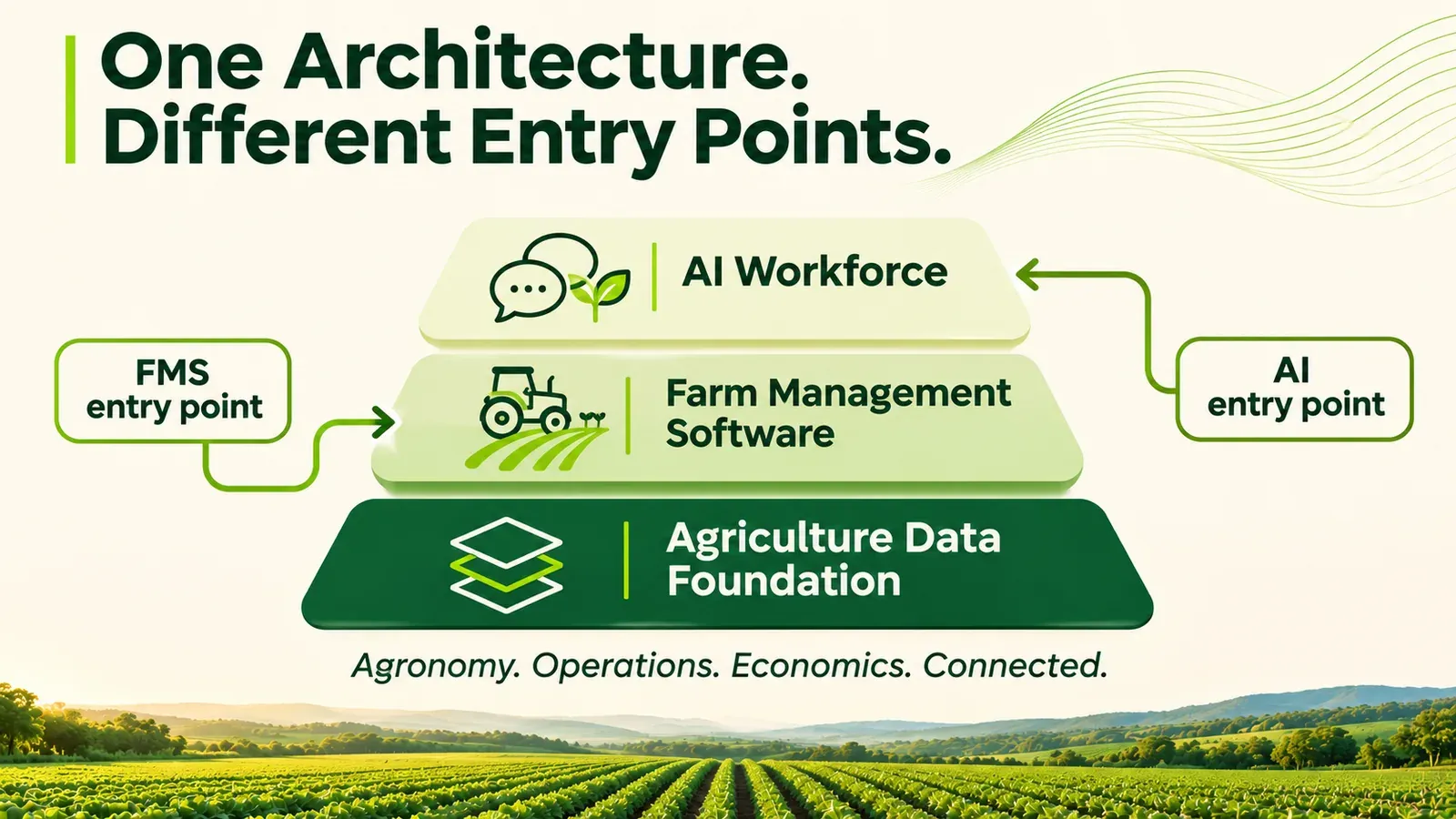
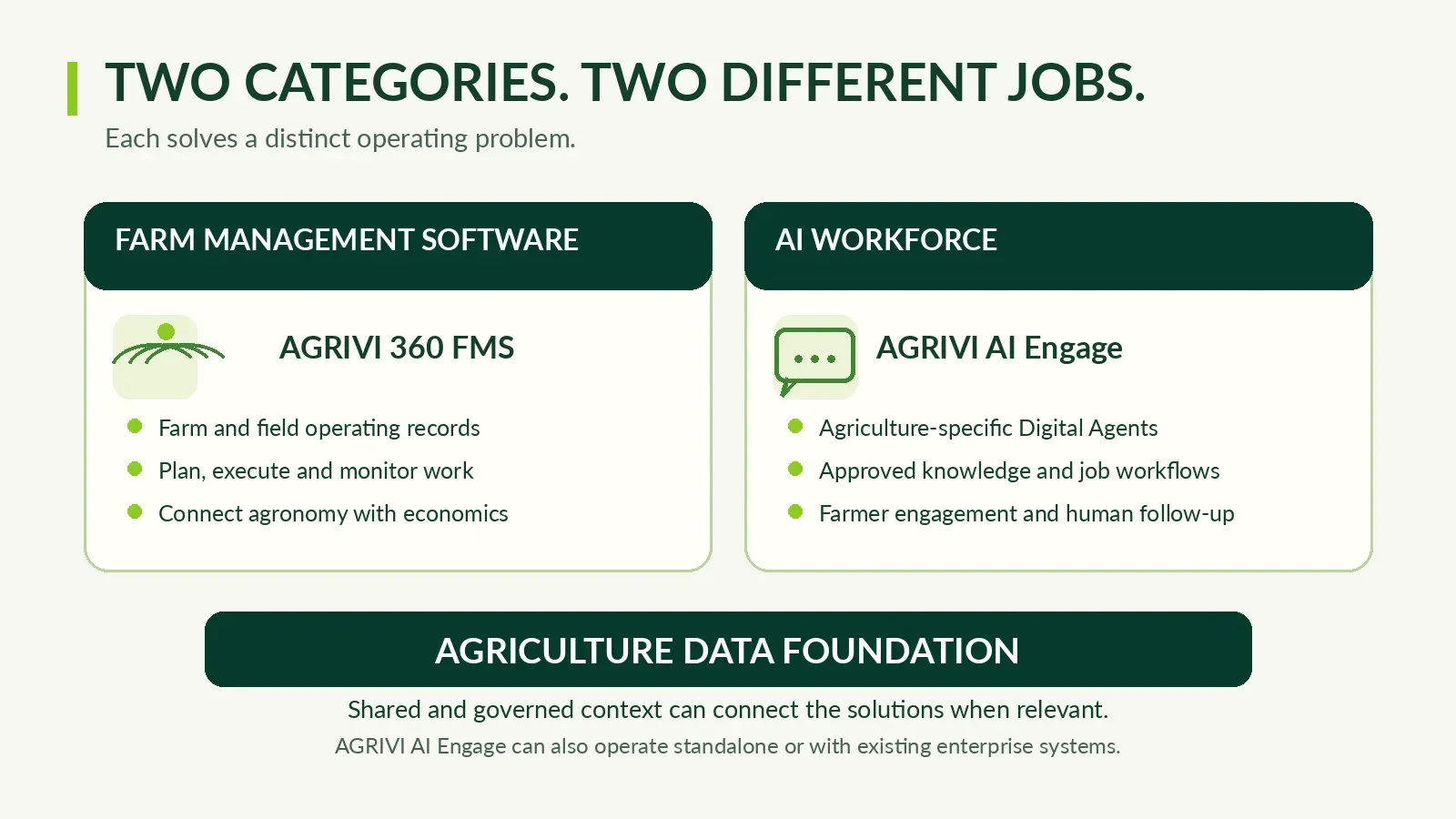
Farm Management Software (FMS) and AI Workforce solve different enterprise agriculture problems. FMS provides the operating record for fields, activities and farm economics. AI Workforce adds Digital Agents for defined communication and business roles. AGRIVI 360 FMS and AGRIVI AI Engage can work independently or connect through approved agricultural data and integrations.
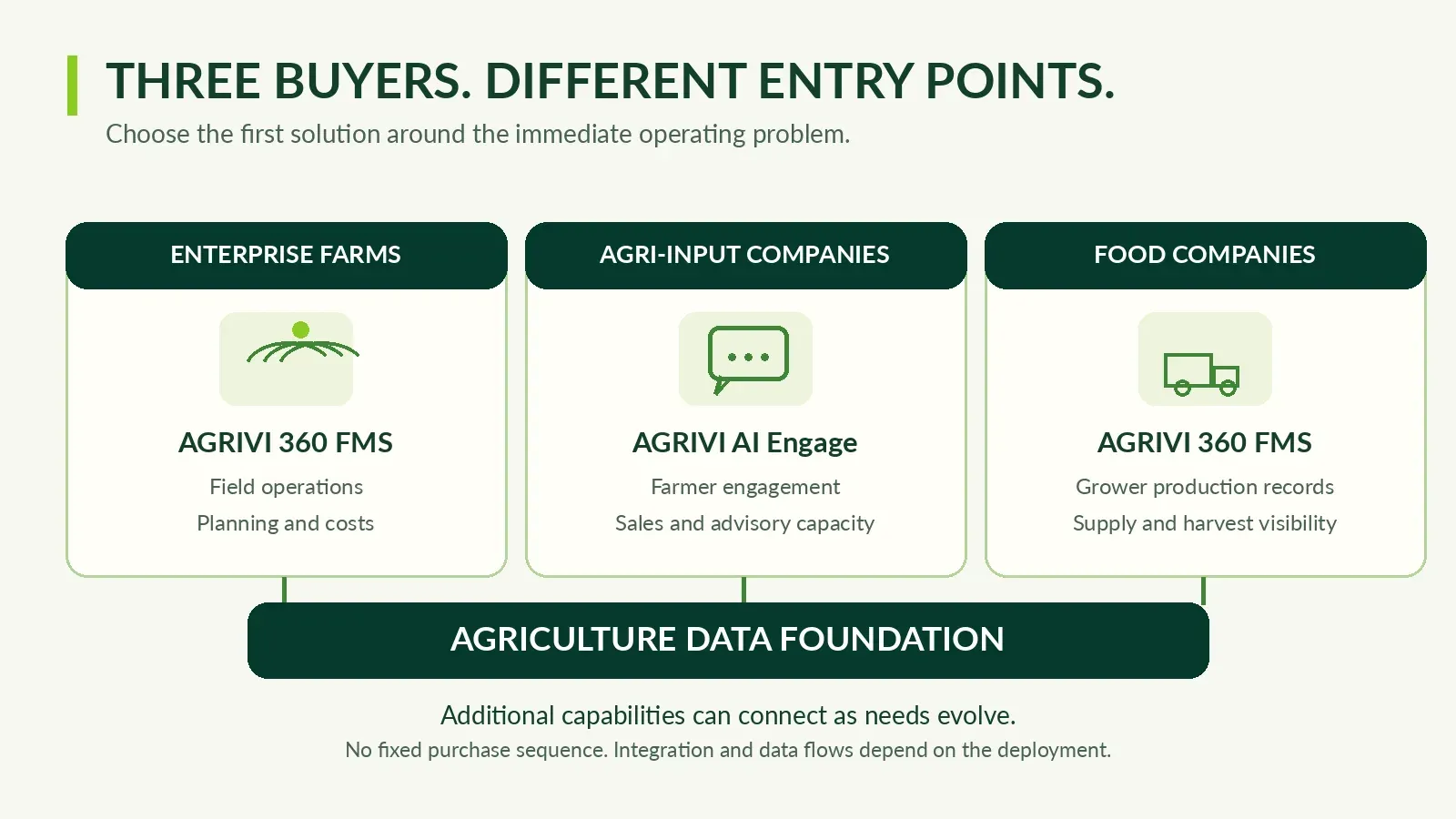
An enterprise farm may start by organizing field operations. An input manufacturer may first need better farmer engagement. A food company may prioritize production visibility across suppliers. Their initial purchases need not be identical for the systems to share a coherent long-term architecture.
At a Glance
- AGRIVI 360 FMS is the product within the Farm Management Software category.
- AGRIVI AI Engage is the platform within AI Workforce, which is a separate category.
- Agriculture Data Foundation is the shared architectural layer for trusted, connected agricultural context.
- ERP, CRM and external data services retain their own responsibilities.
- An AI Engage deployment does not require AGRIVI 360 FMS as a prerequisite.
What Farm Management Software Owns
Farm Management Software organizes agriculture-specific work and evidence. It connects fields, crops, seasons, planned tasks, completed activities, resource use, monitoring, harvest and related economics. Those records give agronomy, operations and management an informed basis for decisions during the season.
In AGRIVI, AGRIVI 360 FMS serves this role. The enterprise-farms solution applies that operating record across multiple farms, teams and production units. Its responsibilities differ from ERP and finance systems, which may still own purchasing, accounting or group-level processes. For a more detailed explanation of those boundaries, see ERP Farm Management: What Runs the Agriculture?.
What AI Workforce Adds
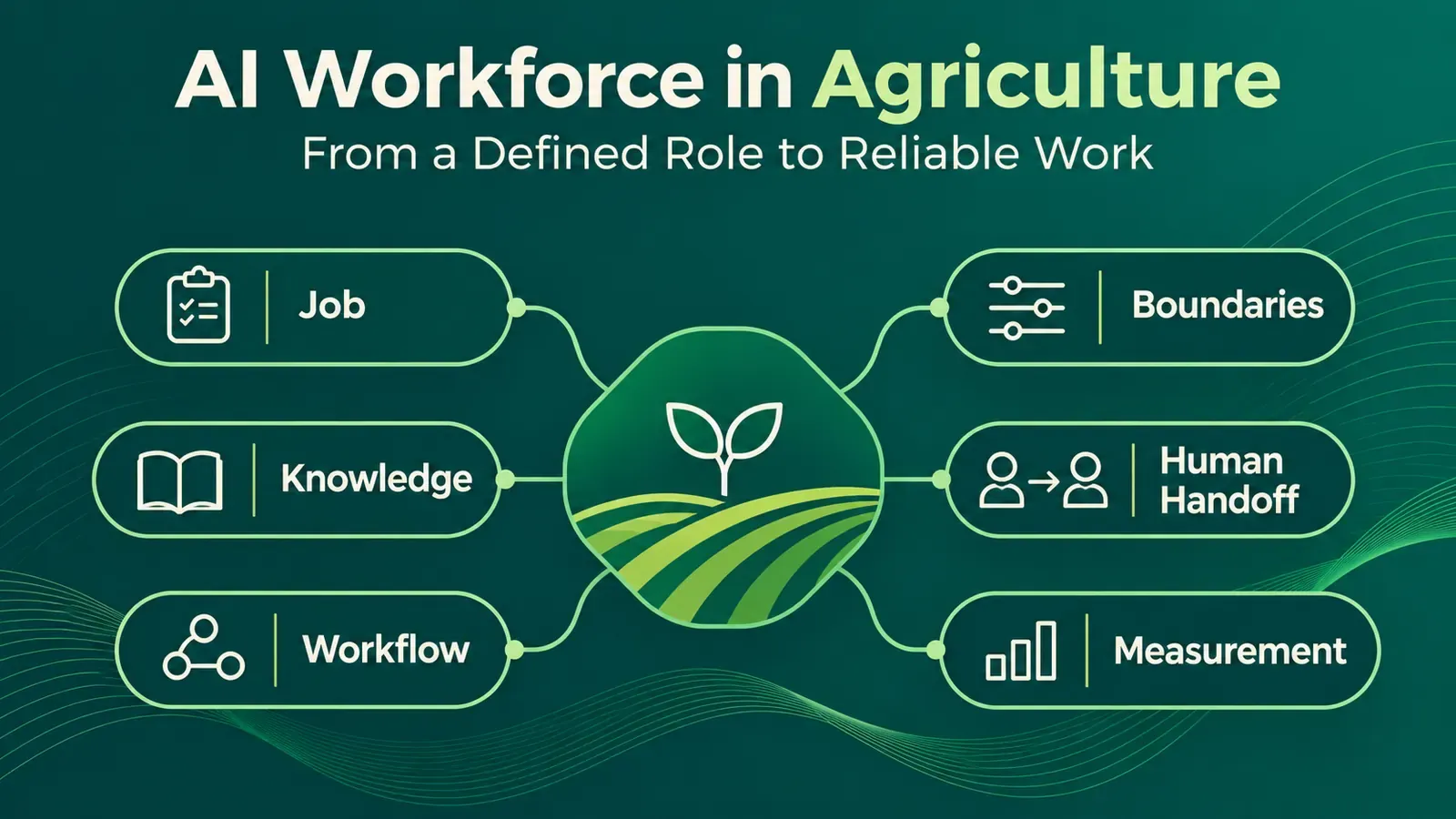
AI Workforce extends organizational capacity through Digital Agents assigned to specific jobs. In AGRIVI, AGRIVI AI Engage is the platform used to configure and operate those roles with approved knowledge, defined workflows, boundaries, escalation routes and monitoring.
For an input manufacturer, the AI Agri-Input Sales Representative can support farmer questions, product information and qualification of commercial interest. For food companies, the AI Supply Chain Manager can support grower communication, updates and coordination. An AI Public Advisory Officer serves a different public-advisory purpose. The job definition, content ownership and human decision rights are specific to each use case.
An operational role is more than a chat interface. The practical controls are explained in What Makes an AI Workforce Role Operational in Agriculture?.
How the Agriculture Data Foundation Connects the Picture
The Agriculture Data Foundation is AGRIVI’s architectural concept for maintaining useful agricultural context across data, software and AI workflows. For FMS, that context includes field and crop identities, actual activities, timing, resources and economic information. For AI Engage, it can include approved agronomy or product knowledge, farmer profiles and context needed for a defined task.
Connection does not mean that every data source must be copied into one database or that every customer must purchase both products. A Digital Agent can use its approved knowledge and AI Workforce storage, integrate with supported existing systems or, where it creates value, use AGRIVI 360 FMS farm context. Access, synchronization and permitted actions depend on the agreed implementation.
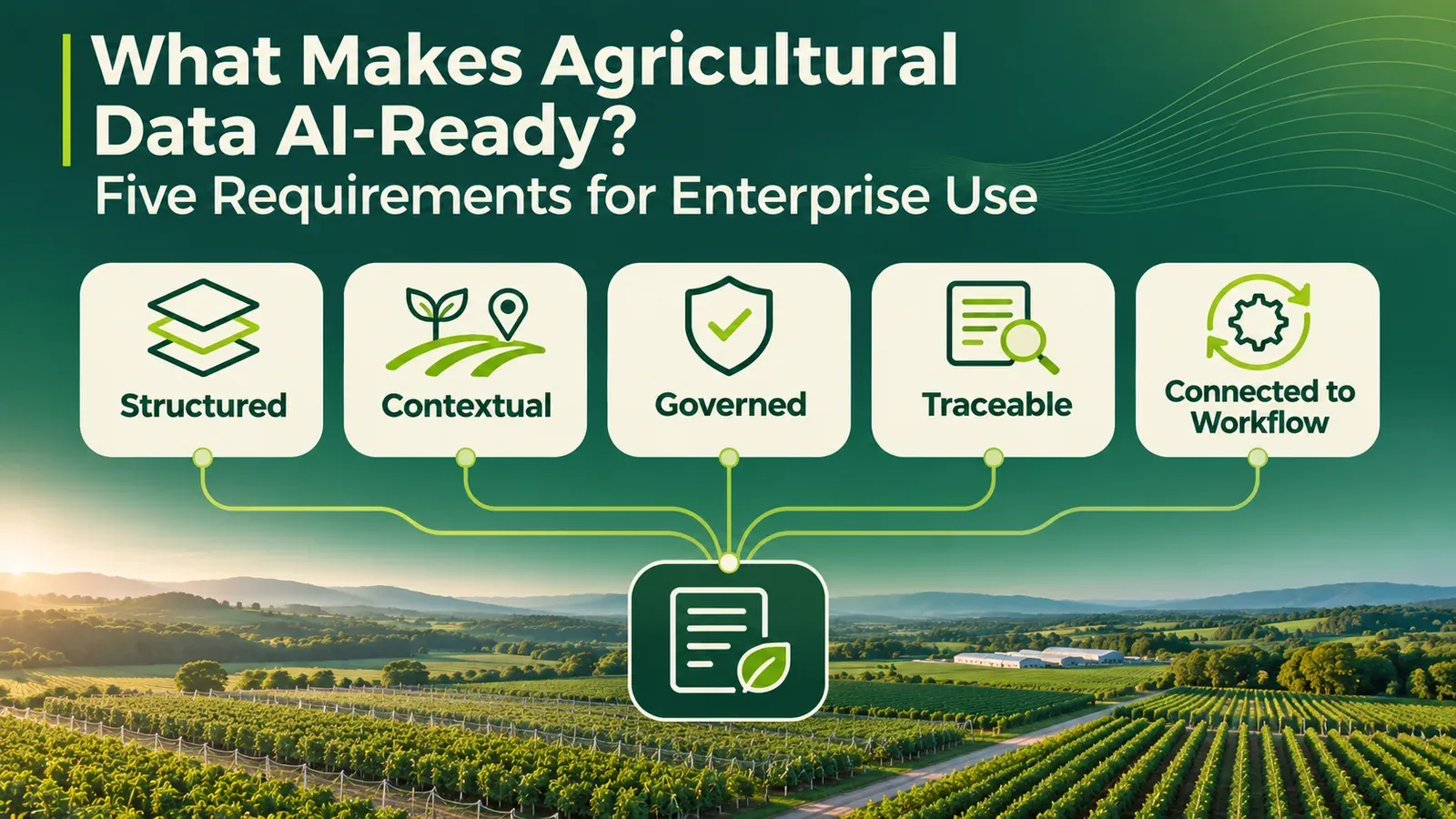
For enterprise architecture, data quality also means clear ownership, provenance and permissions. The European Commission’s agricultural data-space blueprint discusses trusted exchange across the wider ecosystem, while FAO’s Digital Agriculture and AI Innovation Roadmap emphasizes responsible, context-aware deployment. These are supporting principles, not proof that a particular integration is present in every AGRIVI deployment.
What Stays in ERP, CRM and External Data Systems
FMS and AI Workforce do not need to absorb every enterprise function. An ERP can remain the financial and procurement system of record; a CRM can retain ownership of sales opportunities and account processes. Weather services, IoT sensors, satellite providers and other specialized applications continue to provide their own data or capabilities.
A sound design identifies the owner for each process, which identifiers are shared, what information passes between systems, how often it updates and who reviews errors. A field-input application may be recorded in FMS while finance retains purchase and accounting records. Similarly, a Digital Agent may identify buying intent and forward the context to a human sales owner in the CRM without becoming the CRM itself.
Three Entry Points Based on the Buyer’s First Problem
Different entry points are a design feature when each one solves a real problem and has an expansion path:
- Enterprise farm: Begin with AGRIVI 360 FMS to connect multi-farm planning, field execution and economics. Add relevant AI Workforce roles only when they address a defined communication or capacity need.
- Agri-input company: Begin with AGRIVI AI Engage to extend farmer engagement and approved agronomic or product guidance. Connect commercial systems or farm data later where the workflow justifies it.
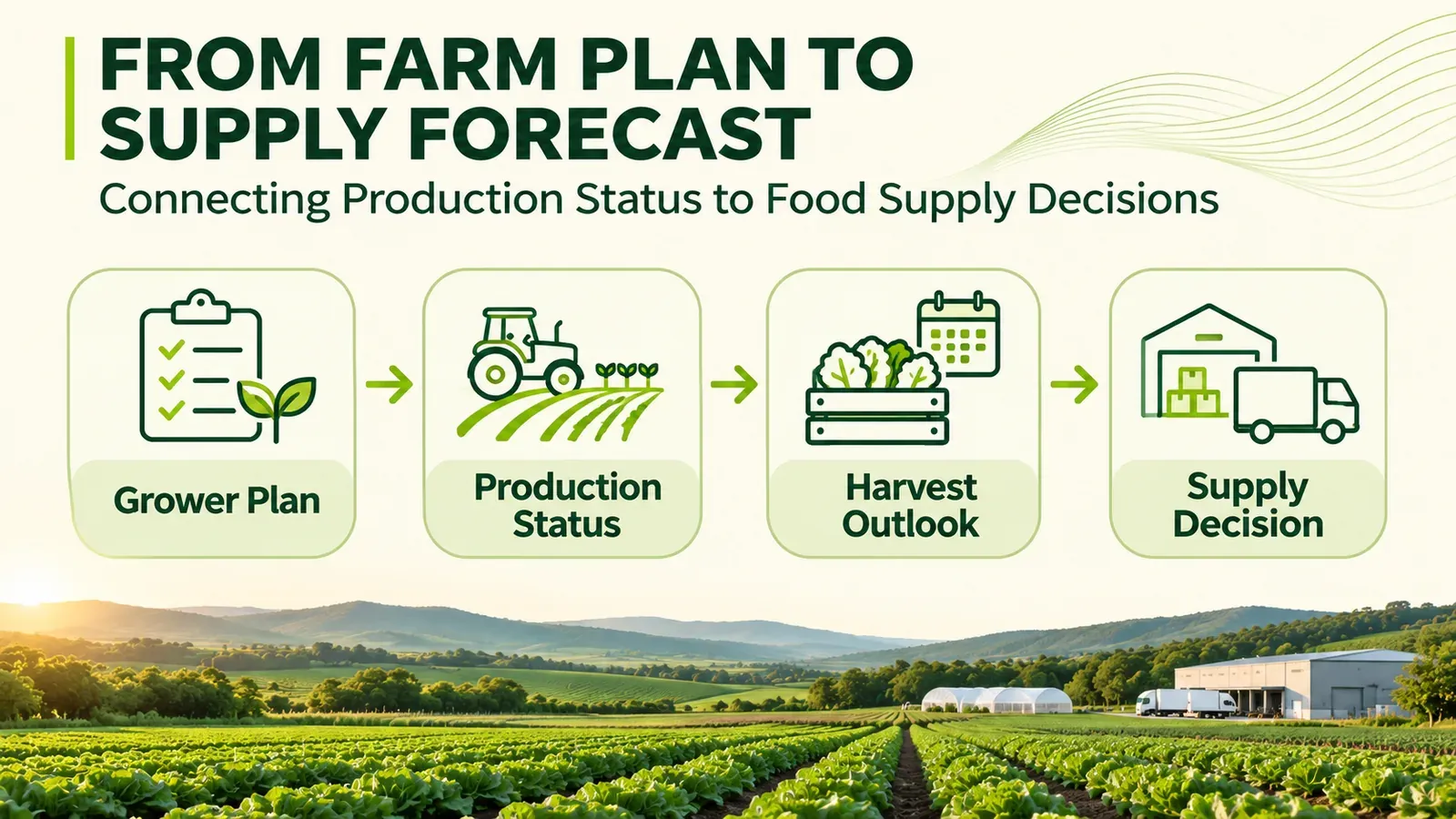
- Food company: Begin with structured grower and production visibility through the AGRIVI 360 FMS agriculture-supply-chain use case. Add AI Supply Chain Manager to support grower communication when useful.
The Agriculture Supply Chains solution shows how growers, production records and sourcing can fit a food-company workflow. None of these routes establishes an obligatory order of purchase or an automatic link between unconfigured systems.
What Enterprise Buyers Should Check Before Integrating
A useful architecture review starts with process responsibility rather than a long feature list. Ask these questions before committing to integrations or rollout dates:
- Which system owns each record, approval and business process?
- What agricultural context is required by the selected FMS workflow or Digital Agent role?
- Which sources are approved, and who maintains the knowledge or data?
- Which integrations are supported, and what data must move in each direction?
- What happens when information is incomplete, inconsistent or unavailable?
- How are human review, escalation, monitoring and business outcomes measured?
These checks are particularly important for enterprise AI. The article Enterprise Agricultural AI: What Buyers Should Expect examines knowledge, context, workflow, governance and accountability from a procurement perspective, while Knowledge Architecture in Agricultural AI examines the approved information behind Digital Agents.
How to Extend the Architecture without Rebuilding It
Change should be introduced one supported workflow at a time. A farm may add machine or weather data to existing operating records. A food company may expand comparable grower information across suppliers. An input manufacturer may configure a second Digital Agent role after testing the first against clear commercial or advisory measures.
The common requirement is that each addition has clear identifiers, data owners, permissions and acceptance criteria. This protects continuity when the company introduces more farms, suppliers, AI roles or external systems. It also avoids promising automatic interoperability where the integration work has not yet been defined.
For the wider AGRIVI positioning behind this approach, see From Farm Records to Enterprise Intelligence. Buyers who want to compare specific solutions can review the AGRIVI product portfolio without assuming that all components must be implemented together.
Frequently Asked Questions
What Is the Difference Between FMS and AI Workforce?
FMS manages agriculture-specific records, execution and economics. AI Workforce adds Digital Agents that perform defined communication and business workflows with approved knowledge and human oversight.
What Is AGRIVI 360 FMS?
AGRIVI 360 FMS is AGRIVI’s Farm Management Software product for agricultural planning, operations, monitoring and economics, including enterprise and supply-chain use cases.
Is AGRIVI AI Engage the Same as AI Workforce?
No. AI Workforce is the category. AGRIVI AI Engage is the platform through which AGRIVI deploys agriculture-specific Digital Agent roles.
Does AGRIVI AI Engage Require AGRIVI 360 FMS?
No. AI Engage can operate standalone, connect with supported existing business systems or use AGRIVI 360 FMS agricultural context when the deployment requires it.
What Is the Agriculture Data Foundation?
It is the architectural layer for trusted, contextual and connected agricultural information that can support operational and AI workflows. It does not mean every data source must reside in one database.
Can AGRIVI Replace Our ERP or CRM?
AGRIVI 360 FMS and AGRIVI AI Engage serve different responsibilities from ERP and CRM. Integration can exchange relevant information while the existing systems retain their agreed roles.
Which AGRIVI Product Should a Food Company Start With?
That depends on the priority. Farm and grower production visibility may call for AGRIVI 360 FMS, while grower communication at scale may call for AGRIVI AI Engage. Either use case needs a clear operating owner.
How Should an Enterprise Evaluate the Architecture?
Confirm system ownership, required data, approved knowledge, supported integrations, exception routes, human oversight and measurable outcomes before extending the deployment.
Published by AGRIVI. Editorial responsibility: AGRIVI Marketing & Communications.
Ready to digitalize your farm?
See how AGRIVI can help you apply these insights in your own operations.
Book a Meeting