
How to Build a Weekly Farm Operations Review
Use five questions and a simple exception-to-action routine to run weekly farm reviews from current field records rather than spreadsheets and recollection.
AGRIVI

A weekly farm operations review is a short management routine that compares completed fieldwork with the plan, examines material exceptions and assigns the next actions. It needs current records for activities, inputs, labour, machinery, timing and costs. Its main output is a decision log with named owners and due dates, not a longer report.
The most productive weekly meetings start before anyone enters the room. Field supervisors have confirmed completed work, agronomy has recorded relevant changes, and operations can see which resources were actually used. The meeting can then concentrate on the next seven days instead of reconstructing the previous seven.
At a Glance
- Review completed work, deviations, resources, operational impact and the next owner.
- Use one current farm record for every exception so that agronomy, operations and economics see the same event.
- Prioritize changes that still affect an upcoming field decision, rather than reviewing every routine activity.
- Close every material item with a decision, an accountable owner, a due date and a follow-up status.
- Start with one team and one recurring crop or operations decision before expanding the routine across farms.
Why the Weekly Review Depends on Current Records
A weekly farm operations review should help managers decide what work to authorize, reschedule or investigate before conditions change again. If work orders, input use and delays are recorded only after the meeting, the discussion is already out of date.
The required information is often present, but scattered across messages, team spreadsheets and field notes. That creates a second job: deciding whose version is correct. The underlying problem is described in AGRIVI’s article on farm operations visibility, which addresses the gap between completed fieldwork and what management can reliably see.
For a useful review, each completed or changed activity needs a shared identity: farm, field or block, crop, date, operation, status and responsible team. Relevant resources and explanations should remain attached to that event. The wider case for reliable records is covered in Farm Data Management: Records the Business Can Act On.
Start with Five Questions
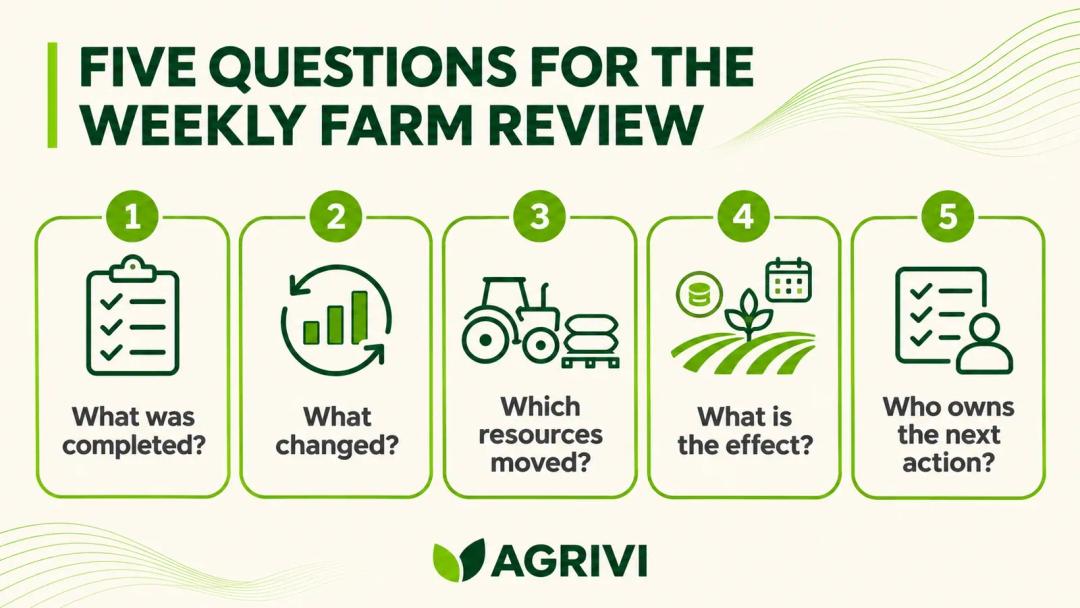
The meeting agenda can be built around five questions. They are deliberately short because the discussion should focus on exceptions, not a presentation of everything the farm team did.
- What was completed? Confirm planned activities that were finished, partly completed or not performed. Use actual field records rather than verbal estimates.
- What changed? Identify delayed work, revised application rates, new agronomic needs and activities added during the week.
- Which resources moved? Check significant changes in labour, machinery, contractors and applied inputs, not simply what was purchased.
- What is the effect? Establish what the change means for the next operation, crop condition, timing, capacity or cost.
- Who owns the next action? Assign one person to decide, act or follow up, together with a date the next review can verify.
The order matters. A change in input consumption is only meaningful after the team knows which activity and field it belongs to. Likewise, a reported delay is not automatically a problem if the revised crop plan has already accounted for it.
Bring Only Records That Can Change a Decision
The minimum working pack should be compact and current. For a multi-farm operation, it is more useful to have comparable records across sites than a highly detailed report from one farm and unstructured updates from the others.
- Activity status: planned, assigned, completed, delayed, cancelled and added work by farm or block.
- Resource usage: actual inputs, labour hours, machinery time and contractor use attached to completed activities.
- Exceptions and reasons: weather, staffing, equipment, field conditions or agronomic decisions that altered execution.
- Economic context: significant cost changes and budget effects where management can still choose a different action.
- Open actions: previous decisions, owners, due dates and whether the issue has been resolved.
Where an organization manages contracted growers, the same principles apply to a smaller agreed set of comparable updates. AGRIVI 360 FMS for agriculture supply chains supports the farm and grower records needed for these coordination routines, subject to the configured workflow.
Review Exceptions in Their Field Context
Not every delay deserves management attention. The meeting should prioritize deviations that are material, still actionable or likely to recur. The crop, block and operating window determine whether an exception is urgent.
Consider a crop-protection application moved by two days. An operations lead may see a scheduling conflict, an agronomist may see a valid change in treatment timing, and finance may see additional machinery time. All three explanations belong to the same farm event. AGRIVI’s single-event crop-protection example explains how one field activity can support different management decisions without creating competing records.
A good exception discussion asks what changed, why, which next task depends on it and whether the revised plan needs approval. For a fuller method of accepting, correcting or escalating deviations, use Plan vs. Actual in Farm Management.
Connect the Review to Economics and Capacity
Cost and capacity information makes the review more useful, but the meeting should not become a finance reconciliation exercise. Managers need just enough context to understand whether the upcoming work plan is still realistic.
An additional spray can increase input, labour and machinery costs. The correct decision may still be to proceed if the crop risk justifies it. Conversely, repeated field passes caused by a scheduling problem may be a process issue. The distinction is easier to see when actual activities carry their economic information, as described in Farm Economics During the Season.
Management should also ask whether the revised plan is executable. If machinery availability changed or two high-priority activities now require the same team, the review should produce a resource decision and a revised owner, not only a red indicator on a dashboard.
AGRIVI 360 FMS connects operational work with field, crop and economic context. The AGRIVI 360 FMS platform and its enterprise farms solution describe these connected records and the practical operating visibility they support.
From Field Exception to Management Action
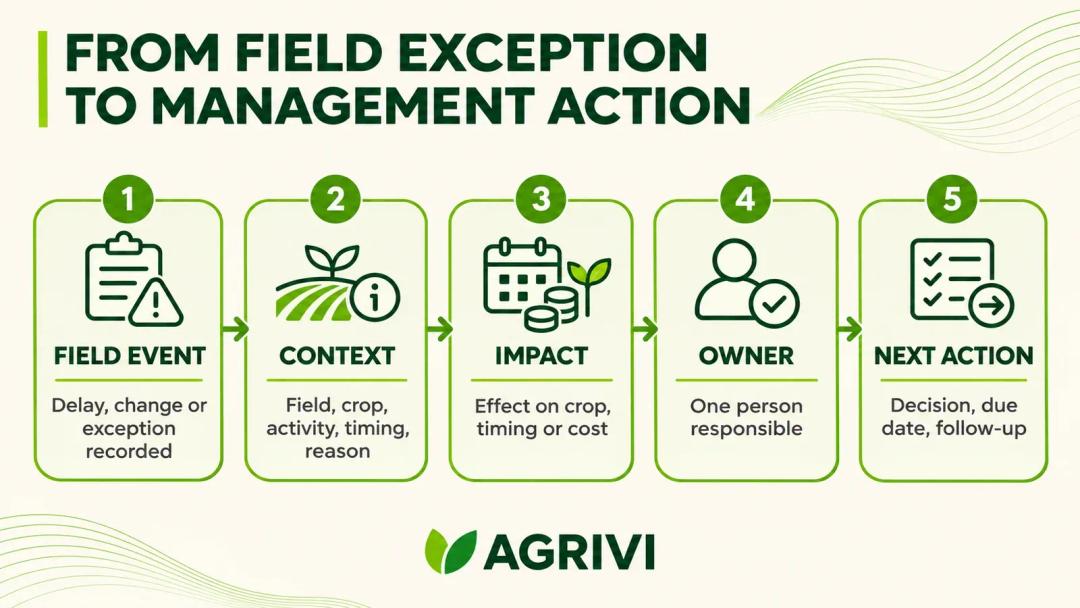
A useful exception workflow is short: record the field event, confirm its context, assess impact, assign an owner and document the next action. The last two steps are where meetings most often lose momentum. A clear observation without a person and a deadline is not yet a management decision.
For example, if machinery failure delays irrigation maintenance, the record should identify affected blocks, the planned operation, its revised time window and the reason for the delay. Operations assigns the alternative machinery or contractor, agronomy confirms whether crop risk requires a different priority, and the accountable manager sets the due date. The next review checks whether the activity was completed, rather than repeating the original discussion.
The review decision should remain linked to the original record. That supports a repeatable cycle across teams and locations, consistent with the idea of a shared operating record for agronomy, operations and finance.
Close with an Action Log That Carries into Next Week
The meeting should end with a short list of material decisions, not a transcript. Each item needs a reference to the underlying field record, the decision taken, the accountable owner, a deadline and one status for the following review.
Before opening new issues next week, confirm what happened to the old ones. Was the corrective activity completed? Was the plan updated? Was the accepted variance documented? If it remains open, what specifically blocks progress? A recurring review has value only when the previous week’s decisions change the next week’s execution.
A practical starting point is one weekly crop-protection, irrigation or harvest-preparation review for four consecutive weeks. Keep the same questions and action fields. Expand only after field records are current and people have established the routine. If the biggest challenge is fragmented recordkeeping, the AGRIVI Farm Digitalization Score provides a simple starting assessment. For how this review fits a wider seasonal rhythm, see weekly operating cadence on specialty crop farms.
Where AGRIVI 360 FMS Fits
AGRIVI 360 FMS supports the agriculture-specific records behind a weekly management routine, including planning, work assignment, execution, inputs, labour, machinery and economic context. Its purpose in this process is to make relevant field information accessible across agronomy and operations, so teams can make and follow through on decisions with less manual reconstruction.
For organizations coordinating multiple farms, the AGRIVI 360 FMS enterprise farm solution provides a relevant starting point for connected farm records and management visibility. The operating discipline remains the customer’s responsibility: owners must keep records current, agree escalation rules and use the information to make decisions.
Frequently Asked Questions
What Is a Weekly Farm Operations Review?
It is a recurring management meeting that uses current field and resource records to assess completed work, prioritize exceptions and assign the next decisions and actions.
Which Five Questions Should a Weekly Farm Review Ask?
Ask what was completed, what changed, which resources moved, what the operational or economic effect is, and who owns the next action.
How Often Should Farm Managers Review Operations?
Weekly is a practical starting cadence during active production periods. Critical weather, crop-protection or equipment issues should be reviewed sooner if the decision window requires it.
Which Records Need to Be Updated Before the Meeting?
Activity status, field and crop context, actual inputs, labour, machinery, timing, material exceptions and unresolved decisions should be current enough to support action.
Should Every Farm Variance Be Discussed?
No. Prioritize material, actionable or recurring exceptions. Routine changes that have already been approved and recorded may require no additional discussion.
How Do You Prevent a Farm Review from Becoming a Reporting Meeting?
Start with exceptions and decisions, not a complete activity report. Assign owners and due dates, and open the next meeting by checking the previous action list.
How Does Farm Management Software Support a Weekly Review?
It connects planning, field execution and resource records, so managers can review related activity and cost information in the same farm context. The configured workflow and decision ownership remain important.
Can One Weekly Review Work Across Several Farms?
Yes, if the business agrees on comparable activity statuses, exception definitions and action ownership while preserving the field and crop context specific to each site.
Published by AGRIVI. Editorial responsibility: AGRIVI Marketing & Communications.



Ready to digitalize your farm?
See how AGRIVI can help you apply these insights in your own operations.
Book a Meeting